
Atiku Accuses Babachir Of Ethnic Profiling Over Fulani Remark
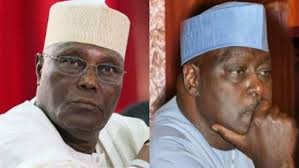
African Democratic Congress presidential candidate Atiku Abubakar has launched a sharp rebuttal of former Secretary to the Government of the Federation Babachir Lawal, accusing him of promoting ethnic prejudice, peddling conspiracy theories and deepening divisions at a time the country requires unity to confront its mounting challenges.
In a statement issued on Sunday by his Senior Special Assistant on Public Communication, Phrank Shaibu, Atiku said Lawal’s recent attacks were devoid of facts and evidence, relying instead on ethnic profiling and inflammatory rhetoric aimed at discrediting a political opponent. Lawal had referred to Atiku as “Kachalla,” saying the title is commonly used by people such as notorious bandit leader Bello Turji to address their local leaders, adding that Atiku, being a Fulani man, should not find the description unusual.
Atiku said the most troubling element of Lawal’s interventions was a persistent effort to associate an entire ethnic group with the actions of a few criminal elements. “It was both dangerous and irresponsible to suggest that any Nigerian should be judged, condemned, or held accountable for crimes committed by individuals simply because they share a common ancestry,” he said. He warned that “every ethnic nationality in Nigeria could be collectively blamed for the actions of a few criminal elements within their communities, a mindset that has historically fuelled division and undermined national unity.”
The former vice president accused Lawal of seeking to stigmatise the Fulani despite serving under former President Muhammadu Buhari, who is of Fulani extraction. He recalled that Buhari appointed Lawal as SGF, the highest office he occupied in public service. “At no point did Mr Lawal object to receiving such trust and elevation from a Fulani President. It is, therefore, difficult to understand why he now seeks to stigmatise an entire ethnic group merely because another Fulani man seeks the presidency through democratic means,” Atiku stated.
Pointing to what he called contradictions in Lawal’s posture, Atiku asked: “Which Babachir should they believe? The Babachir who claims to be a victim of political conspiracies and ethnic domination, or the Babachir who boasts that governors are scrambling for his services?”
Rejecting suggestions he had been indifferent to victims of violence, Atiku cited his attendance at a church thanksgiving service in solidarity with the people of Kagoro in Southern Kaduna. “Leadership is not about counting tribes or measuring faith. It is about standing with people in moments of difficulty, regardless of their ethnic or religious identity,” he said. He also recalled facilitating scholarships for some of the released Chibok schoolgirls at the American University of Nigeria, Yola.
The exchange follows a Facebook post by Lawal titled “Kachalla II.” In it, Lawal said, “It is my right to interrogate the character and competence of someone who seeks to be my President,” urging the ADC to replace Atiku with “a more qualified candidate” before the Independent National Electoral Commission timetable runs out. In the same post, Lawal also defended himself over the 2017 grass-cutting scandal, saying he was discharged and acquitted in court.
Atiku declared: “Babachir may see tribe. I see Nigerians. Babachir may see division. I see a nation that must come together if it is to overcome its present challenges.”