
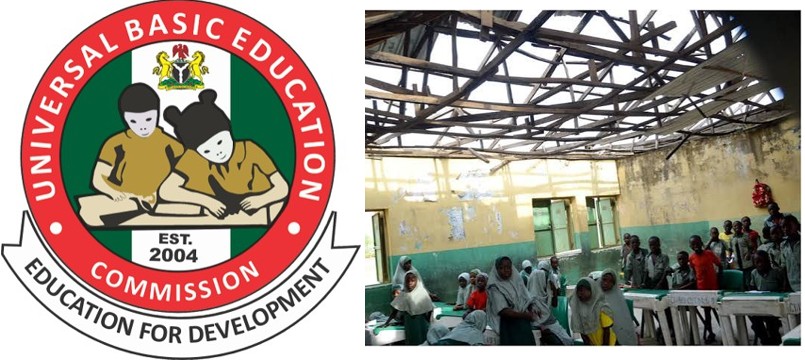
State governments across Nigeria have allowed more than ₦264.12 billion in Universal Basic Education Commission (UBEC) matching grants to sit dormant in central vault accounts. This massive backlog of uncollected capital persists despite a visible, widespread collapse of infrastructure across public primary schools nationwide. From leaky roofs and missing desks to completely open-air classrooms, the physical state of primary education facilities reflects a deep, structural crisis. A report from federal education authorities shows that dozens of sub-national governments have failed to draw down their designated allocations for years, effectively leaving federal funds locked away in Abuja rather than mobilising local resources to fix basic learning environments.
The central policy conflict driving this collapse lies within the statutory funding mechanism itself. Under the Universal Basic Education Act, accessing the federal intervention fund requires each state government to provide a fifty percent counterpart contribution. Designed during an era of optimism regarding sub-national fiscal discipline, this statutory matching requirement aimed to guarantee that state governors maintained skin in the game when building classrooms, training teachers, and purchasing learning materials. Ground realities have made that assumption upside down. Rather than forcing fiscal responsibility, the fifty percent matching formula becomes a structural barrier. Poorly performing state treasuries, burdened by high debt servicing obligations, bloated administrative overheads, and stagnant internal revenue generation, routinely fail to allocate or release their counterpart funds. As a consequence, statutory intervention capital remains trapped at the centre, leaving rural pupils in dilapidated, unsafe structures while billions in allocated money gather dust.
This statutory matching-grant formula disproportionately penalises fiscally constrained states, creating a reverse-redistributive cycle within Nigerian federalism. Richer states with higher internally generated revenue can comfortably set aside counterpart cash, draw down their UBEC allocations, and continually refresh their basic education infrastructure. Fiscally weak states—frequently those facing the highest out-of-school child counts, severe security challenges, and low literacy levels—cannot assemble the matching sum. The statutory rule treats fundamentally unequal states as equals, demanding identical financial commitments from state budgets that operate on vastly different scales. Because a state cannot produce its fifty percent share, it loses access to the fifty percent federal share as well. The policy framework actively starves the precise districts that require the most urgent assistance, compounding regional educational disparities under the guise of fiscal accountability.
Decoupling federal basic education funding from strict matching requirements without encouraging sub-national financial recklessness requires a total rethink of intervention triggers. Rather than demanding a raw, upfront cash match from state coffers, the framework should transition toward performance-linked conditional grants tied to verifiable governance metrics. Federal allocations can be disbursed based on a state’s compliance with transparent payroll audits, timely teacher recruitment, audited school maintenance records, or the execution of local educational reforms. Alternatively, the matching ratio itself must become dynamic, scaled according to a state’s economic capacity, poverty headcount, and out-of-school demographic burden. Requiring a lower-income state to provide a fifteen or twenty percent match while maintaining strict public procurement oversight allows capital to flow where it is most needed without releasing states from operational accountability.
Allowing UBEC to bypass sub-national bottlenecks requires specific, urgent legislative amendments to the Universal Basic Education Act. The National Assembly must amend the law to grant UBEC statutory emergency powers to execute direct intervention projects in critically under-resourced school districts. When a state government fails to access its allocated matching grants for a continuous period of twenty-four months, the law should empower UBEC to automatically trigger a direct procurement protocol. Under this mechanism, the trapped federal portion of the funds would be unallocated from the matching scheme and deployed directly by the commission to construct classrooms, drill boreholes, and supply desks within that state’s worst-performing local government areas.
Leaving over ₦264 billion untouched while millions of children learn on bare floors or under trees is an indictment of sub-national governance and federal legislative design alike. The matching-grant system, conceived as a tool for joint responsibility, has degenerated into an administrative mechanism for institutional neglect. Until the National Assembly amends the statutory framework to match the economic realities of sub-national treasuries, the promises of universal basic education will remain entirely out of reach for the nation’s most vulnerable children.