
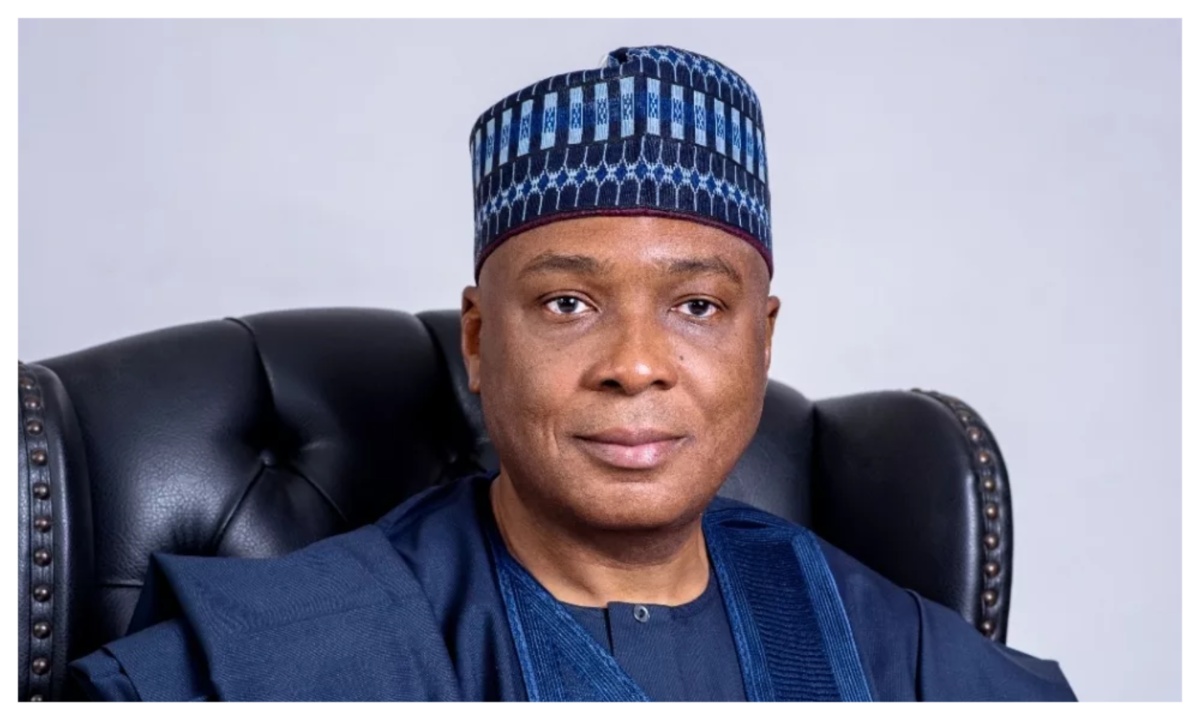
Former Senate President Bukola Saraki has again stressed the critical importance of legislative independence, declaring that a legislature which cannot reject executive proposals has failed its constitutional mandate.
Speaking as a guest at The Platform public lecture organised by Covenant Nation on Democracy Day, 12th June 2026, Saraki said lawmakers must be able to scrutinise proposals from the executive arm of government, according to a report by Channels Television.
“So what I learned in those four years in the National Assembly is that a legislature that cannot say no is not a legislature at all. A legislature which simply receives executive proposals, approves them without scrutiny, and goes home has not fulfilled its constitutional mandate,” Saraki was quoted as saying. “It has merely performed a ceremonial function. It’s an echo. A democracy made only of echoes is only one election away from becoming something else entirely.”
The former governor of Kwara State said the “greatest danger to a free people is not a weak government but an unchecked government: authority that answers to no one and cannot be questioned.” He noted that the framers of the Nigerian Constitution deliberately split power into three separate arms of government—dependent on one another yet meant to be independent.
“They built friction into the system on purpose; it was not a mistake. That friction is not dysfunction; it is the very thing that guarantees your freedom,” Saraki said. He argued that the legislature serves as a shield for democracy, without which the system would be destroyed.
Drawing lessons from the annulment of the 12th June 1993 presidential election, Saraki stated, “We did not lose democracy in 1993 because the people failed; we lost it because the institutions that should have defended the people’s verdict were too weak to do so. The remedy is not less politics; it is stronger institutions, and the legislature stands at the centre of them.”
To illustrate the importance of legislative oversight, Saraki recalled how the National Assembly under his leadership tracked alleged irregularities in the fuel subsidy regime. He said during the 7th Senate, he moved a motion on fuel subsidy corruption, noting that vessels were documented as arriving in Nigeria when they were elsewhere. “I went as far as going to the register, and I could see that the vessel that was supposed to be in Lagos port was somewhere in Colombia,” he said. “So I told NNPC to see the vessel they paid for and see where it is. This is the capacity of what I mean by legislatures also having the capacity.”