

Trump, Pezeshkian Seal 60-Day Truce In Historic First Since 1979
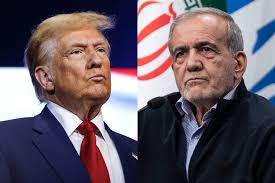
The United States and Iran have formally signed a memorandum of understanding aimed at ending months of war, but President Donald Trump made clear that military action remains on the table should Tehran fail to honour the terms.
Both Trump and Iranian President Masoud Pezeshkian signed the agreement on Wednesday, June 17, 2026, with the US leader putting pen to paper at the Palace of Versailles near Paris, shortly before a dinner hosted by French President Emmanuel Macron. The leaders signed the memorandum digitally in English and Farsi, and Iran’s foreign ministry said the agreement was already in effect as of Wednesday.
Trump, who had attended the G7 summit in Evian-les-Bains, France, welcomed the accord while warning that any violation could trigger renewed strikes.
“We’re going to bomb the hell out of them if they violate the agreement,” he told reporters.
Earlier he had put it more bluntly, saying that if Iran did not behave, “we’ll go right back to dropping bombs right smack in the middle of their head.”
The 14-point memorandum extends a ceasefire announced in April by another 60 days, including in Lebanon, to allow both sides to negotiate a final settlement.
Its terms include an immediate end to the war on all fronts, the full resumption of maritime traffic through the Strait of Hormuz, the lifting of a US blockade of Iranian ports, the waiving of US sanctions, the unfreezing of Iranian assets, and a $300 billion investment fund for post-war reconstruction.
Iranian officials framed the deal as vindication. Lead negotiator and Parliament Speaker Mohammad Baqer Qalibaf told state television, “Everything we sought to achieve through military action, we obtained several times over through negotiation; it was not even comparable.”
Tehran released photographs of what is believed to be the first agreement signed by both a US and Iranian president since the Islamic Republic’s founding in 1979.
The context is a war that began on February 28, 2026, when surprise US-Israeli airstrikes targeting military and government sites in Iran killed several officials, most notably Supreme Leader Ali Khamenei.
Iran retaliated against Israel, US-aligned Arab states, and American bases, and effectively blocked the Strait of Hormuz, disrupting the global economy and triggering a fuel crisis. Commercial traffic through the strait, which carries roughly a fifth of the world’s oil, dropped more than 90 per cent after fighting broke out.
The human cost has been heavy. The Iranian Red Crescent put fatalities at nearly 3,500 with more than 26,500 injured as of May 20, while Israel recorded 26 killed and Iranian retaliation claimed 13 US soldiers. A parallel escalation in Lebanon has killed more than 2,000 people.
Markets responded with cautious relief. Brent crude fell 1.6 per cent to $78.31 a barrel, still above its pre-war level of about $70 but well below the $100-plus it touched at the height of the conflict.
Questions over durability persist. Despite declaring victory, Trump appeared to soften earlier war aims. Iran’s government remains in place, its missile programme intact, and its regional allies, including Hezbollah, undismantled. Fighting in Lebanon has abated but not ceased, and Israel, which was not party to the negotiations, says it retains the right to use force.
The deal has also strained ties between Washington and Israeli Prime Minister Benjamin Netanyahu, who has distanced himself from the talks. Trump gently rebuked him over tactics in Lebanon, remarking, “Netanyahu is a good man, but he gets a little excited sometimes.”
Whether the truce becomes a foundation for lasting peace or merely another pause will depend on the next 60 days. As Iran’s foreign ministry spokesman Esmaeil Baghaei put it, “Now it is time to test the implementation of the agreement.”