
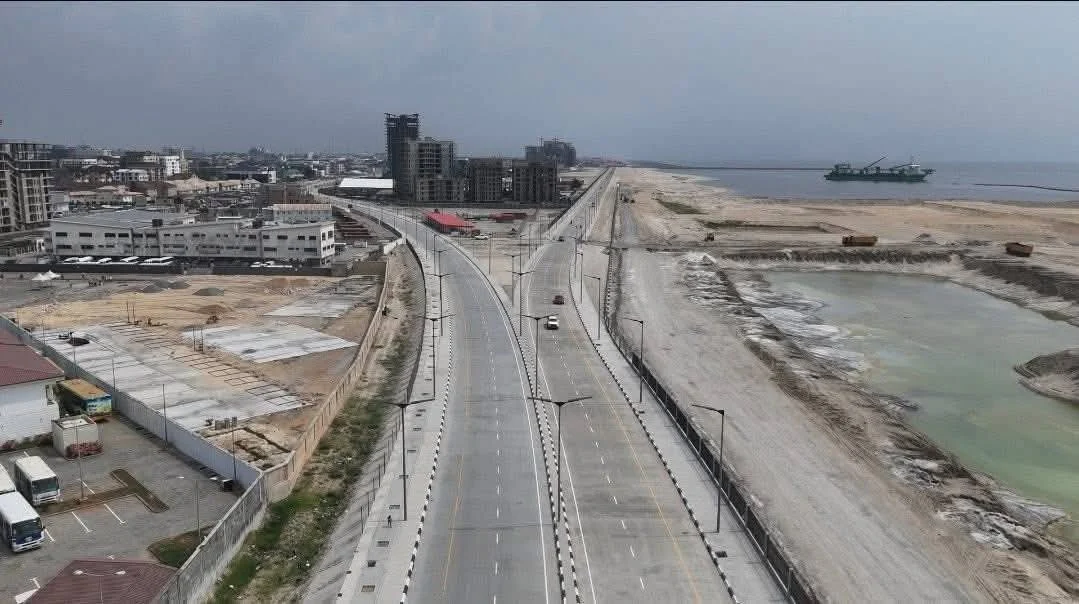
The Federal Government has renamed the Lagos to Calabar Coastal Highway as the President Bola Ahmed Tinubu Coastal Highway, tying the country’s costliest single road project directly to the man whose administration revived it, even as questions over the project’s price tag, procurement and environmental footprint remain unresolved.
Minister of Works David Umahi announced the change on Thursday during a briefing in Abuja, framing it as a tribute to a vision he said the President had nursed for close to three decades. “That highway is named President Bola Ahmed Tinubu Coastal Highway. By the powers conferred on me as Minister of Works, in consultation with my Permanent Secretary, the Minister of State, directors and staff of the ministry, we decided to name it after him because of his dream for it,” Umahi said. He added, “He had that dream about 27 years back as governor of Lagos State. It is one thing to dream and another thing to have the grace of God to actualise that dream.”
The renaming arrived alongside a cluster of fresh presidential approvals that Umahi presented as evidence of an accelerating infrastructure agenda. According to the minister, Tinubu approved a 400 kilometre extension of the Fourth Legacy Highway, lengthening the corridor that runs from Akwanga in Nasarawa State to Maiduguri in Borno State through Jos, Bauchi, Gombe and Biu. The project, earlier put at 700 kilometres, now stretches to 1,100 kilometres and reaches into Taraba State. “The greatest story is that yesterday President Bola Tinubu approved the addition of 400 kilometres to our Fourth Legacy Road… that is unprecedented,” Umahi said.
The President also cleared the dualisation of a further 400 kilometres of the East West Road, the reconstruction of the Lagos to Ibadan Expressway using reinforced concrete pavement, the completion of the long abandoned Ibi Bridge in Taraba State and the construction of the 5.76 kilometre Lao Bridge. On the Lagos to Ibadan corridor, which Umahi described as roughly 135 kilometres in each direction, the minister argued that early failures on portions rebuilt by earlier contractors justified the switch to concrete. He said the road had begun failing on the Ibadan bound carriageway despite being less than five years old.
On the coastal highway itself, Umahi put the full length at 750 kilometres and reported simultaneous work across several sections. Section One, the 47.47 kilometre stretch from Victoria Island toward Eleko in Lagos, was built as a six lane carriageway with a 25 metre median reserved for a future railway line. Section Two, running from Eleko to the Lagos and Ogun boundary, stands at about 60 percent completion and is expected to be substantially finished by the end of November, save for some bridge works. Section Three, covering 75 kilometres from Calabar, is around 30 percent done, while Section Four, spanning 82 kilometres through Ogun and Ondo states, has reached roughly 20 percent.
The figures land against a backdrop of sustained controversy that has trailed the project since demolitions began in early 2024. The full highway has been estimated at about 15 trillion naira, a figure that ranks it among the most expensive road projects on the African continent, with dollar valuations cited in various reports ranging between 12 and 13 billion dollars. The contract was awarded on a single source basis to Hitech Construction Company Limited, a firm owned by the Chagoury family and long associated with the President, without the open competitive tender required under the Public Procurement Act of 2007. Umahi has previously defended the arrangement, citing the firm’s expertise in coastal engineering.
The pilot phase, described by officials as roughly six percent of the whole, was awarded at about 1.06 trillion naira and runs from the Eko Atlantic area toward the Lekki Deep Sea Port. In July 2025, the government confirmed a 747 million dollar syndicated loan led by Deutsche Bank, with participation from the African Export Import Bank and the ECOWAS Bank for Investment and Development, to finance the first segment from Victoria Island to Eleko. The broader project carries an eight year construction timeline pointing to completion around 2032, with the contractor expected to recover its outlay through tolls over a 15 year concession.
Criticism has come from across the political spectrum and civil society. Former President Olusegun Obasanjo has publicly described the venture as wasteful, while former Vice President Atiku Abubakar has questioned the decision to bypass competitive bidding in favour of a firm linked to the President. Oyo State Governor Seyi Makinde has faulted the Ministry of Works over what he called secrecy around the true cost. Beyond procurement, the project has drawn objections over the demolition of homes and businesses, including parts of the Landmark Beach complex in Lagos, disputes over compensation described by affected owners as far below market value, and warnings from environmental groups about a route that cuts through mangroves and wetlands along a climate vulnerable coastline. The government has consistently maintained that due process is being followed and that affected persons are being compensated.
The coastal road is the most prominent of four highways the Tinubu administration has branded its legacy projects, alongside the Sokoto to Badagry Super Highway, the Trans Sahara Highway and the Akwanga to Maiduguri corridor. Attaching the President’s name to the flagship of that portfolio while three of its four sections remain incomplete signals the political weight the government has placed on the venture. Whether the renamed highway ultimately settles the debate over cost and process, or simply sharpens it, is likely to depend on how transparently the remaining phases, financing and compensation are handled in the months ahead.