
Sixth Facility In Tinubu’s Name: Coastal Road Renaming Sparks Backlash
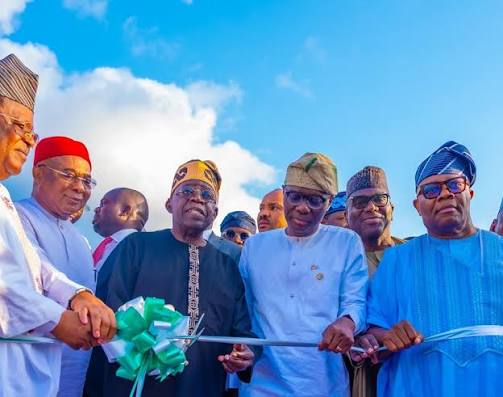
A single announcement from the Federal Ministry of Works has once again placed the question of political self commemoration at the centre of national conversation, after the government renamed its flagship coastal road the President Bola Ahmed Tinubu Coastal Highway, making it the sixth public facility to bear the President’s name since he took office in May 2023.
The Minister of Works, David Umahi, disclosed the decision on Thursday at a media briefing in Abuja, tying it to what he described as a vision the President nursed nearly three decades ago. “By the powers conferred on me as Minister of Works, in consultation with my Permanent Secretary, the Minister of State, directors and staff of the ministry, we decided to name it after him because of his dream for it,” Umahi said, adding, “He had that dream about 27 years ago as governor of Lagos State. It is one thing to dream and another thing to have the grace of God to actualise that dream.”
The renaming did not arrive in isolation. At the same briefing, Umahi announced that the President had approved a 400 kilometre extension of the Fourth Legacy Highway, stretching the corridor from about 700 kilometres to roughly 1,100 kilometres and pushing its reach from the original Akwanga to Maiduguri alignment into Taraba State. He also disclosed fresh approvals for the reconstruction of the Lagos to Ibadan Expressway using reinforced concrete pavement, the completion of the long abandoned Ibi Bridge in Taraba, the construction of the 5.76 kilometre Lau Bridge, and the dualisation of a further 400 kilometres of the East West Road.
The coastal road joins a growing list. The National Assembly renamed its library the Senator Bola Ahmed Tinubu Building in May 2024. That December, the Nigeria Immigration Service christened its Command and Control Centre in Abuja the Bola Ahmed Tinubu Technology Innovation Complex. In January 2025, the Nigerian Army named its newly completed Asokoro barracks after the President, and the government approved the establishment of the Bola Ahmed Tinubu Polytechnic in Gwarinpa. By June 2025, the Minister of the Federal Capital Territory had renamed the Abuja International Conference Centre the President Bola Ahmed Tinubu International Conference Centre. Separately, in March 2024, Niger State Governor Umar Bago renamed the Abubakar Imam International Airport in Minna after the President.
The project now carrying the President’s name is among the most ambitious and most contested in Nigeria’s history. Designed to run 750 kilometres from Victoria Island in Lagos to Calabar in Cross River State while traversing about nine coastal states, it is estimated to cost around 15 trillion naira on completion, a figure equivalent to roughly 11 to 13 billion dollars. Construction began in 2024 on an eight year timeline, placing full delivery around 2032.
Umahi told journalists that work was progressing on more than 360 kilometres of the corridor and described the first section, a 47.47 kilometre six lane carriageway from Victoria Island to the Lekki area with a 25 metre median reserved for a future railway line, as a landmark. The first operational segment was opened to the public in December 2025, with the formal inauguration of Section One planned for 2026. On financing, the government secured a syndicated facility of about 747 million dollars for Section One, and reported a further arrangement valued at roughly 1.26 billion dollars for Section Two, which officials have presented as evidence of investor confidence.
The cost, however, has been a persistent flashpoint. Umahi placed the price at about 4 billion naira per kilometre at the outset, while later independent estimates put it far higher. Critics have repeatedly contrasted the per kilometre figure with the Cairo to Cape Town Highway, a transcontinental route of more than 10,000 kilometres delivered at a fraction of the cost. Former Vice President Atiku Abubakar in 2024 described the project as a “highway to fraud” and drew attention to the presence of the President’s son, Seyi Tinubu, on the board of a Chagoury Group subsidiary, framing it as a conflict of interest, a characterisation the government has denied.
Procurement remains the sharpest legal question. The contract was awarded to Hitech Construction Company Limited, a firm owned by the Lebanese Nigerian businessmen Gilbert and Ronald Chagoury, without an open competitive tender. Umahi has confirmed the award was made on a single source basis, which opponents, including the former governorship candidate Funso Doherty, argue contravenes the Public Procurement Act of 2007. The demolition of businesses and homes along the Lagos coastline, including parts of the Landmark Beach Resort, valued in some accounts at about 200 million dollars, drew protests and complaints of inadequate compensation. Oyo State Governor Seyi Makinde separately pressed the ministry in 2025 for clearer disclosure of the project’s true cost.
Against that backdrop, the renaming has hardened existing divisions. The National Publicity Secretary of the African Democratic Congress, Bolaji Abdullahi, called it “the highest form of sycophancy that we have ever witnessed, not even under military rule,” and accused the ruling party of treating public assets as personal property. “You cannot be using public money to build public infrastructure and personalising it,” he said. “When you serve the nation, the nation names things after you.”
The National Coordinator of the Obidient Movement, Dr Yinusa Tanko, questioned the timing, noting the road is far from finished. “Even the project has not been completed and you are naming it after yourself. It has not even gotten up to a quarter,” he said, urging the President to reject the honour.
Former Peoples Democratic Party Deputy National Chairman Bode George counselled restraint and raised environmental concerns, saying, “Calabar to Lagos is a long journey. So, I don’t know what is the hurry.” Human rights lawyer Inibehe Effiong described the move as “completely misguided” and a “personalisation of governance,” linking it to what he called the “Emilokan” ideology, while the Executive Director of the International Society for Social Justice and Human Rights, Jackson Omenazu, argued that such honours should rest on a leader’s measurable impact.
Not all voices were critical. The President of the Nigerian Society of International Affairs, Professor Hassan Saliu, offered a measured reading, noting that naming institutions after leaders is not unusual in Nigeria and Africa and suggesting the President may not have initiated it. “It is a symbolic gesture that is acquiring political colouration now, given the way politics is heated up in Nigeria,” he said. A former Oyo State Deputy Governor, Hazeem Gbolarumi, and the Kwara State APC Chairman, Prince Sunday Fagbemi, both dismissed the controversy and urged Nigerians to focus on the road’s completion, a position echoed by the 2027 presidential aspirant Professor Christopher Imumolen.
For now, the President himself has not publicly responded to the calls that he decline the honour. What began as a routine ministerial update has instead sharpened a broader argument about legacy, accountability and the line between public service and self memorial, an argument likely to intensify as the corridor moves, kilometre by contested kilometre, toward its distant completion date.