
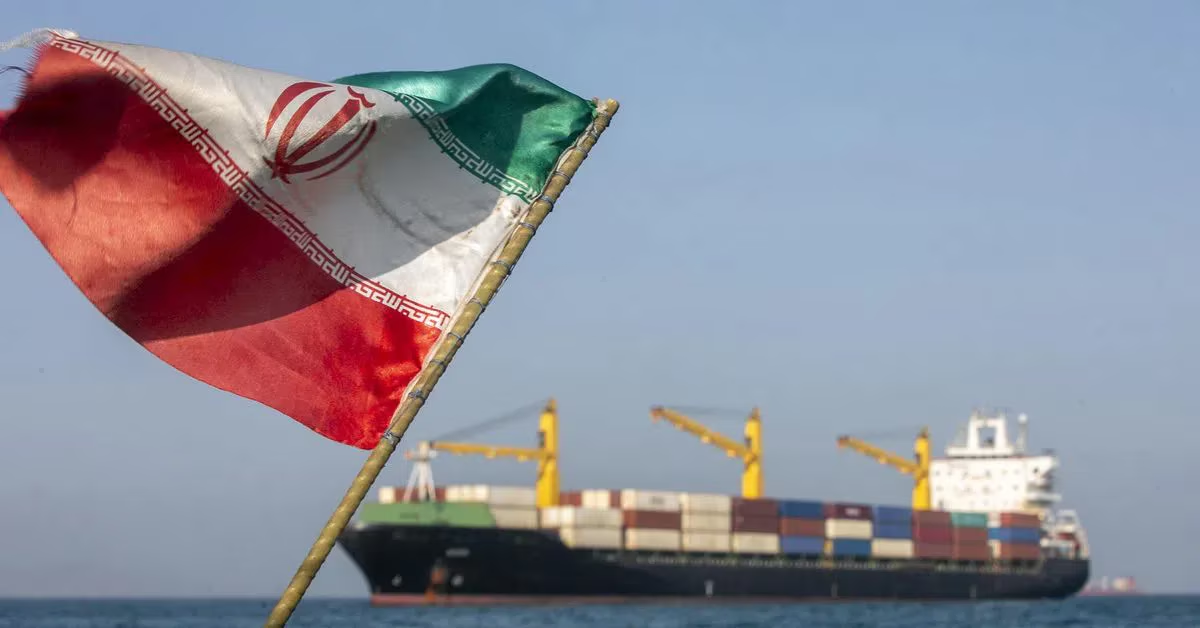
Iran has firmly rejected claims by United States officials that the Strait of Hormuz is open, insisting that the strategic waterway remains blocked and will not be reopened until Tehran’s conditions are accepted.
The Persian Gulf Strait Authority, the Iranian body responsible for maritime traffic in the strait, dismissed statements by US officials in a social media post on X on Wednesday. “Claims and repeated posts by U.S. officials that the Strait of Hormuz is no longer blocked do not change the reality,” the authority said. “The Strait of Hormuz remains blocked and will not be reopened until Iran’s conditions are accepted”.
The rejection came after President Donald Trump claimed the United States had “total control” over the strait and would “keep it”. In a post on Truth Social, Trump described the US naval blockade as a “wall of steel” and said Iran lacked the capability to challenge it. In remarks to reporters at the White House on Monday, Trump said the US had “mine swept the entire strait” and that the US Navy holds “100 percent” control over the waterway. He also said the strait “is actually open now” and that “the only one that has control of the Strait of Hormuz right now is the United States Navy”.
The standoff over the strait, one of the world’s most critical chokepoints for energy shipments, has deepened as both sides hold firm to their positions. Before the conflict, about one-fifth of the world’s oil and liquefied natural gas passed through the waterway.
Iran tightened its grip on the Strait of Hormuz on February 28, barring safe passage of vessels belonging to or affiliated with Israel and the United States following joint strikes on Iranian territory by the two countries. The US-Israeli aggression targeted Iran from February 28 until April 7. Iran declared the strait closed in response.
The US and Iran signed a memorandum of understanding in June to end the cycle of hostilities. Iran subsequently reopened the strait but was forced to reimpose the closure after Washington began interfering with the legal transit mechanism that Tehran had devised for passage through the chokepoint.
The newly appointed secretary of Iran’s Supreme National Security Council, Mohsen Rezaei, said the Strait of Hormuz would remain closed unless the United States changes its behaviour and accepts Iran’s conditions. “The United States must end the war and pay the country’s frozen assets, and the war must end in the entire region, including Lebanon and Gaza,” Rezaei said, according to the official IRNA news agency.
In a post on X, Rezaei listed Iran’s demands: an end to the US war and blockade, the release of Iran’s frozen assets, and a region-wide ceasefire covering Lebanon and Gaza. “Until all conditions are met, the Strait will remain closed,” he wrote. He added that Iran’s other conditions had been conveyed to the United States through mediators.
Rezaei also referred to ongoing negotiations between Iran and Oman over the designation of a new route through the strait, saying a potential agreement between the two countries “will be an issue separate from the strait’s closure”. Iranian Foreign Ministry spokesman Esmaeil Baghaei said Iran and Oman are working on a new Traffic Separation Scheme that would establish a route acceptable to both sides while safeguarding their sovereign rights and national interests. Baghaei also said that a possible agreement with Oman would not mean the full reopening of the strait.
Iran’s Deputy Foreign Minister Kazem Gharibabadi announced that the Iran-Oman understanding on new arrangements for the passage of commercial vessels through the strait is nearing its final stage. He said the new model does not mean the complete reopening of the strait and that a significant part of the new route will be located in Iran’s territorial waters. The route is temporary and could remain valid for around two to four months or longer.
Iranian Foreign Minister Seyed Abbas Araghchi on Thursday warned the United States against making a “big miscalculation” about the Strait of Hormuz based on “fake intelligence”. Iran’s main military command, the Khatam al-Anbiya Central Headquarters, said that no commercial vessel or oil tanker has been or will be able to cross the strait safely without the Iranian armed forces’ permission and supervision. Spokesman Ebrahim Zolfaghari rejected US claims of normal vessel passage through the strait as “false and nothing but lies”.
The standoff has already had a significant impact on shipping through the strategic waterway. Shipping traffic through the Strait of Hormuz dropped to eight vessels on Tuesday, compared with a 10-day average of roughly 12 vessels and 130 to 140 ships before the war. The US Energy Information Administration reported that oil flows through the strait fell to 4.9 million barrels per day in the second quarter of this year, from 21.6 million barrels per day in the fourth quarter of last year. The EIA said ongoing disruptions have driven down global oil inventories, keeping prices elevated until flows normalise.
The International Energy Agency on Wednesday forecast a decline in global oil supply of 4.3 million barrels per day, or around four per cent, this year. A month earlier, the agency had forecast a drop of 3.7 million barrels per day. The IEA now expects global oil demand to decline by 1.6 million barrels per day in 2026, raising its forecast from a 1 million-barrel-per-day drop in its July report. The EIA forecasts Brent crude oil to average around $85 per barrel during the third quarter of 2026, $11 per barrel higher than it projected just one month ago. The agency expects prices to ease to around $78 per barrel in the fourth quarter as shipping increases.
The United States on Thursday said it could maintain a naval blockade of Iran indefinitely and would ratchet up economic pressure on Tehran as ceasefire talks have stalled. Defence Secretary Pete Hegseth told reporters that the US military has the capability to maintain a naval presence in the region to enforce its blockade. “Indefinitely the United States Navy can maintain a blockade like that because we’ll rotate ships in and out, as we have, and we’ll continue to,” Hegseth said. Treasury Secretary Scott Bessent said the US planned to impose additional financial measures on Iran. “Watch this space for more announcements coming next week because we are going to apply measures like have never been seen in the history of economic isolation on a country,” he said.
The dispute goes beyond reopening the waterway to questions of control, sanctions and implementation. Alan Eyre, a former US diplomat and Iran expert, said Tehran was using the strait as leverage to prevent Washington from dictating the pace of events. Jonathan Panikoff, a former senior US intelligence officer now with the Atlantic Council, a Washington think tank, said that whatever Trump does, “the fundamental result is going to be significant Iranian de facto control over the strait”.
Energy security experts have warned that the prolonged crisis is pushing governments across the Gulf and beyond to seek alternative routes and reassess their energy security strategies. Saudi Arabia is considering expanding the capacity of its crude oil pipeline to the western Red Sea coast by up to 2 million barrels per day. The United Arab Emirates in May announced it was fast-tracking the construction of a new oil pipeline to bypass the strait. However, experts warned that these alternatives cannot immediately replace Hormuz. While Saudi Arabia’s proposed pipeline expansion could take years, Qatar and Kuwait lack routes that can bypass the strait. Liquefied natural gas is even harder to reroute because it requires specialised infrastructure and tankers. As about one-fifth of global LNG supplies passed through the strait before the war, LNG exporters will be heavily dependent on Hormuz for the foreseeable future.
Economists have forecast a sharp drop in global growth as a result of the war, and potentially a swing into recession in some areas, warning that the impact will grow if the war is not ended soon. Mohammad Mokhber, a senior adviser to Iran’s Supreme Leader Mojtaba Khamenei, said Thursday that the war would enter an offensive phase if Tehran’s conditions were not met. “The Supreme Leader’s definitive strategy is for the war to become offensive if Iran’s conditions are not fulfilled,” Mokhber said in a post on X.