
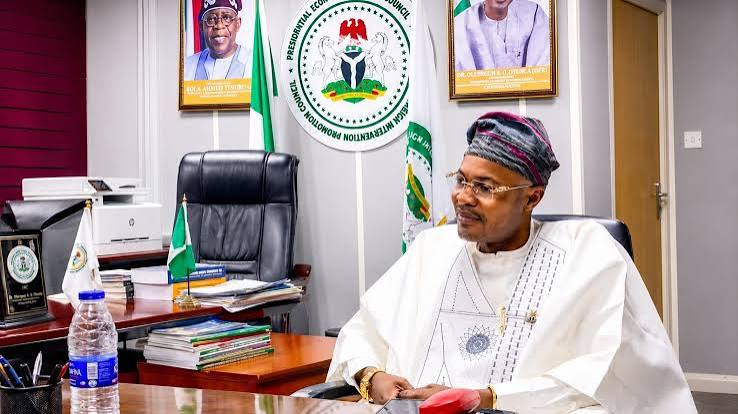
The Independent Corrupt Practices and Other Related Offences Commission has named senior federal officials who, it says, processed approvals, opened financial channels and allocated offices for the purported Presidential Foreign Intervention Promotion Council, an organisation the Presidency has said never existed.
The findings are in the commission’s interim investigation report, ordered by President Bola Tinubu after the government disowned both the council and its self-styled director-general, Adeniyi Adeyemi Matthew. ICPC Chairman Musa Aliyu has said Adeyemi was never appointed by the Federal Government and that the PFIPC, also styled as the Presidential Economic Advisory Council, was not created by law, executive order or any valid instrument.
Adeyemi faces an eight-count charge of forgery and impersonation. He has denied wrongdoing and said he will prove his case in court. The commission has recommended his prosecution, administrative sanctions against public officers whose acts or omissions enabled the scheme, and reforms in ministries, departments and agencies.
According to the ICPC, Adeyemi began seeking official recognition in November 2024, approaching the Office of the Accountant-General of the Federation for an administrative code, self-accounting status and Central Bank of Nigeria accounts. He presented an appointment letter, an establishment instrument and a State House letter attributed to one Akanbi Adewale. Investigators said Akanbi Adewale did not exist and that forensic examination showed Adeyemi signed the letter himself.
On 27 May 2025 the OAGF nonetheless granted self-accounting status and assigned administrative code 0111062001. A GIFMIS platform and a Sub-Treasury Account followed. The OAGF also mandated the CBN to open two domiciliary accounts. The CBN later told the House of Representatives that the accounts were never activated because authorised signatories were not provided.
The 2026 Appropriation Act listed N1.3 billion for the purported council: N802 million for personnel, N200 million for overhead and N300 million for capital. The Budget Office of the Federation had received the OAGF code on 29 November 2024 and later recalculated a PFIPC personnel proposal of N3.85 billion down to that N1.3 billion figure. The ICPC said it found no evidence that the money was released, cash-backed or spent. Adeyemi has said he was in detention when the budget was processed and did not prepare it.
The commission examined three civil servants over an authorised establishment and recruitment waiver: Rose Achem, senior administrative officer to the director-general of the Budget Office; Patricia Akhigbe, an assistant director in the Ministry of Budget and Economic Planning; and Mimi Abu, director of organisation design and development at the Office of the Head of the Civil Service of the Federation.
ICPC said Achem introduced Akhigbe to Abu as the PFIPC’s head of human resources, although Akhigbe remained an assistant director in the Budget Ministry. The three then facilitated OHCSF approvals. Investigators said Adeyemi paid Akhigbe N500,000 at Easter 2025, described in the evidence as a “thank you for your support.” The authorised establishment was granted the same day the three met. The commission found no formal PFIPC application for the waiver. When it asked for the OHCSF file, the office said it was missing.
Abu’s department handles establishment, manpower and recruitment waivers. Standard procedure requires a mandate, establishment instruments and the head of agency’s appointment letter. Achem and Akhigbe presented what investigators called forged instruments and a forged appointment letter. Abu described a letter said to have been issued by the Chief of Staff to the President as an “aberration” and said she could not recall another organisation using such a document. The OHCSF did not deploy staff. A 9 May 2025 PFIPC request for officers was neither approved nor effected, the Enterprise Content Management System showed.
Separately, the ICPC examined Aminu Abdullahi, who coordinates office allocation in the Office of the Secretary to the Government of the Federation. It said Ibrahim Abdulkadir, a deputy director in General Services, introduced him to Adeyemi in March 2025 after an approach to the EFCC for recovered property had not yielded space. Abdullahi then allocated offices previously used by former Chief Economic Adviser Doyin Salami at Federal Secretariat Phase III without written approval, and broke locks on remaining doors. Analysis of his bank statement, the commission said, showed N3.25 million from Adeyemi in three tranches between March and November 2025.
The named officials have not been convicted. The ICPC’s account is investigative, not a court finding. Adeyemi’s broader claim that he paid N400 million, via an intermediary, in connection with his appointment was not upheld against Chief of Staff Femi Gbajabiamila. The commission said it found no evidence linking Gbajabiamila, his office or the State House to the appointment.
Investigators also linked Adeyemi to two other purported bodies, the FCT Investment Promotion Agency and the Foreign Investment Promotion Agency and Public Private Partnership. A further suspected fake entity, the National Brands Development and Made in Nigeria Special Project Office, was identified inside the OSGF. President Tinubu ordered the suspension of three permanent secretaries, M.S. Danjuma, Nadungu Gagare and Richard P. Pheelangwah, and the arrest of its alleged promoter, George Buchi Nwabueze.
The ICPC said the Federal Government did not disburse funds to the PFIPC, but that weak verification, missing files, informal processing and reliance on scanned or forged papers allowed a body with no legal existence to obtain a budget line, an office, an accounting code and the appearance of state authority. Those control gaps, not only one man’s forgeries, are what the commission says now require both prosecutions and institutional repair.