
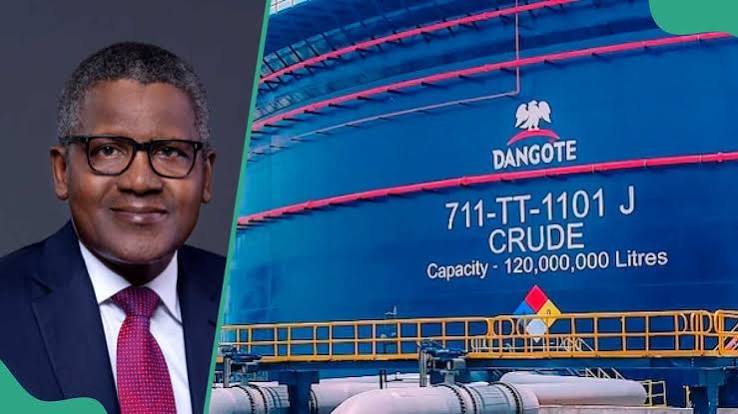
Dangote Petroleum Refinery and Petrochemicals has said continued petrol import licences are making it harder to plan for the Nigerian market and are pushing more of its output into export, even though it maintains that it can meet and exceed domestic demand.
The company said imported Premium Motor Spirit accounted for about 43 per cent of fuel supplied into Nigeria in July. Figures from the Nigerian Midstream and Downstream Petroleum Regulatory Authority are consistent with that share. NMDPRA data show imports averaged 19.7 million litres a day in July, against total petrol supply of 45.5 million litres a day, or roughly 43.3 per cent. Domestic refineries supplied the remaining 25.8 million litres a day.
The same official series shows a mixed picture. Dangote’s petrol supply to the local market fell 21 per cent in July, from 32.5 million litres a day to 25.8 million. Imports rose 9 per cent, from 18.1 million litres a day to 19.7 million. National consumption was reported at 35.7 million litres a day, down 25 per cent on the previous month. Compared with July 2025, domestic supply was still 56 per cent higher and imports 45 per cent lower.
Dangote said it has kept large inventories and reserved volumes to protect the country from shortages, at significant cost in storage, logistics and working capital. It argued that limited visibility on how much imported product will arrive makes that stance commercially unsustainable.
“As a responsible energy provider, we have always endeavoured to keep adequate reserves to satisfy local demand at all times. However, in an environment where significant volumes of imported PMS continue to enter the market through licences issued by the regulator and where there is limited visibility on future import volumes, it becomes commercially unsustainable to continue holding excess inventory indefinitely,” the refinery said.
Surplus not absorbed at home, it added, is being sold in regional and international markets to avoid carrying costs. The company said higher exports should not be read as a withdrawal from Nigeria, but as a response to competition from imports while local capacity sits available. It also said that if shortages arise from what it called market distortions, they should not be blamed on the refinery.
The 650,000-barrel-a-day plant has previously said it can supply well above estimated national petrol consumption. State-owned refineries remain largely idle, so Dangote is the dominant domestic producer. That concentration is part of the policy argument on the other side.
The NMDPRA has issued fresh petrol and diesel import approvals for the third quarter of 2026, covering July to September, to selected marketers including AA Rano, AYM Shafa, Bono, Matrix, Nipco and Pinnacle. The regulator has previously framed licences as a buffer when stock levels fall or local output dips. Earlier in 2026, import permits were suspended for periods when officials judged domestic supply adequate. The Federal Government later relaxed restrictions, a move that drew mixed reactions.
Importers and some officials have argued that a single private refinery should not be the sole source of a strategic product, and that import windows help keep prices competitive and prevent shortages if the plant slows, as it did in July. Dangote has long argued that large-scale imports drain foreign exchange and undercut the case for local refining.
The refinery called for clearer data on expected import volumes, better coordination and policies that favour domestic refining, energy security and foreign-exchange conservation. How the regulator balances those aims against supply-risk and competition will shape both pump availability and the share of Nigerian-refined fuel that stays at home rather than going abroad.