
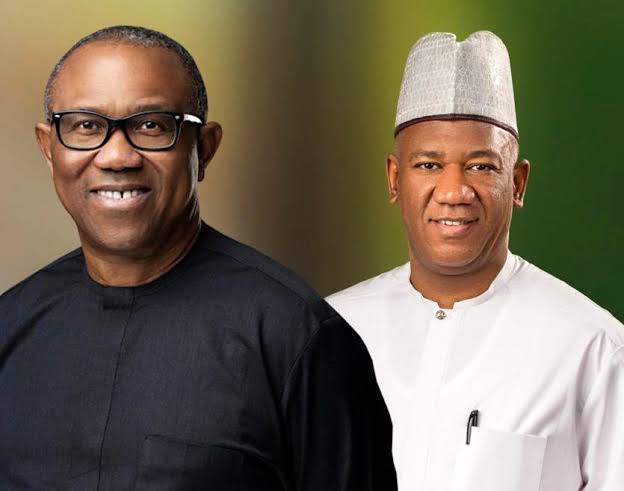
Yusuf Datti Baba-Ahmed, Peter Obi’s running mate on the Labour Party ticket in the 2023 presidential election, has said he personally advised the former Anambra State governor against joining the African Democratic Congress, describing the platform as unsuitable for Obi’s ambitions.
Speaking during an interview on the MIC ON Podcast, Baba-Ahmed recalled that he travelled ahead of Obi to the Yar’Adua Centre, pulled him aside and stated his reservations clearly. “This is the last time I’m coming to this place. I gave him my reasons. This is not a place for you,” he said he told Obi. He added that those around them noticed the private conversation and wondered why he was speaking to Obi separately.
Baba-Ahmed maintained that subsequent events vindicated his position. “Was I wrong? I was proven right. Within four months, Peter Obi left ADC,” he stated. He linked Obi’s exit to a broader discomfort with what he described as contradictions in political conduct, while carefully distancing himself from any extended critique of other opposition figures.
The comments come against a backdrop of rapid realignments in the opposition ahead of the 2027 general election. Obi and Baba-Ahmed finished third in the 2023 presidential poll under the Labour Party, behind Bola Tinubu of the All Progressives Congress and Atiku Abubakar of the Peoples Democratic Party. Their joint ticket had energised a significant youth and urban voting bloc, particularly in the South-East and parts of the North and South-West.
After the election, the Labour Party became embroiled in prolonged leadership disputes. Obi formally left the party and joined the ADC in late December 2025, presenting the move as part of a broader coalition effort aimed at presenting a stronger challenge in 2027. Public records and party statements from that period confirm his formal entry into the ADC at a rally in Enugu. Less than five months later, in early May 2026, Obi resigned from the ADC, citing internal crises, court cases, suspicion and what he described as the infiltration of state agents into the party structure. By the end of May 2026 he had been ratified as the presidential candidate of the Nigeria Democratic Congress, with Rabiu Kwankwaso as his running mate.
Baba-Ahmed did not follow Obi into the ADC. He has repeatedly stated that his political choices remain independent and that he informed Obi of his reasons for staying away. In earlier public comments, he emphasised that Obi does not own his politics and that he preferred to address problems within the Labour Party rather than abandon it. He later associated with the Peoples Redemption Party. Despite the divergent paths, Baba-Ahmed has continued to express personal respect for Obi, describing their relationship as intact and noting that Obi attended a family event at his home.
The ADC itself became the vehicle for a wider opposition coalition that at various points included figures such as Atiku Abubakar, who emerged as its presidential candidate after primaries in 2026. That coalition experienced its own fractures, with several prominent politicians exiting over disagreements on consensus, internal democracy and ambition. Obi’s brief stay in the party and subsequent departure formed part of that larger pattern of realignment and failed consolidation among opposition forces.
Baba-Ahmed’s latest remarks underline the personal and strategic calculations that have shaped the post-2023 opposition landscape. He presented his advice to Obi as principled rather than personal, rooted in an assessment of the ADC’s suitability at the time. Obi’s subsequent exit after roughly four months is cited by Baba-Ahmed as confirmation of that assessment. For his part, Obi has publicly explained his successive party moves as responses to internal crises and a desire to operate in environments free of what he has called “fire.”
The episode illustrates the fluidity of party affiliation in Nigeria’s current political environment. Former running mates now operate on separate platforms. Coalition efforts that once appeared promising have repeatedly struggled to contain competing ambitions and organisational disputes. With the 2027 election approaching, the ability of opposition figures to convert individual popularity into durable institutional vehicles remains an open question. Baba-Ahmed’s account adds a first-hand layer to the public record of how one of the more prominent relationships of the 2023 cycle navigated that turbulence.