
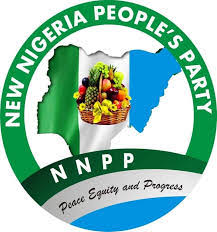
The New Nigeria People’s Party has declared a decisive turn in its protracted internal war, announcing that the Independent National Electoral Commission has restored its original logo on its portal and affirmed the National Working Committee headed by Dr Major Agbo, even as the party uploaded a placeholder presidential candidate ahead of the 2027 general elections.
Agbo, who addressed journalists in Abuja, said the commission had pulled down what he described as a “fake” emblem and reinstated the party’s cherished “Basket of Fruits on Nigerian Map,” the symbol at the heart of a bruising contest over the party’s identity. “We are pleased to formally announce that the logo and identity of our party have been fully restored by INEC,” he said, adding, “I urge everybody to visit the INEC portal and see that the previous fake logo has been pulled down and replaced with the original logo of our great party.” An independent check confirmed that the old logo now sits above the party’s name on the commission’s portal.
The announcement is the latest episode in a leadership crisis that has consumed the NNPP since after the 2023 elections, splitting the party into rival camps each claiming control of its structure, name and symbol. One faction is led by Agbo, who was elected national chairman at a convention in February 2025 and who, alongside the party’s founder and Board of Trustees chairman, Dr Boniface Aniebonam, insists his is the authentic leadership. The other was loyal to the party’s 2023 presidential candidate, Senator Rabiu Kwankwaso, and was for a time fronted by Dr Ajuji Ahmed, who maintained that the party’s National Working Committee had been constituted in 2022 under INEC’s supervision for a tenure running to April 2026 and that no fresh convention had validly taken place.
The rupture hardened along the way. At its February 2025 convention, the Agbo faction ratified the expulsion of Kwankwaso, Elder Buba Galadima and the wider Kwankwassiya bloc over alleged anti party activities and misappropriation of campaign funds, and reverted the logo to the original design. The rival group rejected the outcome outright, arguing that the gathering carried no legitimacy. Matters moved decisively into the courts. In two ex parte rulings delivered on November 25 and 27, 2025, Justice Bello Kawu of the Federal Capital Territory High Court in Apo restrained INEC from recognising or dealing with any faction other than the one led by Agbo, and barred the commission from uploading, publishing or recognising any logo or document originating from the rival camp. The court also granted the party leave to seek judicial review by way of mandamus, with the order operating as a stay of any contrary action by INEC.
Beyond the logo, Agbo said the party had moved to demonstrate readiness for 2027. “Despite the time constraints due to the late recognition of the legitimate National Working Committee under my leadership, our Situation Room was able to upload a total of 355 National Assembly candidates, including placeholders,” he said, referring to the party’s slate across the 36 states and the Federal Capital Territory. He confirmed that a placeholder presidential flag bearer had also been uploaded but pointedly declined to name the person, saying, “Withholding his name and identity is a deliberate act on our part.” He added that the upload of governorship and state House of Assembly candidates had begun and would be concluded before INEC’s August 8, 2026 deadline, after which the window for substitution and replacement opens.
Agbo framed the developments as vindication. “It, therefore, stands to reason that all the failed hijackers have been defeated totally to serve as a warning to shameless politicians who are in the habit of reaping where they did not sow,” he said. According to reporting by Leadership newspaper, the leadership has also threatened a N10 billion suit tied to the logo dispute, underscoring how far from settled the legal terrain remains.
The stakes are considerable for a party whose national relevance rests heavily on a single stronghold. In the 2023 presidential election, Kwankwaso finished fourth nationally with 1,496,687 votes, but his real weight was in Kano, where the NNPP polled 997,279 votes to sweep the bulk of the state’s 44 local government areas, beating the All Progressives Congress candidate, Bola Tinubu, who scored 517,341, the Peoples Democratic Party’s Atiku Abubakar with 131,716, and the Labour Party’s Peter Obi with 28,513. That concentration of strength made the question of who controls the NNPP structure especially consequential.
That question has since been complicated by Kwankwaso’s own exit. In late March 2026, the Kwankwassiyya Movement directed its members to join the African Democratic Congress, and Kwankwaso formally left the NNPP, citing the need for a fresh political alignment. The realignment has continued to shift within the opposition. More recent reporting indicates Kwankwaso has emerged as the vice presidential candidate of the Nigeria Democratic Congress alongside Peter Obi, with the accord reportedly built around a single four year term commitment, an arrangement designed to avoid the opposition vote splitting that many analysts blamed for Tinubu’s 2023 win. For the Agbo led NNPP, Kwankwaso’s departure both removes its most recognisable figure and, in the party’s telling, clears the path to rebuild on its own terms.
Agbo closed with an appeal for fresh recruits ahead of the polls. “As preparations heighten towards the 2027 general elections, we call on all patriotic Nigerians, particularly our youths, women, professionals, workers and those in diaspora to join the NNPP in the collective mission of building a new Nigeria,” he said, describing the candidate uploads as evidence of “the consolidation of our membership base and our readiness to provide purposeful leadership.”
Whether the restoration of the logo and the flurry of uploads translates into electoral competitiveness will depend on decisions still pending in court, the party’s ability to hold its base without Kwankwaso, and the substitution choices it makes before the wider field crystallises. For now, the party that once turned Kano into an opposition fortress is signalling that it intends to contest 2027 under its own colours, quite literally.