
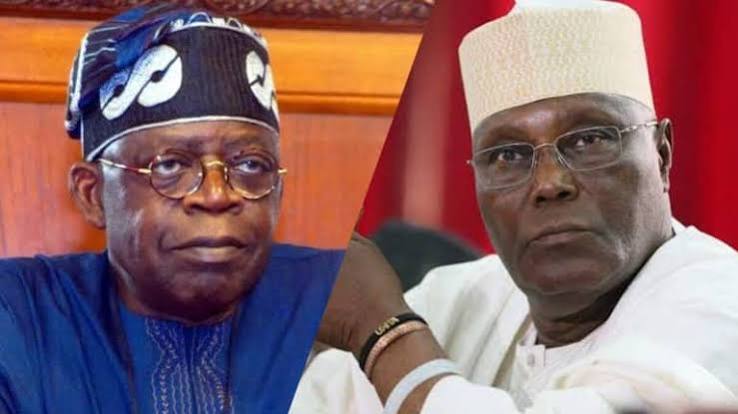
The two dominant figures of Nigeria’s 2027 presidential contest, President Bola Tinubu and former Vice President Atiku Abubakar, have between them committed more than 10 million dollars to lobbying firms in the United States, a level of foreign spending now drawing scrutiny at a time when official data show millions of Nigerian households struggling with the cost of living.
Publicly available filings under the United States Foreign Agents Registration Act put the combined value of the two engagements at about 10.2 million dollars. At an exchange rate of roughly 1,400 naira to the dollar, that translates to just over 14 billion naira. The Central Bank of Nigeria’s official Nigerian Foreign Exchange Market rate stood at about 1,329 naira to the dollar in the second week of September 2026, with parallel market quotations between 1,385 and 1,410 naira, so the naira value of the contracts depends on which rate is applied.
The larger of the two commitments is a government contract. Documents filed with the US Department of Justice show that Aster Legal, a Kaduna based law firm acting on behalf of the Office of the National Security Adviser, Nuhu Ribadu, engaged the Washington firm DCI Group on 17 December 2025. The agreement provided for a monthly retainer of 750,000 dollars, an initial six month engagement worth 4.5 million dollars with an automatic renewal clause that could take the total to 9 million dollars over a year, and a prepayment of 4.5 million dollars made on 12 December 2025. The stated purpose was to help communicate Nigeria’s efforts to protect Christian communities and to sustain American support for the country’s campaign against jihadist groups in West Africa. The engagement followed the October 2025 decision by US President Donald Trump to redesignate Nigeria a country of particular concern over alleged attacks on Christians, a characterisation Nigerian authorities have consistently rejected, attributing the violence mainly to terrorism, banditry and communal conflict.
The second engagement is personal and political. Filings show that Atiku, presidential candidate of the African Democratic Congress, contracted the Washington firm Von Batten-Montague-York under a 1.2 million dollar, 12 month agreement. According to the filing, the firm was retained partly to counterbalance the Nigerian government’s narratives in Washington, facilitate engagement with members of Congress and executive branch officials, and provide strategic advice on policy positioning. Since July 2026, the firm has circulated historical US law enforcement records concerning Tinubu, tied to a 1990s narcotics and money laundering investigation and a civil forfeiture of 460,000 dollars from an account bearing his name. Civil forfeiture is not a criminal conviction, and the records remain the subject of a Freedom of Information Act case before a US federal court, in which Tinubu’s lawyers have asked that certain FBI and Drug Enforcement Administration material stay redacted.
Both camps have used the other’s spending as ammunition. The Special Adviser to the President on Media and Public Communications, Sunday Dare, in a statement on 1 September 2026 titled “Speculation as Classified Information”, described the reports emanating from Von Batten-Montague-York as fabricated and politically motivated, and challenged those behind them to produce documentary evidence. Atiku, through his Senior Special Assistant on Public Communication, Phrank Shaibu, responded that his own engagement was voluntarily disclosed under FARA and accused the government of hypocrisy for criticising a 1.2 million dollar contract while running a far larger arrangement with DCI Group. He urged the Presidency to answer the substantive questions raised by the American records rather than attacking the lobbyist.
The sharper question raised by the spending is one of opportunity cost, and here the comparisons should be read as illustrative rather than precise. Divided into packages of 250,000 naira, 14 billion naira would fund about 56,000 microenterprises. At 500,000 naira it would reach 28,000, at 1 million naira about 14,000, and at 5 million naira roughly 2,800. Whether any of those interventions would produce lasting businesses depends on the financing model, the sectors chosen, administrative costs and survival rates, so the headline figure of 56,000 is a ceiling rather than a forecast.
What is not in dispute is the scale of the financing gap the comparison points to. In December 2025, the World Bank approved a 500 million dollar package, the Fostering Inclusive Finance for MSMEs in Nigeria project, to expand credit for small businesses. In its assessment, micro, small and medium enterprises account for most businesses in Nigeria, nearly half of gross domestic product and a large share of employment, yet fewer than one in 20 have access to bank credit, and the loans available are often short term, costly and tied to collateral requirements that exclude many viable firms. The project is expected to expand debt financing to 250,000 MSMEs and mobilise about 1.89 billion dollars in private capital, a structure that underlines the World Bank’s own point that public money works best when it draws in far larger sums of private capital rather than being handed out directly.
The hardship backdrop is measurable. Headline inflation eased for a second straight month in July 2026 to 15.43 per cent, down from 15.91 per cent in June and 24.94 per cent a year earlier, according to the National Bureau of Statistics. Food inflation moved the other way, rising to 20.31 per cent year on year from 17.52 per cent, with monthly food inflation accelerating to 5.56 per cent. The moderation in the overall rate has not reached the food basket, where lower income households spend most of their money. Comparisons with figures before 2025 should be treated with care, as the bureau rebased its index early that year.
Analysts have cautioned that money alone is not the answer. Bismarck Rewane, Managing Director of Financial Derivatives Company, argued in June 2026 that successful reforms should attract investment, raise productivity and create jobs, and identified power, agriculture, manufacturing, fintech and telecommunications as key drivers, while noting that small firms are particularly hurt by unreliable electricity and high operating costs. On that reading, the value of 14 billion naira would depend less on the amount than on whether it were combined with credit guarantees, infrastructure and access to markets.
Both engagements remain active, and neither firm’s work has yet produced a publicly documented outcome that either side can point to as a return on the money spent.