
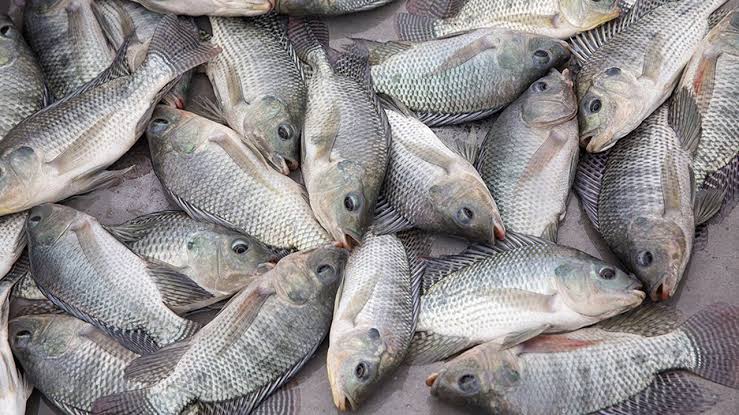
Nigeria’s fish import bill dropped to about N167.91 billion in the second quarter of 2026, down 14.8 per cent from the N197.17 billion spent in the same quarter last year, according to figures in the latest Foreign Trade in Goods Statistics report from the National Bureau of Statistics.
The report, which tracks six fish categories, covers blue whiting (panla), herrings (shawa), mackerel (titus), jack and horse mackerel (kote), yellowfin tuna and other frozen species. On paper it reads like a country slowly weaning itself off imported protein. The detail underneath tells a more complicated story.
Blue whiting stayed the single largest item on the list, though its value eased from N116.13 billion in the second quarter of 2025 to N96.93 billion this year. Mackerel fell more sharply, from N6.32 billion to N2.20 billion. Jack and horse mackerel, once sourced from Chile, South Korea, Peru, Germany and the Netherlands, came entirely from Mauritania in the review period, the bureau’s data shows.
Herrings went the other way. Import value surged from N9.84 billion to N62.74 billion, enough to make it the country’s third largest food import for the quarter. Blue whiting again ranked second. Between them the two species show that the headline fall masks a reshuffling of what Nigeria buys rather than a clean drop in appetite.
The fish came in mainly from the Netherlands, Faroe Islands, Ireland, Poland, Germany, Chile, South Korea, Peru, Russia, China and Mauritania. Frozen crustaceans, largely from China, also entered the top five food imports for the quarter.
Placed against the wider trade numbers, the fall fits a pattern. The bureau reported total imports of N14.42 trillion in the second quarter, down 12.55 per cent on the same period in 2025, so the fish decline runs broadly in line with a softer import bill overall. That softening owes as much to a stronger naira and weaker household demand as to any structural shift in local supply.
The longer view is where the pressure sits. Nigeria consumes more than 3.6 million tonnes of fish a year, but domestic output reached only about 1.4 million tonnes in 2025, up from roughly 1.1 million the year before, according to figures the Minister of Marine and Blue Economy, Adegboyega Oyetola, has cited. By his own account, local production covers under 39 per cent of what the country eats.
That leaves a deficit the Federal Government now puts at about 2.2 million tonnes, filled almost entirely by imports. A technical committee was set up in Abuja in late August 2026 and given eight weeks to draw up a roadmap for lifting production, processing and distribution. The committee’s report is not yet public.
The cost of the gap has drawn comment from business figures too. Speaking at an agro export event in Lagos, the Chief Executive of Greenview Fertilizer Corporation, Vishwajit Sinha, said Nigeria had no business importing fish given its endowments. He put the annual fishery import bill at between 1.5 billion and 2 billion dollars.
“You have 850km of coastline and so much freshwater pond, why do we have to import 1.5 to 2 billion dollars worth of fish products? We should rather be exporters,” Sinha said. He set Nigeria’s position against India’s, noting that India has roughly double the coastline and fishery exports of around 10 billion dollars.
Sinha’s figure sits at the higher end of available estimates. Development and industry reports, including a paper delivered on behalf of Aliko Dangote earlier this year, more commonly put the annual outlay near 1 billion dollars. The quarterly naira figures from the bureau, when annualised, point to a bill closer to the lower estimate, so the precise dollar total depends heavily on the year, the exchange rate used and which species are counted.
What is not disputed is the direction of the problem. Fish supplies a large share of the animal protein Nigerians eat, particularly in coastal and riverine communities, and every tonne imported is paid for in scarce foreign exchange. When the naira weakens, imported fish grows dearer at exactly the moment poorer households can least absorb it.
Whether the second quarter fall marks the start of a genuine decline in dependence, or simply a quieter quarter for imports, will only become clear across future readings. The bureau publishes the data quarterly, and the third quarter figures, together with any output gains once the new committee reports, will show whether the trend holds.
For now the numbers confirm two things at once. Nigeria spent less on imported fish this quarter than a year ago, and it remains a long way from feeding itself.