
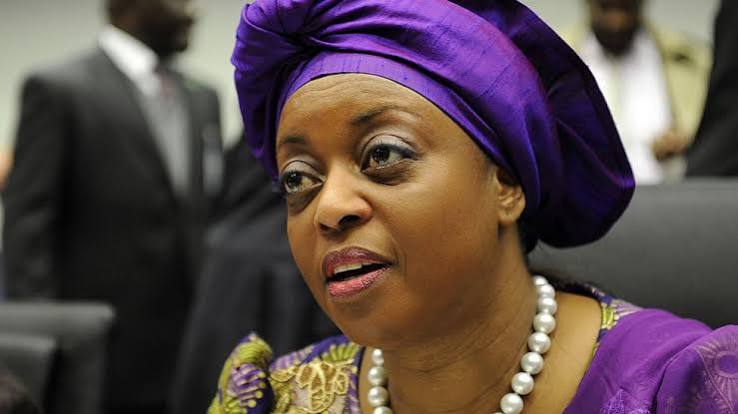
The Economic and Financial Crimes Commission has asked a Federal High Court in Abuja to throw out an attempt by former Petroleum Minister Diezani Alison-Madueke to rely on her London acquittal in her fight to recover forfeited assets.
In a further counter-affidavit before Justice Inyang Ekwo, the commission argued that the acquittal by the Southwark Crown Court was neither material nor relevant to the questions the Nigerian court must decide. It wants the application dismissed.
The affidavit, dated and filed on 5 October, was deposed to by Oyakhilome Ekienabor, a litigation officer in the law firm of EFCC counsel Mofesomo Oyetibo, SAN. According to him, several claims in Alison-Madueke’s application were misleading, immaterial and unconnected to the core issues in the suit.
“The proceedings before the Southwark Crown Court, London, United Kingdom, and the purported acquittal of the applicant therein, are in respect of a proceeding that is not being prosecuted before any Nigerian court and have nothing to do with the substantive suit before this honourable court,” the affidavit stated.
The commission went further on the question of ownership. Ekienabor averred that nothing in the public sale notice at the centre of the suit showed that any of the listed properties belonged to Alison-Madueke. He said the forfeiture order in question related only to jewellery and did not extend to any other category of assets.
He also accused her legal team of trying to stretch the boundaries of the case. The further and supplementary affidavit, he argued, introduced irrelevant facts that diverted attention from the issues properly before the court. On that basis, he urged the judge to discountenance it.
When the matter came up on Tuesday, it was set down for the hearing of the EFCC’s preliminary objection and the former minister’s originating motion. Queen-Ubokutom Uwe, who appeared for Alison-Madueke, told the court the commission had served its latest process only shortly before proceedings began, and reminded the court of a pending motion to regularise her side’s papers.
Paul Mgbeoma, for the commission, expressed surprise at the volume of processes being filed, remarking that the suit was being run as though it were an election petition. He said he was ready to proceed. Justice Ekwo fixed 11 November for the hearing of the motions.
The dispute traces back to events that long predate the London trial. Alison-Madueke, who served as Minister of Petroleum Resources between 2010 and 2015 under President Goodluck Jonathan and later chaired OPEC, left Nigeria in 2015 as the EFCC began moving against her. In the years that followed, Nigerian courts granted interim and final forfeiture orders over assets the commission said were proceeds of unlawful activity.
The scale of those seizures is on record. The EFCC has valued the forfeited jewellery at about N14.4 billion and the forfeited properties at roughly 80 million dollars. A Federal High Court in Lagos ordered the final forfeiture of jewellery, including a customised gold iPhone, valued at 40 million dollars in 2019, and the Court of Appeal affirmed that order in 2021.
Her current suit, marked FHC/ABJ/CS/21/2023, names the EFCC as sole respondent. In it, she challenges the public notice issued for the auction of properties she says affect her proprietary rights. Her case, argued through senior counsel Mike Ozekhome, SAN, is that the commission sought to impose severe proprietary consequences on her without conviction, without fair hearing, and without strict compliance with the statutory rules governing forfeiture and disposal of assets.
The London verdict is what her team now seeks to introduce. On 17 June 2026, after a five-month trial and more than 46 hours of jury deliberation, Southwark Crown Court acquitted her of five counts of accepting bribes and one count of conspiracy to commit bribery. Her brother, Doye Agama, and oil executive Olatimbo Ayinde were also cleared. She had denied all the charges.
Ozekhome’s position is that the acquittal is a subsequent and material development that occurred while the Nigerian suit was pending, bearing directly on the issues of absence of conviction, fair hearing and due process. He has stressed that the court is not being asked to sit on appeal over the foreign judgment or to treat it as automatically conclusive, but to weigh it in doing substantial justice. He argues the fact was not available when her earlier processes were filed.
Justice Ekwo had granted leave on 1 July for the acquittal evidence to be filed, after the application went unopposed at the time. The EFCC’s fresh counter-affidavit now seeks to limit the weight of that material.
The outcome turns on a legal question that remains open. Whether a foreign criminal acquittal can bear on a separate civil forfeiture proceeding in Nigeria is for the court to determine on 11 November. The EFCC has also maintained in earlier filings that the forfeiture orders remain valid and that affected properties were sold in line with due process.