
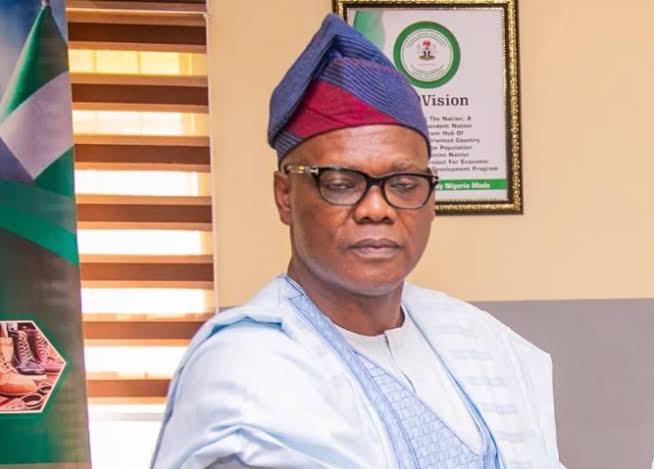
A widening anti corruption inquiry into fictitious government bodies has met a firm rebuttal from George Buchi Nwabueze, who maintains that the office at the centre of the latest scandal is a legitimate special project domiciled in the Presidency since 2010, and not the fake federal agency the authorities have described.
Nwabueze, National Coordinator and Executive Director of the National Brands Development and Made in Nigeria Special Project Office, told Journalist on Sunday that the outfit had never presented itself as an agency. “It has been existing since 2010. It’s a special project. Made in Nigeria is never an agency,” he said. He argued that a programme running for 16 years could not reasonably be described as newly discovered, adding, “How can you discover a 16 year programme in 2026? It means you have been blind.”
His pushback follows a briefing on Friday by the Chairman of the Independent Corrupt Practices and Other Related Offences Commission, Dr Musa Adamu Aliyu, SAN. According to Aliyu, the commission uncovered the office in the course of its investigation into the fictitious Presidential Foreign Intervention Promotion Council. He alleged that the office had been allocated space within the premises of the Office of the Secretary to the Government of the Federation without presidential authorisation and contrary to extant laws, with suspected collaborators inside the OSGF. Aliyu also said Nwabueze operated under several variations of his name, including George Nathan and Prince George Buchi Nwabueze.
Acting on the findings, President Bola Tinubu ordered the immediate arrest of Nwabueze and suspended three Permanent Secretaries, named as M. S. Danjuma, Nadungu Gagare and Richard Pheelangwah, pending investigation. The OSGF is headed by the Secretary to the Government of the Federation, Senator George Akume.
To support his defence, Nwabueze released documents on his LinkedIn page. One is a letter dated 19 July 2010, referenced NIG@50/S.7/C,3/45, purportedly issued by the OSGF to acknowledge a proposal for a “Made in Naija” project tied to Nigeria’s 50th independence anniversary. He also produced an appointment letter dated 3 October 2025, referenced OSGF/MIN/59310/11/205, conveying approval of his role for a five year tenure from July 2025. The letter was signed by the Permanent Secretary, Political and Economic Affairs Office, Nadungu Gagare, one of the three officials since suspended. A separate record indicated that the office had sought special project status from the OSGF in April 2025.
Nwabueze further pointed to a stakeholders engagement in Nasarawa State, where Governor Abdullahi Sule was quoted as saying the state had domesticated the Federal Government’s Made in Nigeria initiative and captured it in its 2026 budget. Checks on the 2026 Appropriation Act, however, showed that the office does not appear as a federal agency or as a separate budgetary line. When contacted, the SGF’s spokesman, Christopher Ugwuegbulam, asked that a formal letter be written to the office before any response.
The dispute is best understood against a broader pattern that has embarrassed the public service this year. The Made in Nigeria office is the latest entity flagged in the fallout from the Presidential Foreign Intervention Promotion Council, whose self styled Director General, Adeniyi Adeyemi Matthew, is facing prosecution over alleged forgery and impersonation. Tinubu had ordered a 30 day probe into that body, and the ICPC submitted an interim report on 6 August 2026. That report reportedly uncovered two further fictitious bodies, the FCT Investment Promotion Agency and the Foreign Investment Promotion Agency and Public Private Partnership, before the trail led to the Made in Nigeria office. In effect, one questionable entity has repeatedly exposed another operating within or around the seat of government.
The recurrence raises questions that extend beyond any single promoter. Investigators are expected to examine not only the individuals involved but the procedural weaknesses that allowed unauthorised entities to secure federal premises, official looking insignia and, in some cases, working relationships with state governments. The commission has said its inquiry into the OSGF is continuing.
What is confirmed at this stage is that the ICPC has classified the office as unauthorised, that the President has ordered an arrest and three suspensions, and that the office is absent from the 2026 budget as a distinct agency. What remains contested is the office’s true legal standing, given the documents Nwabueze has produced and the involvement of serving officials. Those competing accounts will now be tested through the ICPC investigation and any prosecution that follows. Until then, the case stands as a fresh reminder of how easily the appearance of state authority can be assumed, and how difficult it can be to separate a dormant project from an outright fabrication.