
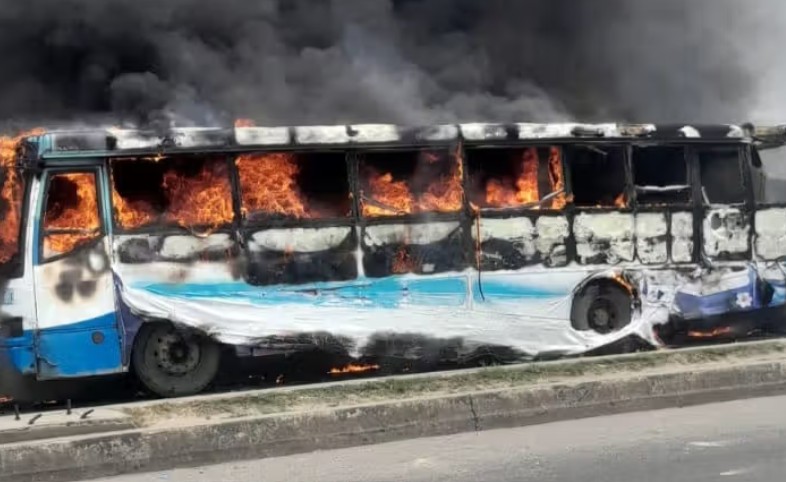
Plumes of acrid black smoke rose above the Ogolonto corridor in Ikorodu as an enraged mob set a Bus Rapid Transit (BRT) vehicle on fire. Minutes earlier, the high-capacity bus had collided with a commercial motorcyclist along the corridor, leaving the rider dead on the tarmac. Before law enforcement personnel could secure the scene or traffic investigators could establish the facts, neighbourhood youths and informal transport operators converged. They attacked the driver—who was rescued by police officers and operatives of the Lagos Neighbourhood Safety Corps—and turned the multi-million-naira municipal asset into an inferno.
This arson in Ikorodu was not an isolated flash of madness. It was an instalment in a predictable pattern of street vengeance across Lagos metropolis. Over the past decade, collisions involving state-franchised transit vehicles have triggered arson, assaults on public drivers, and riots. Official statements from municipal transit managers lament the destruction of public property and recite traffic codes that bar motorcycles from designated transit lanes. Yet this administrative posture evades the core issue. The immediate resort to petrol and matches following a fatal crash exposes a total collapse of public trust in traffic law enforcement, the magistracy, and civic accountability. On the asphalt of Lagos, the social contract has disintegrated into street law.
The violence at Ogolonto cannot be separated from the socioeconomic division between the regulated city and the informal urban underclass. For two decades, Lagos State transport policy has pursued modern transit architecture: segregated corridors, digital payment cards, compressed natural gas buses, and light rail tracks. These investments exist alongside an informal transit sector that moves millions of residents daily. The operators of yellow commercial minibuses, known as danfos, and motorcycle riders, known as okadas, face regulatory hostility. They endure sweeping route bans, task-force raids, vehicle seizures, and routine extortion by both municipal enforcement squads and state-tolerated transport union enforcers.
To the informal operator, the BRT vehicle is not a symbol of civic progress. It is an agent of state-backed displacement. The dedicated lanes carve through congested highways, taking space from the informal transport ecosystem while transit authorities enforce rules with punitive zeal. When a BRT vehicle collides with an okada rider, the incident is no longer a road traffic accident between two drivers. It becomes a lethal encounter between the apparatus of the state and an unprotected, criminalised informal worker. The collective rage of roadside spectators, union touts, and fellow riders erupts because they view the victim as one of their own, discarded by a city that demands their labour but criminalises their means of survival.
This economic resentment connects with an expectation that formal justice will be compromised or evaded. Street vengeance in Nigeria is an informal tribunal of last resort. When a fatal collision occurs, onlookers do not wait for the Federal Road Safety Corps or the police to conduct a forensic investigation. The prevailing belief, shaped by decades of experience, is that once a state-affiliated driver or a government-contracted vehicle is taken into custody, the institutional machinery will close ranks.
The public assumes that the driver will be quietly granted administrative bail, the case file will disappear from the local police station, and the family of an impoverished motorcyclist will receive neither compensation nor a formal inquest. Traffic trials in Nigerian magistrate courts are notoriously slow, costly, and opaque. Citizens observe daily how political figures, security escorts, and privileged motorists drive against traffic, cause fatal crashes, and walk away without legal consequences. The mob acts with sudden violence because it believes that if vengeance is not claimed while the tyres are still warm, no justice will be delivered at all. The fire vetoes a legal system perceived as an instrument of class impunity.
This cycle of violence exposes the administrative failure of the state transport management architecture. The Lagos Metropolitan Area Transport Authority (LAMATA) and its sister enforcement bodies have treated transit expansion as an engineering task, ignoring emergency governance and public orientation. State agencies lack rapid-response protocols for fatal incidents. When a high-impact crash occurs along a segregated corridor, the response window before a crowd turns into a mob is narrow—often less than ten minutes.
The state has no rapid tactical deployment of community mediators, crisis de-escalation officers, or independent crash-investigation teams equipped to secure both the site and the public peace. Instead, the scene is abandoned to regular police units that arrive late, fire tear gas into crowds, and worsen panic. Emergency numbers rarely lead to immediate roadside action. Transit buses carry closed-circuit cameras, but the footage is locked away for administrative inquiries rather than shared to counter misinformation. The state’s communication strategy remains reactionary, issuing press releases about disrupted routes and financial damages without addressing the loss of human life that ignited the riot.
Ending the cycle of lynching and arson requires more than threats of arrest or warnings against taking the law into one’s hands. The state government must overhaul post-crash protocols on all regulated corridors. First, every transit franchise operator must carry mandatory, third-party liability compensation backed by an independent claims tribunal. When a fatality occurs, the state must demonstrate that the family of the deceased will receive independent legal representation and immediate administrative support, removing the perception that the poor are left to bury their dead without recourse.
Second, the state ministry of justice must establish open, expedited coroner inquests for transit-related fatalities. If the driver of a municipal bus is reckless, the prosecution must be public; if the motorcyclist violated right-of-way rules or drove into restricted corridors, the physical evidence must be released promptly to dispel street rumours. Third, transit authorities must abandon their disdain for the informal sector. Transport planning must treat okada and danfo operators as integral stakeholders rather than criminal nuisances.
A modern megacity cannot be built on segregated concrete when the people walking alongside it feel excluded from its protections. Until the ordinary commuter and the roadside artisan trust the police officer, the traffic judge, and the municipal authority to defend their lives with equal dignity, the street will continue to enforce its own law. Each fresh collision will be met not with patience for the rule of law, but with petrol, rage, and fire.