
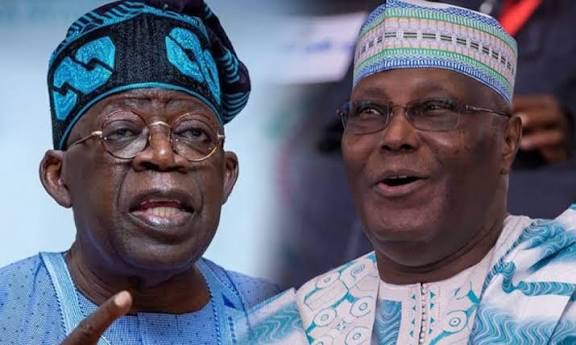
Atiku Abubakar has placed insecurity and the removed petrol subsidy at the centre of his 2027 campaign, promising a rapid security overhaul in his first 100 days in office and vowing to reverse one of President Bola Tinubu’s signature economic reforms, a stance that has already provoked firm pushback from the Federal Government.
Speaking in a Hausa language interview on the PAP show on Wednesday, the African Democratic Congress candidate said his immediate priority would be to expand the number of security personnel and equip them properly. He argued that the country’s worsening violence reflected a failure of leadership rather than a shortage of capacity, recalling that early warnings about the Boko Haram insurgency in Yobe were not acted upon decisively.
He went further on the economy, pledging to restore the fuel subsidy and recover funds he alleged had been stolen since its removal. According to reports of the interview, Atiku said he had not initially opposed scrapping the subsidy but questioned what had become of the savings. “I did not oppose the removal of the oil subsidy, but where is the money?” he asked, insisting that the funds should have gone into health, education and security.
The pledge marks a notable reversal. As the Peoples Democratic Party candidate in the 2023 campaign, Atiku had promised to remove the subsidy within his first 100 days. Tinubu ended the scheme on 29 May 2023, describing it as unsustainable, a decision that pushed petrol prices and the wider cost of living sharply higher. The Federal Government said on Wednesday that subsidy removal and the floating of the naira had generated N15.8 trillion in savings for the federation between June 2023 and December 2025.
The reaction was swift. The Minister of the Federal Capital Territory, Nyesom Wike, dismissed Atiku’s new position and branded him a “voodoo economist”, accusing him of shifting ground for political convenience and asking whether he would pay subsidy on fuel from privately owned refineries. The Presidency, in a statement by Bayo Onanuga, said the promise reflected a man out of step with current economic realities and disputed the roughly N30 trillion in savings Atiku had cited in the interview, describing that figure as imaginary. Omoyele Sowore of the African Action Congress has taken a position closer to Atiku’s, also pledging to restore the subsidy.
The security half of Atiku’s message rests on grim and well documented figures. The National Bureau of Statistics, in its Crime Experience and Security Perception Survey, reported that 614,937 Nigerians were killed in crime related incidents between May 2023 and April 2024, while households paid an estimated N2.23 trillion in ransom to kidnappers over the same period. Nextier’s Nigeria Violent Conflicts Database recorded 4,654 deaths and 3,141 abductions in 1,274 incidents across 2025, with banditry the single deadliest driver at 2,724 deaths, up from 1,585 the previous year. The geography of the crisis is stark. SBM Intelligence found that 2,938 people were kidnapped in the North West between July 2024 and June 2025, more than 60 per cent of the national total, with Zamfara alone accounting for 1,203. Cumulative violence has displaced more than 1.3 million people across the North Central and North West.
That toll has persisted despite rising public spending. Defence and security allocations climbed from N1.97 trillion in 2021 to N5.41 trillion in the 2026 budget, yet independent monitors report little corresponding improvement in safety. It is this gap between spending and outcomes that opposition candidates are seeking to exploit as the campaign takes shape.
Atiku’s fresh bid is his seventh attempt at the presidency, following unsuccessful runs in 1993, 2007, 2011, 2015, 2019 and 2023. The 79 year old former vice president secured the ADC ticket in May by polling 1,846,370 votes in the party primary, well ahead of Rotimi Amaechi with 504,117 and Mohammed Hayatu-Deen with 177,120. In 2023, contesting for the PDP, he finished second with 6,984,520 votes to Tinubu’s 8,794,726.
Several uncertainties remain. Atiku has not spelt out how a restored subsidy would be funded or how it would sit with the Petroleum Industry Act and the deregulated market that has emerged since 2023, questions the Presidency and Wike both pressed. Nor has he detailed the scale of recruitment or the cost of the security expansion he envisages. What is firmly established is that both major camps are now trading positions on the two issues, cost of living and safety of life, that are likely to define the next election. For Nigerians weighing those competing claims, the record on spending and outcomes offers the clearest available yardstick.