
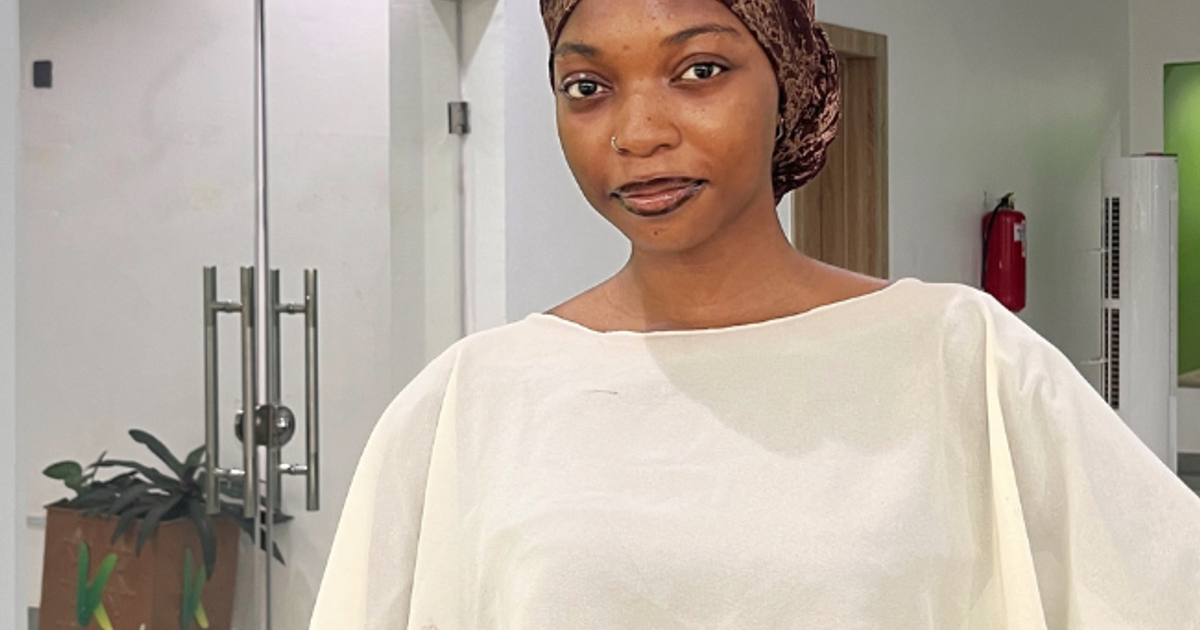
Millions of Nigerians now need their fingerprints to sit an examination, open a bank account or collect a national identity number. For a small number of citizens whose fingerprints never formed, that requirement has turned ordinary transactions into a recurring struggle, a problem brought back into public view by a young woman’s account of living with a rare genetic condition.
The woman, known on Instagram as J for Jidds, described in a video posted at the weekend how she has navigated the country’s identification systems without readable fingerprints. She said she first discovered the condition in 2017 while registering for the Joint Admissions and Matriculation Board, JAMB, examination.
What should have been a routine registration became an all day ordeal. “I stayed there the whole day with my dad. I watched over 200 people register before me,” she said, adding that she wept as officials struggled to capture her prints. According to her account, they tried sand, spirit, methylated spirit, chalk and even watermelon to raise a readable pattern. “I had to scrub my hand on a stone at a point. And then I got to register,” she said.
The difficulties did not end there. During the examination itself, she said the biometric system sometimes verified her on entry but failed to authenticate her on the way out. “Sometimes I would be able to thumbprint in and I will not be able to thumbprint out,” she said. During her National Youth Service Corps, NYSC, programme, she resorted to using her foot for verification because the ridges on her toes were also too faint.
She identified her condition as adermatoglyphia, an extremely rare disorder in which a person is born with absent or greatly reduced fingerprints. Medical literature supports the description. Research published in the American Journal of Human Genetics in 2011, led by dermatologists Eli Sprecher and Peter Itin, traced the condition to a mutation in a skin specific form of a gene known as SMARCAD1. Itin had earlier nicknamed it “immigration delay disease” after a patient was held up trying to enter the United States without prints for identification.
Fingerprints form in the womb by about the seventeenth week of pregnancy. Those with adermatoglyphia have smooth fingertip skin but, according to the researchers, are otherwise healthy, aside from a possible reduction in sweat glands. The condition is inherited in an autosomal dominant pattern, meaning a single copy of the altered gene can pass it from parent to child. It is genuinely uncommon. Only a handful of extended families worldwide have been documented with the isolated form.
That rarity is precisely what makes the Nigerian setting difficult. The woman said she long believed she was alone. “I was born without fingerprints, and for many years, I thought I was the only person with something like this in Nigeria,” she said. After a light hearted post on Instagram, she said almost a hundred people contacted her to report the same issue.
Their experience runs against the direction of official policy. Nigeria has built much of its public and financial infrastructure on biometric identity. The National Identity Number, NIN, issued by the National Identity Management Commission, NIMC, captures ten fingerprints and a facial image, and is now required for banking, JAMB registration, passports, the NYSC and SIM registration. Figures published by NIMC show enrolment passed 130 million by the middle of 2026, against a restructured national target of at least 180 million by 31 December 2026 in a country of about 220 million people.
The banking system rests on similar foundations. The Central Bank of Nigeria made the Bank Verification Number, BVN, compulsory for account holders, and the Nigeria Inter Bank Settlement System reported about 66 million BVN holders by the middle of 2025. For anyone whose fingerprints cannot be read, each of these gateways carries the risk of failure.
There is a workaround. NIMC systems increasingly rely on facial recognition alongside fingerprints, and enrolment can proceed on facial capture where prints cannot be taken. Officials have not published data on how many enrollees fall into this category, and there is no public record of a dedicated policy for citizens with adermatoglyphia or with worn or damaged prints, a group that also includes some elderly people and manual labourers.
For now, the burden falls on individuals to explain a condition most officials have never encountered. The woman’s account has drawn attention less for its rarity than for what it reveals about a system that assumes every citizen carries the same ten marks of identity.