
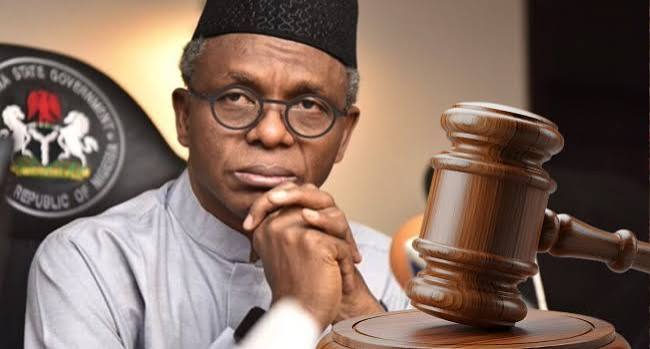
The Federal High Court in Abuja on Monday dismissed a no-case submission filed by former Kaduna State governor Nasir El-Rufai, ordering him to enter his defence in a five-count charge alleging unlawful interception of the telephone communications of National Security Adviser Nuhu Ribadu. Justice Joyce Abdulmalik held that the Department of State Services had placed sufficient evidence before the court to warrant the former governor’s defence. The case was adjourned to November 25, 2026.
El-Rufai had asked the court to discharge and acquit him after the prosecution closed its case with two witnesses. His counsel argued that the evidence did not establish a prima facie case. The prosecution, led by Oluwole Aladedoye, countered that Exhibit B contained an admission by El-Rufai concerning the alleged tapping, and the court agreed that the threshold for a defence had been met.
The charge, marked FHC/ABJ/CR/99/2026, arose from an interview El-Rufai granted on Arise Television’s Prime Time programme on February 13, 2026. During that appearance, he said he had listened to an intercepted call in which the NSA allegedly ordered his arrest. He acknowledged the act’s illegality, adding that the government does the same. “Someone tapped his phone,” he said. “The government listens to our calls all the time without a court order.”
The interview followed an incident at Nnamdi Azikiwe International Airport in Abuja on February 12, when security operatives attempted to arrest El-Rufai on his return from Cairo. He alleged that the Independent Corrupt Practices and Other Related Offences Commission had asked the DSS to abduct him. The DSS has not confirmed that account, and the airport episode remains contested.
The counts draw on two statutes. The first alleges an offence under Section 12(1) of the Cybercrimes (Prohibition, Prevention, etc.) (Amendment) Act, 2024, which carries a maximum of two years’ imprisonment or a fine of N5 million, or both, for unauthorised interception of non-public transmissions. The second alleges a failure to report the individual who carried out the interception, an offence under Section 27(b) of the same Act. The third invokes Section 131(2) of the Nigerian Communications Act, 2003, accusing El-Rufai and others still at large of using technical equipment that compromised public safety and national security.
The case is one of several legal fronts involving El-Rufai. He has been in custody since February and faces proceedings in both Abuja and Kaduna. In July, Justice Abdulmalik rejected his application to vary bail conditions that required him to produce Level 17 civil servants with property in Maitama or Asokoro, along with verification from the Kaduna State Traditional Council. He has also challenged the charge on the ground that a television remark cannot amount to a judicial confession, an argument the court has not accepted at this stage.
El-Rufai served as minister of the Federal Capital Territory from 2003 to 2007 and as governor of Kaduna from 2015 to 2023. His break with the ruling All Progressives Congress has made him one of the most vocal critics of the current administration, and the trial has drawn attention because the complainant is the National Security Adviser, a senior official of the same government. The court has not made any finding on his guilt, and the order to enter a defence does not shift the burden of proof onto him; the prosecution must still establish its case beyond reasonable doubt.
For now, the legal question is whether the evidence supports the charge. The political question, which the court will not answer, is what the trial means for a former governor who once stood at the centre of the governing party and now sits in opposition.