
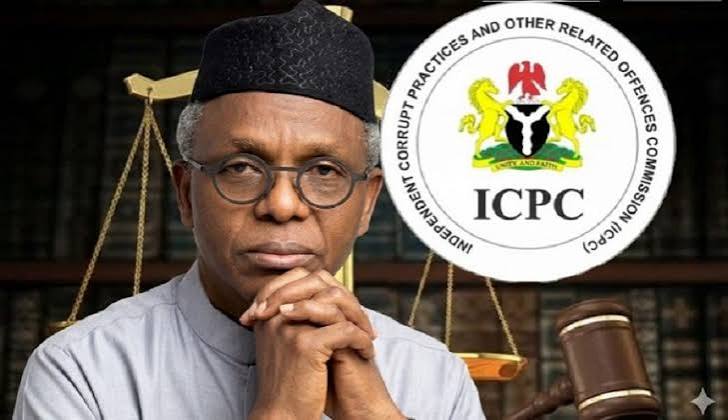
The Federal High Court in Abuja has reserved ruling until 26 October on a no-case submission filed by former Kaduna State governor Nasir El-Rufai, who is standing trial over the alleged unlawful interception of telephone communications belonging to the National Security Adviser, Nuhu Ribadu.
According to the court proceedings on Tuesday, both the prosecution and the defence adopted their arguments before Justice Joyce Abdulmalik. The prosecuting counsel, Oluwole Aladedoye, SAN, told the court the business of the day was for El-Rufai to move his application. Counsel to the former governor, Akinyemi Aremu, said the lead defence lawyer, Paul Erokoro, SAN, had asked for the matter to be stood down as he was still on his way. The judge declined, saying, “I do not do stand downs,” and a co-counsel, Ekere, stepped in.
Ekere first sought an extension of time to regularise the no-case submission, which the court granted, deeming the process properly filed and served. He then urged the court to uphold the submission and discharge his client, arguing that the prosecution had not made out a case strong enough to require any defence at all. Aladedoye asked the court to overrule the application and order El-Rufai to enter his defence, saying the submission had sidestepped what the prosecution described as the defendant’s confession, listed in the record as Exhibit B. In his words, “If they had averred it, they won’t make the no-case submission, so I urge my lord to invite the defendant to open his case.” The judge fixed 26 October for her ruling.
A no-case submission is a routine step in Nigerian criminal trials. The defence argues, after the prosecution has closed its evidence, that the state has failed to establish a prima facie case, and that the accused therefore has nothing to answer. If the court agrees, the defendant is discharged without opening a defence. If it disagrees, the trial continues and the accused is called upon to respond to the charge. The 26 October ruling will decide which of those two paths this case follows.
The charge itself is unusual because it flows from a live television appearance rather than any physical seizure. El-Rufai was arraigned on 23 April 2026 on a five-count amended charge marked FHC/ABJ/CR/99/2026, brought by the Department of State Services on behalf of the Federal Government, and he pleaded not guilty to all counts. The counts allege that he intentionally and unlawfully interfered with and intercepted Ribadu’s communications, secured access to classified information, failed to report the person who carried out the interception, and used technical equipment in a way said to compromise public safety and national security.
The prosecution’s case rests substantially on remarks the former governor made on Arise Television’s prime time programme on 13 February 2026. The charge sheet states that during that interview El-Rufai admitted that he and others had listened to the NSA’s phone conversations, including a directive said to relate to his own arrest and detention. The offences are framed under the Cybercrimes (Prohibition, Prevention, etc) Amendment Act 2024 and the Designation and Protection of Critical National Information Infrastructure Order 2024, which classifies the NSA’s communications as critical national information infrastructure.
Reports of the February interview indicate that when a presenter pointed out that tapping the NSA’s phone was illegal, El-Rufai responded that he was aware, but that the government listened to citizens’ calls routinely without court orders. That exchange, widely circulated at the time, formed the basis of the DSS action. The former governor has consistently denied wrongdoing and has cast the prosecution as politically driven.
The backdrop is a long and public fallout. El-Rufai and Ribadu were allies during the Olusegun Obasanjo administration before falling out, and their relationship has grown sharply hostile since 2025. In earlier Arise TV appearances, El-Rufai accused Ribadu of being behind investigations of his time as Kaduna governor by the Economic and Financial Crimes Commission and other agencies, an accusation the NSA has brushed aside. El-Rufai has since become one of the most prominent opposition figures in the coalition ranged against President Bola Tinubu ahead of the 2027 elections, which has sharpened the political reading of the case.
The trial has also seen shifts along the way. The charge began as a three-count case and was later amended to five counts, and the matter has moved through more than one judge before settling before Justice Abdulmalik. A DSS witness earlier told the court that he was present during the Arise programme and heard El-Rufai make the remarks now at the centre of the prosecution.
For now, the outcome turns on the 26 October ruling. If the no-case submission succeeds, El-Rufai walks free without testifying. If it fails, he will be required to open his defence, and a case that began with words spoken on live television will move into its next and longer phase.