
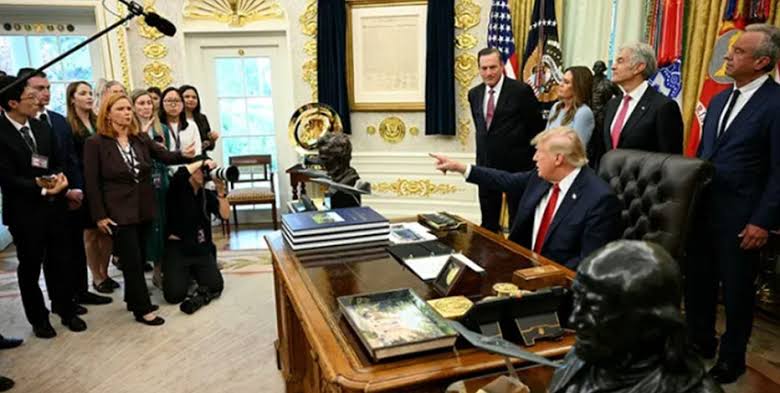
The White House has begun running its own round-the-clock video channel, “Trump TV: The Essentials Station,” on the same day three major news organisations sued the administration over their exclusion from the presidential complex and the networks that normally film the president suspended their shared coverage.
The channel went live on Monday, 21 September, streaming through the White House’s official YouTube page and its website. According to the White House, it carries administration speeches, announcements and public appearances around the clock, described in its own promotional language as the place to watch “the Trump Administration’s biggest moments all in one place.”
It is not a conventional broadcaster. Trump TV is a government-run feed of selected footage, curated and controlled by the White House rather than an independent newsroom. Its opening programming leaned on the archive, including President Donald Trump’s July speech at Mount Rushmore and video from his January 2025 inauguration.
Kaelan Dorr, a deputy assistant to the president, described the channel on X as “a livestream of the Administration’s greatest hits, unfiltered.” That framing sits at the centre of the argument now unfolding, because the launch coincided with a sharp break between the White House and part of the Washington press corps.
CNN, MS NOW and Politico filed a federal lawsuit on Monday challenging the decision to bar their journalists from the White House. The three organisations argue that the restrictions breach their First Amendment rights and have asked a federal judge to restore their access. A hearing on the request was set for Wednesday.
Trump announced the ban on Friday, 18 September, accusing the three of publishing what he called “fake news.” Reporters from the outlets said their press credentials were revoked and they were turned away from the complex over the weekend. The administration’s position is that while the First Amendment protects press freedom, it does not guarantee any particular organisation access to the White House. Vice President JD Vance made the same point, saying the outlets could keep reporting but would lose entry to offices and facilities inside the building.
The dispute quickly spread to the White House television pool, the rotation through which ABC, CBS, CNN, Fox and NBC take turns filming presidential events and sharing the footage with other broadcasters. CNN was due to handle pool duty on Monday, and when the White House prevented it from doing so, the other four declined to step in.
In a message to pool subscribers, Fox News Washington bureau chief Bryan Boughton, who currently chairs the pool, wrote that the pool would not cover events designated as pool coverage of the president, and that there would be “no replacement pool put in place.” In a joint statement, the five networks said the public had “a vital interest in receiving accurate, independent information about its government” and that no administration should restrict an outlet because it objects to its reporting.
The effect was visible within hours. There was no traditional television coverage of several presidential events on Monday, including the unveiling of a new White House helipad. The administration relied on its own feed, but Trump’s remarks were largely drowned out by the noise of a helicopter, with no professional audio setup in place. Print and photo outlets also joined the protest, with several agencies and newspapers holding back images of the president’s appearances through the day.
The confrontation did not come from nowhere. Trump has clashed with sections of the American media across both his terms, and his second term has already produced legal battles with the Associated Press, which was barred after declining to adopt the “Gulf of America” naming in its reporting, and with CBS over an interview edit. What is different this time is the combination of a court challenge, a suspension of the pool that has supplied shared presidential footage for decades, and the debut of a government channel offering the administration’s own version of events.
That last point is where the sharpest disagreement lies. The White House presents Trump TV as a way to bring its main moments directly to the public without depending on the pool. Critics, including California Governor Gavin Newsom, have characterised it as a move towards state-controlled messaging that substitutes official footage for independent scrutiny. Both readings describe the same channel, and which one holds will depend partly on what the courts decide and how long the pool blackout lasts.
For now, three things are settled. The channel is live. The pool has stopped supplying shared video of the president. And the legal question of whether the administration can bar specific outlets over their coverage is headed to a courtroom, with the Wednesday hearing the next fixed point. What remains open is whether the ban survives that challenge, whether the networks resume pool duty, and whether Trump TV becomes a permanent fixture or a product of this particular standoff.