
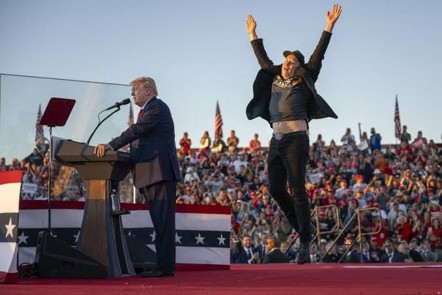
United States campaign spending passes $16 billion as Elon Musk and rival billionaires deploy record sums through super PACs to control Congress ahead of the 2026 elections.
United States political fundraising has breached historic thresholds as total spending for the 2026 election cycle passed sixteen billion dollars, driven primarily by an unprecedented influx of billionaire wealth flowing through independent political action committees.
Federal Election Commission disclosures confirm that traditional candidate committees no longer dominate election strategy, replaced instead by super PACs capable of accepting unlimited corporate and individual donations.
At the summit of this political spending rush stands technology executive Elon Musk, who has emerged as the largest individual donor of the election cycle, directing over four hundred million dollars to conservative campaigns and political groups.
Musk and the Rightward Money Surge
Musk’s financial intervention marks a dramatic shift in American electoral politics, eclipsing historic spending figures recorded during previous national election cycles.
In September alone, Musk transferred 158 million dollars to the Senate Leadership Fund, which promptly redirected resources into regional political operations, including Texas PAC.
That financial influx supported Texas Attorney General Ken Paxton in his defence against Democratic contender James Talarico, illustrating how national billionaire wealth actively shapes key legislative races.
Musk’s financial alignment with the Republican establishment comes after earlier public disagreements with party leadership and suggestions that he might form an independent political movement.
Escalating Super PAC Rivalries
The Republican campaign machine has built a substantial financial advantage in national legislative contests, supported by both individual mega-donors and corporate interest groups.
While the Democratic-aligned Senate Majority PAC reported a group record of 354 million dollars, the Republican-affiliated Senate Leadership Fund countered with more than 540 million dollars raised over the same period.
Campaign finance records show that President Donald Trump’s political network, centred on MAGA Inc., holds hundreds of millions of dollars in reserve to protect congressional majorities.
Donations to MAGA Inc. include multi-million-dollar contributions from casino developer Steve Wynn, financial executive Stephen Schwarzman, and industrialist Diane Hendricks, alongside a one-million-dollar donation from GEO Reentry Services, a subsidiary of a private prison operator with federal immigration facilities contracts.
To offset the Republican funding surge, former New York City Mayor Michael Bloomberg announced a late 80-million-dollar infusion to assist Democratic candidates, while Democratic mega-donor George Soros channeled over 100 million dollars into Democracy PAC structures supporting progressive legislative efforts.
Despite the total funding gap, campaign strategists note that Democratic money frequently achieves greater purchasing power because direct candidate committees receive lower, legally protected advertising rates on local broadcast television compared to independent super PACs.
Artificial Intelligence in Campaign Media
Beyond funding records, the 2026 midterms mark the first major election cycle to witness widespread deployment of cheap artificial intelligence tools in political advertising.
Campaigns and political action committees have deployed digitally generated video advertisements depicting candidates in fictitious situations designed to mislead viewers.
Recent political broadcasts feature fabricated sequences showing a legislative candidate driving undocumented migrants to polling locations, a gubernatorial candidate seizing cash, and a congressman in fabricated personal scenarios.
Federal regulators have yet to establish clear legislative guidelines governing synthetic media in political campaigns, leaving digital platforms to moderate political content under varying internal policies.
As final campaign disclosures prepare for release after Election Day, the election highlights the growing power of non-candidate organizations and hyper-wealthy individuals in directing public political discourse.