
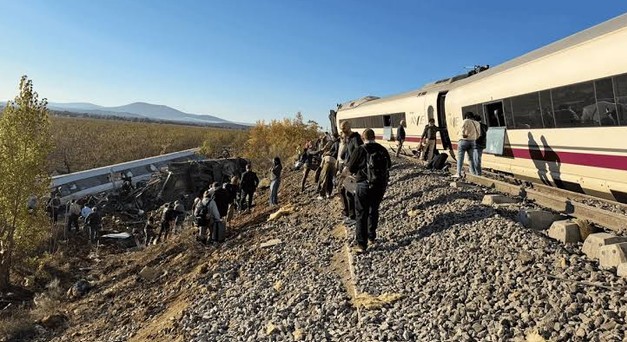
Two high-speed passenger trains carrying 544 people collided near Urda in Toledo province on Wednesday, killing at least 30 passengers and injuring dozens more. A state-owned Renfe AVE train ran into the back of a stationary private Iryo service along the main line connecting Madrid and Seville. The impact forced multiple carriages off the tracks and down a steep embankment near kilometre 118. Rescue crews continue working through the mangled wreckage to recover victims as emergency responders warn the death toll will rise.
Technical failures within the automated signalling network forced operators to switch to manual traffic controls shortly before the collision occurred. A failure in the main signalling apparatus caused the Iryo train to come to a halt on the track. Initial government reports suggest human error by a rail infrastructure operator allowed the trailing AVE train to proceed along the same occupied line. State safety investigators from the independent transport accident agency have opened a formal inquiry to confirm the precise failure chain.
Emergency services transformed a local sports hall in nearby Urda into a temporary triage centre and field shelter to manage the sudden influx of victims. Medical teams dispatched three rescue helicopters, intensive care ambulances, and specialised military units to assist local firefighters at the crash site. Local residents gathered along the tracks to distribute clean water and help emergency workers pull survivors from twisted metal carriages. Prime Minister Pedro Sánchez expressed deep shock over the disaster while main political parties suspended upcoming election campaign events.
The violent impact derailed two carriages from the Iryo train and one carriage from the trailing Renfe train, scattering debris across the rural corridor. National rail operator Adif immediately suspended all high-speed rail services between Madrid, Ciudad Real, and the southern region of Andalusia to clear the tracks. Transport Minister Óscar Puente set up an emergency command post in Madrid to oversee the regional response and coordinate infrastructure clearing efforts. Transport officials face mounting pressure from industry unions over the safety protocols used during manual signal overrides.
Wednesday’s collision represents the second catastrophic rail disaster to hit Spain’s extensive high-speed network within the past ten months. A similar crash in January at Adamuz in Córdoba province killed 46 people when a derailed passenger train hit oncoming traffic. Public confidence in the country’s flagship rail network has suffered a massive blow following these recurring technical and operational failures. Industry experts demand immediate audits of signalling hardware and manual override protocols across all European high-speed lines.
Spain operates the largest high-speed rail network in Europe, carrying over 25 million passengers annually across thousands of kilometres of track. Rail administrators must now balance immediate accident clean-up operations against widespread public demands for structural safety overhauls. Families of the victims await official identification lists as medical teams work through the night to treat critically injured survivors. The disaster underscores the fatal consequences of mechanical failure coupled with human operational errors on high-speed transport networks.