
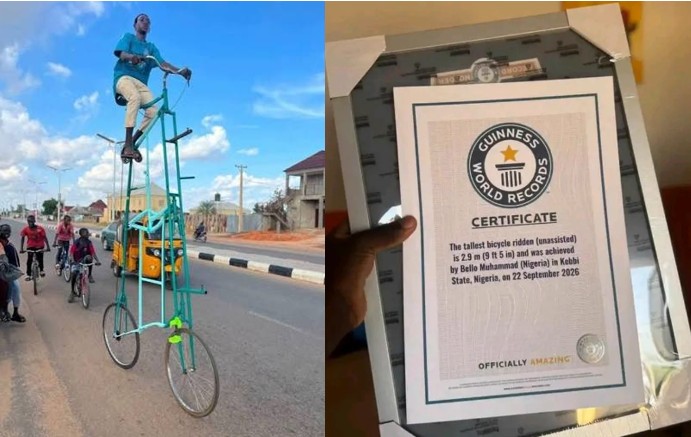
As a young Nigerian cyclist secures a Guinness World Record with a custom-built 2.9-metre bicycle, experts examine how unlocking the nation’s grassroots creative genius could redefine its economic future.
Observing from below, the contraption looked less like a bicycle and more like a mobile observation tower. Standing nearly three metres tall, the custom-built machine required an extraordinary balancing act to mount, let alone propel across open ground. Yet for Bello Muhammad, scaling those heights was only the beginning of a remarkable journey that would soon capture international attention.
Operating entirely on his own power, Muhammad balanced atop the towering frame on September 22, 2026, navigating the terrain in Kebbi State to secure a place in the record books. Official confirmation from Guinness World Records transformed a local engineering feat into a global milestone for Nigerian craftsmanship.
The achievement brought a wave of public celebration to the Kebbi State Government Secretariat in Birnin Kebbi, where state administrators gathered to honour the young builder. For an audience accustomed to navigating the grinding pressures of economic hardship and political fatigue, the spectacle of a self-taught inventor conquering physical limits offered a refreshing narrative of raw human potential. But beyond the immediate spectacle of a towering bicycle lies a much deeper economic question for Africa’s most populous nation: what happens if Nigeria finally learns to commercialise its vast ocean of native brilliance?
Craftsmanship Born of Necessity
Long before state officials and association patrons crowded around to inspect the official certificate, the creation took shape in a modest workshop environment far removed from corporate research laboratories. Abubakar Kalgo, patron of the Kebbi State Equity Cyclist Association, explained that Muhammad designed and fabricated the entire mechanical structure entirely by hand.
Fabricating a bicycle standing 2.9 metres high demands precise geometric alignment, structural calculations, and meticulous welding to ensure integrity under rider weight without heavy industrial machinery. More daunting than the fabrication itself was the physical execution; mounting, riding, and successfully dismounting a machine of that scale without external assistance requires a rare blend of athletic balance and fearless concentration.
In a country where brilliant young minds frequently encounter infrastructural roadblocks, erratic power supplies, and institutional neglect, Muhammad bypassed conventional limitations through sheer resourcefulness. Instead of waiting for formal venture capital or imported technology, he relied on local materials and personal ingenuity to forge a path straight into global recognition. His workshop is a microcosm of a wider national reality: millions of young Nigerians are constantly inventing solutions out of thin air, driven by necessity and an unyielding will to survive.
Bruised by years of economic mismanagement and a heavy reliance on a single volatile commodity, Nigeria stands at a historic economic crossroads. For decades, national budgets have risen and fallen on the tides of crude oil revenues, leaving the country vulnerable to external market shocks while stifling domestic enterprise.
Yet, as global markets transition toward a knowledge-driven digital economy, the nation’s true unexploited crude is its human capital. Creative geniuses, grassroots inventors, software developers, and independent engineers represent an untapped economic frontier. When individuals like Muhammad utilise scrap metal and raw intuition to create world-class achievements without institutional backing, it demonstrates an extraordinary baseline of productivity waiting to be unlocked.
Economists have long argued that sustainable national wealth cannot be imported; it must be engineered from within. If Nigeria were to systematically identify, fund, and protect these pockets of grassroots innovation, the macroeconomic implications would be transformative. Transforming backyard workshops into structured micro-industries would create millions of skilled manufacturing and technology jobs, shifting the nation from a passive consumer market into a robust exporting powerhouse.
The Economic Dividend of Opportunity
Imagine a Nigeria where raw talent meets institutional architecture. If public administration moves beyond token cash gifts and occasional photo opportunities to build functional incubation hubs, technical schools, and accessible venture credit lines, the country’s economic landscape would undergo a profound metamorphosis.
In this future Nigeria, local fabricators would receive patents for their designs, turning informal roadside mechanics into certified industrial manufacturers. Tech prodigies would scale their software solutions across continental free-trade zones without fleeing to Silicon Valley or Europe. Creative geniuses would no longer have to fight against the very system they are trying to uplift.
Instead of an economy driven by imports and rent-seeking, Nigeria’s future GDP would be propelled by intellectual property, home-grown machinery, green energy solutions, and localised manufacturing. The economic multiplier effect of supporting local creators is immense: every successfully scaled invention creates ancillary service jobs, revitalises regional supply chains, and attracts foreign direct investment eager to tap into African innovation.
Recognition at the Crossroads
The formal presentation of the Guinness World Records certificate at the Kebbi State Secretariat symbolised a rare moment where grassroots talent intersected directly with public administration. Accepting the papers on behalf of Governor Nasir Idris, Head of Service TPL Malami Shekare praised the cyclist for demonstrating what perseverance can achieve when combined with native talent, accompanying the praise with a monetary donation of one million naira.
While such gestures provide immediate validation, the broader challenge remains systemic. Government representatives and policy architects must recognise that occasional financial awards are insufficient substitutes for comprehensive structural reform. The true test of leadership lies in building sustainable pipelines—such as specialised technical grants, patent protection offices in every state, and reliable power grids—that ensure future innovators do not have to battle systemic failure to build a bicycle.
As word of the feat continues to circulate across digital platforms and local networks, Muhammad’s towering ride stands as an enduring metaphor. It proves innovation can rise above adversity, one rotation of the pedal at a time. The real question facing Nigeria’s leaders is whether they will catch up to the speed of their own youth, or let another generation of brilliance pedal into the distance.