
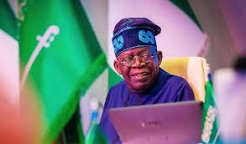
President Bola Tinubu has declared that Nigeria’s economy has moved from stabilisation to what he called shared prosperity, telling an Abuja audience on Thursday that the painful reforms of his first years in office are beginning to pay off. He set a target of a one trillion dollar economy by 2030 and described the moment as proof that the country has left the “emergency ward.”
He was speaking at the public presentation of a book on economic diversification written by the Kano lawmaker Abdulmumin Jibrin Kofa, held at the State House Conference Centre with Anambra governor Charles Soludo as keynote speaker. Tinubu said his government had chosen “reform over ruin,” pointing to the removal of fuel subsidy and the unification of the exchange rate as the decisions that reshaped public finances. He conceded the weight those choices placed on households, but insisted the pain was now yielding its promise.
The President anchored his case on a set of headline figures. He said non-oil exports had crossed six billion dollars, the highest in the country’s history, while external reserves had risen to about 55 billion dollars, enough to cover more than fourteen months of imports. He added that non-oil revenue grew from 13.63 trillion naira in 2023 to 16.4 trillion naira in the first half of 2026, and that non-oil activities now account for roughly 96 per cent of national output.
Those claims align closely with official data. The National Bureau of Statistics put real growth at 4.43 per cent in the second quarter of 2026, the strongest quarterly reading in a year, with the non-oil sector contributing 95.84 per cent of output and oil just 4.16 per cent. The Nigerian Export Promotion Council earlier confirmed non-oil exports of 6.1 billion dollars in 2025, up about 11.5 per cent on the previous year, helped in part by the weaker naira that followed the 2023 currency reforms. Central bank records show reserves climbing steadily through the year, passing 50 billion dollars by mid-year and reaching about 52.66 billion dollars by August.
Tinubu also said his administration had “fought for Mambilla,” citing a 3.38 billion dollar arbitration outcome at the International Chamber of Commerce in Paris that he said freed a project stalled for more than nine years. A tribunal did rule in Nigeria’s favour in September, rejecting claims by Sunrise Power and Transmission Company. The 3.38 billion dollar figure, however, is a combined estimate of two related claims, and senior government lawyers have offered differing accounts of what the award actually covered, with a separate claim reported to be still unresolved.
On power and infrastructure, the President said Geregu Power was moving to raise capacity to 1,300 megawatts and that the Port Harcourt and Warri refineries were stirring back to life. He listed road and rail projects spread across the country, including the Lagos to Calabar coastal highway and the Kano to Maradi railway, and said 52 per cent of legacy highway mileage lay in the North and 48 per cent in the South, a split he presented as deliberate balance.
He pointed to housing and social programmes as evidence that the recovery was reaching households. More than 10,000 homes, he said, are rising across fourteen states and the Federal Capital Territory under the Renewed Hope programme, while a MOFI real estate fund had provided about 128 billion naira in mortgages to 1,859 families at a fixed rate of 9.75 per cent over twenty years. He also cited the student loan scheme, the 3MTT digital skills drive and 90,000 kilometres of fibre optic cable, arguing that private enterprise, not government, must build the trillion dollar economy.
The optimism sits against a harder backdrop that the President touched only lightly. Inflation, though easing through 2026, has stayed close to 15 per cent, food prices remain high in many states, and industrial growth slowed sharply to 3.96 per cent in the second quarter from 7.46 per cent a year earlier. In dollar terms the economy is still valued at roughly 240 to 280 billion dollars after the recent rebasing, which makes the trillion dollar goal a steep climb within four years. Even sympathetic analysts place that mark closer to 2031.
Whether the figures Tinubu cited translate into relief that ordinary Nigerians can feel remains the open question. The government insists the foundations are now permanent and the hardship temporary. For millions still weighing the cost of transport, food and rent, the promise of shared prosperity will be measured less by reserves and growth charts than by what reaches the dining table.