
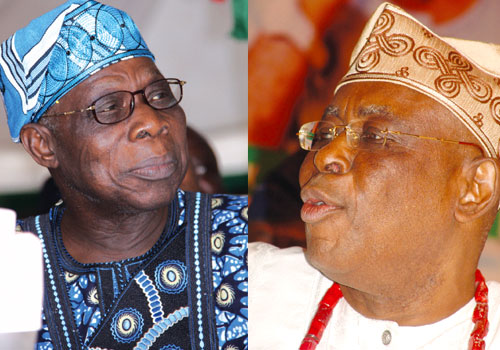
Twenty three years after the Alliance for Democracy lost five of the six states it controlled in the South West, former President Olusegun Obasanjo has reopened one of the Fourth Republic’s most contested political arguments, rejecting claims by former Ogun State Governor, Aremo Olusegun Osoba, that he deceived Yoruba political leaders ahead of the 2003 general elections, and accusing his former deputy of financing an impeachment plot against him.
The rebuttal came in a lengthy letter dated July 23, 2026, addressed to Osoba in Abeokuta and titled “Reply to Your Inaccurate Posture: ‘How Obasanjo Deceived Us in 2003’.” It was written in response to an article published by the former governor in The Legal Observer on July 20, 2026, in which Osoba restated the long standing position of Afenifere and AD leaders that Obasanjo obtained their backing for his re election under a gentleman’s agreement and then presided over their political liquidation.
Obasanjo did not accept the framing. “There are many things you got wrong and many things you omitted advertently or inadvertently in your write up carried in The Legal Observer of July 20, 2026,” he wrote. “Your presentation in your write up was farfetched to put it mildly.”
He reserved his sharpest objection for the central charge. “I take strong and serious objection to your calling me a deceiver because I deceived nobody. I always presented my case and all issues as I had them and as I understood them, no matter whose ox is gored,” he said, adding that Osoba was not privy to key negotiations. “There were issues you did not know or understand because, as you pointed out, they were above your head. They were handled by your elders in Alliance for Democracy and Afenifere.”
The dispute is anchored in the arithmetic of two elections. At the return to civil rule in 1999, the AD swept all six South West states, Lagos, Ogun, Oyo, Osun, Ondo and Ekiti, while Obasanjo, running on the platform of the Peoples Democratic Party, polled 18,738,154 votes against 11,110,287 for Chief Olu Falae, the joint candidate of the AD and the All Peoples Party. Obasanjo lost his own geopolitical zone despite being a Yoruba man from Abeokuta, a fact that shaped the politics of the years that followed.
By the April 19, 2003 presidential election, the picture had shifted decisively. Obasanjo secured 24,456,140 votes, representing 61.94 per cent, against 12,710,022 votes, or 32.19 per cent, for Muhammadu Buhari of the All Nigeria Peoples Party. Chukwuemeka Odumegwu Ojukwu of the All Progressives Grand Alliance polled 1,297,445 votes. Of a registered electorate of 60,823,022, turnout stood at roughly 69 per cent, the highest recorded in Nigeria since 1999. Buhari’s petition against the outcome was dismissed by the Presidential Election Petition Tribunal on December 20, 2004, and the Supreme Court affirmed that ruling on July 1, 2005.
In the governorship contests that accompanied that cycle, the PDP took five of the six AD states. Osoba lost Ogun to Gbenga Daniel, Lam Adesina lost Oyo to Rashidi Ladoja, Bisi Akande lost Osun to Olagunsoye Oyinlola, Adebayo Adefarati lost Ondo to Olusegun Agagu and Niyi Adebayo lost Ekiti to Ayo Fayose. Only Bola Ahmed Tinubu, then Governor of Lagos State and now President, survived. That single outcome reordered South West politics and laid the foundation for the political structure that eventually produced the All Progressives Congress.
Obasanjo used the letter to retrace how he entered partisan politics after his release from prison in 1998. He said the first delegation urging him to run met him at his Ota farm under the leadership of Lawan Katsina, followed by a group headed by the late Chief S.M. Afolabi and a third led by the late Dr Martins Kuye. Because the later delegations were largely Yoruba, he said he insisted on wider national consultation.
He listed the elders he approached, among them the late Chief Meredith Akinloye, the late Chief Bola Ige, the late Chief Richard Akinjide, Professor Oyeleye, the late Sunday Awoniyi, the late Adamu Ciroma, Professor Anezi Okoro and Arthur Mbanefo. “That quick consultation was like a sounding board. It gave me a quick and good feel,” he said.
On his dealings with the late Afenifere leader, Chief Abraham Adesanya, Obasanjo was blunt about the rejection he faced. “On three occasions, I visited Chief Abraham Adesanya, and on the three occasions, he vowed that the Yoruba would not vote for me. I never stopped calling on him to report and to campaign,” he wrote, adding, “There was no time I called on Papa Adesanya that I was not well entertained. Yet Papa stood on no vote for me, and I stood on my respect and what was due to him.”
He said Adesanya urged him to join the AD but that he declined on ideological grounds. “I told him that AD as essentially a tribal party was in a cul de sac,” he stated.
Obasanjo defended his post 1999 decision to bring AD figures into his government, rejecting the suggestion that it was a survival tactic. “Bringing PDP and AD to join me for a sort of national government was not out of weakness; rather, it was out of strength and for the unity and progress of the country,” he said. His stated motive, he added, was integration. “My position was simple: the Yoruba had been in the periphery for so long; let them come to the mainstream.”
He also dismissed as implausible any suggestion that six opposition governors could have steered his administration. “Six to dictate to thirty is ridiculous. I had an Executive Council, I had a National Assembly, I had a virile political party, 21 governors and nine other governors from another party with my government,” he wrote.
Obasanjo insisted the AD losses were genuine, with one exception he did not fully explain. “Your loss or defeat in 2003 was genuine in all the six states except the one where the figures were successfully and murderously changed as Chief Tinubu, the Head of Service in Lagos State then, accurately reported to me. I took it as what God allowed,” he wrote.
He went further, questioning the vigour of Osoba’s own campaign. “From information that reached me from the political field, you barely campaigned, and at the tail end of the campaign, you went on TV to apologise to the people for your arrogance and informed them that the starch in your agbada caused your arrogant appearance,” he said.
It should be noted that this remains a contested account. Osoba and other AD leaders have consistently attributed the 2003 reversal to the deployment of federal power, and the former governor’s version, set out in his 2019 memoir “Battlelines: Adventures in Journalism and Politics” and repeated in his latest article, has never been withdrawn.
The most consequential passage of the letter concerns the 2002 impeachment move against Obasanjo by the House of Representatives under the late Speaker, Ghali Umar Na’Abba, which saw the chamber issue a lengthy list of allegations and demand the President’s resignation.
Obasanjo alleged the plot originated inside the presidency. “Na’Abba’s impeachment began at the presidency by the Vice President, who on a Friday when I was out of the office, invited Na’Abba to his office and convinced him, as he had convinced himself and some others but of insignificant number, that I should have only one term as President and this was the act of a man I brought up from governorship to Vice President,” he wrote.
He put a figure on the alleged transaction. “On the Friday, he invited Na’Abba; he gave him N5 million to begin his impeachment work. It was all noted, recorded and reported to me by my Chief of Staff, a professional intelligence officer,” Obasanjo said, adding, “The game continued to be played on with me treating it with contempt as I have committed no impeachable offence except my Vice President who wanted to take over by hook or by crook.”
He said the late President Shehu Shagari intervened voluntarily to defuse the crisis, and that he granted him a free hand to do so.
Obasanjo also alleged a second manoeuvre after the impeachment bid collapsed. “When he failed in the impeachment exercise, he made a two track approach: one to go with Alex Ekwueme and Alex to hand over to him in the third year of his presidency; second is for the six AD governors of South West not to have competition from any other party in 2003 so that in 2007, you would all yield the field to my Vice President,” he wrote, telling Osoba, “You were all convinced of this anti democratic plan, and you all fell for it.”
As of the time of filing, no public response from Atiku Abubakar to the specific allegation had been reported. The claim, like several others in the letter, rests on Obasanjo’s own account and has not been tested in any court or public inquiry.
The timing places a decades old quarrel directly inside a live electoral season. The Independent National Electoral Commission has scheduled the next presidential election for February 20, 2027, with formal campaigning due to open in September 2026. President Tinubu, the last AD governor standing in 2003, secured the All Progressives Congress ticket in May 2026 with 10,999,162 votes. Atiku, the man Obasanjo accuses in the letter, emerged as candidate of the African Democratic Congress in the same month, polling 1,846,370 votes out of 2,527,977 cast in a direct primary, ahead of Rotimi Amaechi with 504,117 votes and Mohammed Hayatu Deen with 177,120 votes. It is his seventh attempt at the presidency. The opposition remains fragmented, with Peter Obi having moved to the Nigeria Democratic Congress alongside Rabiu Kwankwaso.
Obasanjo, now 89, and Osoba, 87, are among the last surviving principals of the events they are debating. Many of the figures named are deceased, including Adesanya, Ige, who was assassinated in December 2001 while serving as Attorney General, Na’Abba, who died in December 2023, and Chief Ayo Adebanjo, who died in February 2025. Obasanjo claimed that several Afenifere leaders privately expressed regret to him before their deaths, an assertion that cannot now be independently verified.
He was unsparing about the movement itself. “Afenifere and its political party never rose beyond tribal cul de sac. There is a lesson for all in that. And it would appear that once you were not an AD or Afenifere member, you would be a liar or a deceiver,” he wrote. “If you failed to follow my line, you must be maligned and set out as an enemy. I have never believed in tribal politics.”
For all its sharpness, the letter closed on a conciliatory register. Obasanjo credited Osoba with allocating the land on which the Olusegun Obasanjo Presidential Library now stands in Abeokuta. “The greatest service you rendered for me and for Abeokuta is the land allocated for the Olusegun Obasanjo Presidential Library. It has become the most significant landmark in Abeokuta,” he said.
He ended with an appeal to perspective. “In politics, no one should be ignored or disregarded, and politics may end, relationships may live till life’s end,” he wrote. “It is not over until it is over and there is no end to humility and thanksgiving.”
Whether Osoba responds, and whether Atiku answers the N5 million allegation, will determine how far this exchange travels into the 2027 campaign season.