
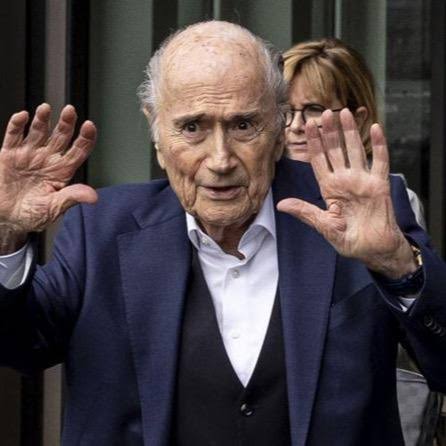
Football’s governing body is facing one of its most awkward credibility tests in years, and the man raising the loudest alarm is one who once sat in its highest office. Former FIFA President Joseph “Sepp” Blatter waded into the storm on Monday over the decision to lift United States forward Folarin Balogun’s red card suspension, warning that the game “must never become a playground for political power.”
His intervention landed just days after United States President Donald Trump publicly thanked FIFA President Gianni Infantino for a decision that cleared Balogun to feature in the Americans’ FIFA World Cup Round of 16 clash against Belgium. That sequence, a presidential thank-you followed by a striker’s sudden reprieve, has left many in the football world uneasy, and Blatter gave voice to that discomfort in blunt terms.
Writing on X, the 89-year-old Swiss did not mince words. “Red cards are not overturned by political phone calls. They are overturned by rules, evidence and independent bodies. If a U.S. President intervenes with the FIFA President and a player is suddenly cleared before a World Cup knockout match, the question is unavoidable: Quo vadis, FIFA? Football must never become a playground for political power,” he wrote, tagging Infantino, Trump and the World Cup in his post.
The Latin phrase he reached for, “Quo vadis,” meaning “where are you going,” carried the weight of a man who understands FIFA’s inner workings better than most. Blatter led the organisation from 1998 until 2015, when he departed amid the sprawling corruption investigations that engulfed world football and eventually ended his own reign. That history gives his warning an unmistakable irony, but it also lends it a certain authority, since few know as intimately how perception and power operate inside the Zurich headquarters.
The controversy itself traces back to Balogun’s dismissal in the 64th minute of the United States’ 2-0 group-stage victory over Bosnia and Herzegovina, where he was shown a straight red card after replay officials sent the referee to the monitor for a foul on defender Tarik Muharemovic. Under normal circumstances, a straight red carries an automatic one-match ban with no appeal, as is standard practice. What followed was anything but standard.
FIFA announced on Sunday that the suspension would be “suspended for a probationary period of one (1) year,” invoking Article 27 of its disciplinary code, which allows a judicial body to fully or partially suspend the implementation of a sanction. In plain terms, the punishment was frozen rather than erased, but the practical effect was that Balogun became available for the knockout tie. For a straight red card at a World Cup, such a reprieve is almost unheard of.
What turned a disciplinary technicality into a political controversy was Trump’s involvement. Multiple international outlets, including The New York Times and the Associated Press, reported that Trump telephoned Infantino during the week to ask why Balogun had been sent off and to request a review of the ban. After FIFA acted, Trump took to social media to celebrate the reversal of what he described as an “injustice,” though he stopped short of claiming he had influenced the outcome. Reports further indicated that United States officials, including figures connected to the White House task force for the tournament, had helped assemble the legal case put before FIFA.
FIFA, for its part, has consistently maintained that sporting sanctions are decided solely by its independent judicial committees and not by the FIFA President or the organisation’s political leadership. That defence, however, has done little to quiet the disquiet, and the timing of events has fed a perception problem that Blatter argues is damaging in its own right, regardless of the legal reasoning behind the decision.
He is far from alone. The Union of European Football Associations, UEFA, delivered a scathing rebuke, describing the move as “unprecedented, incomprehensible and unjustifiable” and warning that “when the certainty of rules is no longer guaranteed by its guardians, the integrity of the game is at stake and the credibility of a competition is undermined.” Belgium’s football federation said it was “astonished” by the about-face and confirmed it was “investigating all potential options,” with reports indicating FIFA subsequently granted the Belgians the right to appeal before a member of its appeals committee. Belgium coach Rudi Garcia captured the mood of European frustration with a sardonic jab, suggesting the 5th of July had somehow become the 1st of April.
The affair has also drawn attention to the unusually close relationship between Trump and Infantino, who have appeared together publicly on several occasions. FIFA awarded Trump its inaugural “FIFA Peace Prize” at the World Cup draw in December, and the American president is expected to play a role in the trophy presentation at the final on July 19. Those optics have only sharpened the questions Blatter and others are asking.
For all the outrage, FIFA’s defenders point out that deferring or suspending disciplinary sanctions is not entirely without precedent. The organisation deferred part of a ban for Portugal’s Cristiano Ronaldo late last year, and earlier in 2026 similar deferrals were applied to Argentina’s Nicolas Otamendi and Ecuador’s Moises Caicedo, allowing them to feature in World Cup openers. Critics counter that none of those cases unfolded in the glare of a knockout tie at the tournament proper, nor against the backdrop of a phone call from a head of state.
There is history here too. Older observers have recalled the case of Brazil’s Garrincha, ejected from a 1962 World Cup semi-final yet permitted to play in the final against Chile after political pressure was brought to bear. That episode, more than six decades old, is a reminder that the tension between football’s rules and political influence is not new. What has changed is the scale of the global audience now watching, and the speed with which a single social media post can crystallise public suspicion.
Balogun’s own story sits quietly at the centre of the noise. Born in Brooklyn to Nigerian parents who were living in London, the 25-year-old Monaco striker represented England at under-21 level before switching his allegiance to the United States in 2023. He arrived at this World Cup as the Americans’ leading marksman, and it is precisely his importance to the team that made his availability worth a fight.
As of the time of filing, neither FIFA nor Infantino had publicly responded to Blatter’s remarks. The organisation now faces a familiar bind: defend a decision it insists was lawful, while managing a perception that its independence bent to political weight at the worst possible moment. For a body that has spent the past decade trying to rebuild trust after the scandals that swept Blatter himself from power, the Balogun affair is a reminder of how quickly that trust can be called into question.