
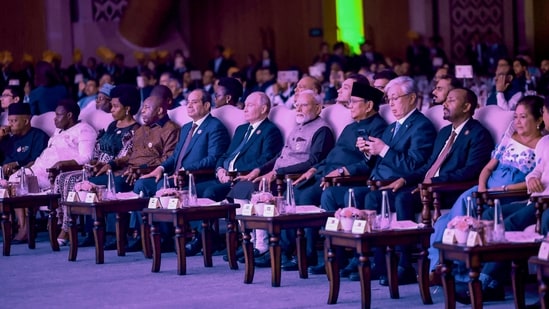
Leaders of the expanded BRICS club resolved to speed up investment in BRICS Pay at their eighteenth summit in New Delhi on 13 September. The platform seeks to link the domestic payments systems of member states and let them settle trade in their own currencies. By avoiding the American dollar, the group hopes to blunt the sting of Western sanctions. Moscow has led this campaign since Western capitals kicked major Russian lenders off the SWIFT messaging network in 2022. Yet the project reveals as much about the bloc’s internal fractures as its shared ambitions. The alliance now includes eleven countries that hold nearly half the world’s population and two-fifths of global output. Even so, building a shared financial pipe across disparate economies is a formidable task. Grand political declarations often founder on the stubborn arithmetic of global finance.
The project started under the BRICS Business Council in 2018 before gaining formal endorsement in 2024. Finance ministers and central bank governors met in Jaipur in August to refine the design ahead of the New Delhi talks. Andrey Mikhaylishin, who runs BRICS Pay, insists the project does not aim to kill the dollar. He frames the platform as a handy decentralised bridge for retail tourists and corporate settlement. Users can make cross-border retail payments through mobile software, digital wallets, and QR codes. Russian shoppers might use Mir, Indians can tap UPI, and Brazilians can rely on Pix. Such domestic rails work well inside national borders. Linking them across eleven legal codes and distinct foreign exchange regimes is another matter entirely.
The immediate appeal lies in self-defence against Western financial muscle. Washington and European capitals turned the Society for Worldwide Interbank Financial Telecommunication, or SWIFT, into a tool of economic warfare. The Belgian co-operative serves 11,000 institutions and handles the bulk of global trade messages. Cutting Russian banks off from that directory raised settlement costs and gummed up trade with partners like China and India. Emerging powers observed that punishment and drew an obvious conclusion. If they stay on Western networks, they remain vulnerable to Western diplomatic whims. Many governments want a spare tyre for global finance. Complete reliance on a single Western utility looks increasingly imprudent.
National self-interest complicates the dream of a unified monetary front. The bloc is not a tight club of identical economies. China, India, Brazil, the United Arab Emirates, and Iran run vastly different trade models and capital controls. India guards its financial sovereignty jealously and will not trade dollar supremacy for Chinese yuan hegemony. China already runs its own Cross-border Interbank Payment System to settle trade offshore. Manoj Kewalramani of the Takshashila Institution in Bengaluru notes that members want a menu of options rather than a single master key. The New Delhi summit text admitted as much by ruling out a single common currency. Members agree on the risks of Western sanctions. They disagree on almost everything else.
SWIFT retains massive operational moats that no upstart platform can cross quickly. It took half a century to establish the legal trust, messaging standards, and clearing compliance that SWIFT provides today. Network effects protect the incumbent fiercely. Banks across Asia and Africa trust the Belgian system because counterparties everywhere use it daily. Replacing that institutional muscle requires billions in capital and years of dispute resolution. Alejandro Reyes of the University of Hong Kong doubts BRICS Pay will dethrone SWIFT across the wider world. He predicts that alternative rails will carve out regional trade corridors instead. A full replacement of the incumbent remains a distant fantasy.
The true impact of BRICS Pay will be fragmentation rather than outright displacement. Instead of a single highway carrying global funds, international commerce will splinter into distinct toll roads. Moscow and Beijing will settle grain and crude transactions in roubles and yuan. New Delhi will settle regional commerce in rupees where bilateral balances permit. Such patchwork routes can keep goods moving during crises, yet they bring higher friction and wider currency spreads. Western policymakers can no longer treat cross-border financial surveillance as an absolute monopoly. Every fresh round of Western sanctions simply speeds up the development of rival conduits. Fractured plumbing will slowly define the next era of global finance.
For emerging markets outside the core group, this split creates tactical options alongside fresh hazards. Developing countries want cheaper cross-border remittance fees and shield walls against foreign currency shocks. A working network that bypasses dollar conversion can shave basis points off trade invoices. Yet smaller partners risk getting caught in cross-border regulatory crossfire if Western regulators penalise non-compliant pipes. Interoperability demands clean accounting, liquid local currency markets, and transparent dispute channels. The New Delhi summit proved that the political will to bypass Western rails has hardened. Turning that defiance into a dependable financial utility remains an unproven gamble.