
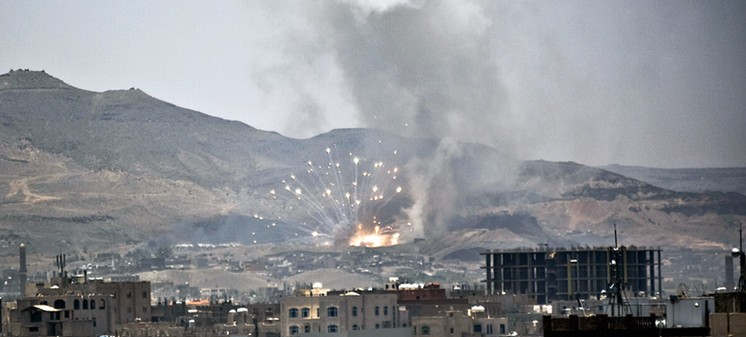
Saudi warplanes pounded Yemen on Wednesday after Houthi fighters launched drones and missiles deep into the kingdom. The exchange marks a sharp escalation in a conflict that now threatens the world’s most sensitive oil routes. Riyadh announced that its air defence units shot down a Houthi drone south of Mecca on Tuesday night before it entered prohibited airspace over Islam’s holiest city. Coalition spokesman Brigadier General Turki al-Malki called the attempted strike a red line and vowed severe deterrent measures against the Iran-aligned group. Houthi military officials swiftly denied targeting Muslim shrines, but the incident triggered nationwide security alarms. The United States quickly tightened its travel warnings for Saudi Arabia and banned official personnel from moving within twenty miles of the Yemeni border.
The fighting shatters a fragile, multi-year lull and opens a dangerous southern theatre in the wider Middle East war. Yahya Saree, the Houthi military spokesman, claimed Saudi aircraft launched as many as 450 air strikes across Yemen this week alone. Officials inside Yemen’s Saudi-backed government admitted carrying out intensive raids against insurgent columns along the western seaboard. The ground reality shifted rapidly when Houthi battalions swept through coastal towns and took Mokha on 10 September. Fighters pushed further south the next day to capture the last government garrisons along the Red Sea coast. Insurgent forces then landed on Mayun island inside the narrow Bab al-Mandab strait. That maritime corridor controls roughly a tenth of all seaborne crude trade.
Tehran’s regional network is squeezing Riyadh across several fronts at once. Last week an attack linked to Iraqi militias severed the kingdom’s East-West Pipeline, which pumps crude to the Red Sea to bypass the Strait of Hormuz. That transit route became unusable just as the Houthis seized coastal ports, leaving Saudi export logistics acutely vulnerable. Oil prices climbed as commercial shippers braced for wider maritime disruption. The Houthis also claim to have downed a Saudi F-15 fighter jet over Marib using a home-built missile, an assertion coalition officials dismiss. Overnight video footage showed insurgent units looting armoured vehicles abandoned by fleeing loyalist troops. Saudi defences face mounting strain from cheap, mass-produced drones.
The attempted drone run toward Mecca adds religious peril to a volatile military dispute. General Malki branded the flight the second deliberate Houthi attack on the holy city since a missile interception in July 2017. The Organisation of Islamic Cooperation issued a swift condemnation from Jeddah to defend the sanctity of the Two Holy Mosques. Pakistani Prime Minister Shehbaz Sharif denounced the attempt and praised Saudi armed forces for intercepting the weapon outside the sanctuary. Houthi spokesmen insist they aim only at military airbases and economic assets tied to the coalition. Even so, errant projectiles flying near holy sites risk drawing regional Sunni powers directly into combat. Reckless air tactics rarely respect sacred boundaries.
This rapid insurgent advance confronts American policymakers with an acute strategic headache. Washington spent months trying to contain regional fallout while conducting military strikes alongside Israel against Iranian installations. President Donald Trump must decide whether to expand American military involvement or leave Riyadh to fight alone. A total Houthi victory along the coast would hand Tehran direct oversight over vital shipping chokepoints. Yet direct American intervention risks entangling Western forces in another open-ended Arabian quagmire. Western diplomats in Riyadh admit that the kingdom cannot afford an unchecked fire on its southern flank. Prolonged border warfare threatens to derail expensive domestic economic reforms.
The collapse of the Yemeni frontline also reveals deep flaws inside the anti-Houthi coalition. Saudi Arabia spent billions of dollars on modern Western weapons over a decade of air operations. Despite that vast expenditure, fragmented loyalist militias folded within days of a determined ground assault. Houthi forces now hold high ground overlooking key maritime chokepoints and threaten remaining government pockets in Aden. Southern Yemeni forces lack the discipline, cohesion, and air cover to reverse those losses unaided. Riyadh must either deploy substantial ground units or reconcile itself to hostile forces along its borders. Splintered local allies make terrible military buffers.
The economic fallout will hit energy markets across the developing world hardest. Developing economies in Africa and Asia already struggle with elevated fuel bills and foreign currency shortages. Any prolonged closure of the Bab al-Mandab strait forces tankers to sail around southern Africa, adding weeks to voyages and driving freight rates skyward. Insurance premiums for Red Sea voyages jumped overnight following reports of drone swarms near coastal hubs. A wider war along the Arabian perimeter will test the endurance of global markets. Saudi Arabia wanted an exit from Yemen; instead, the conflict arrived at its doorstep.