
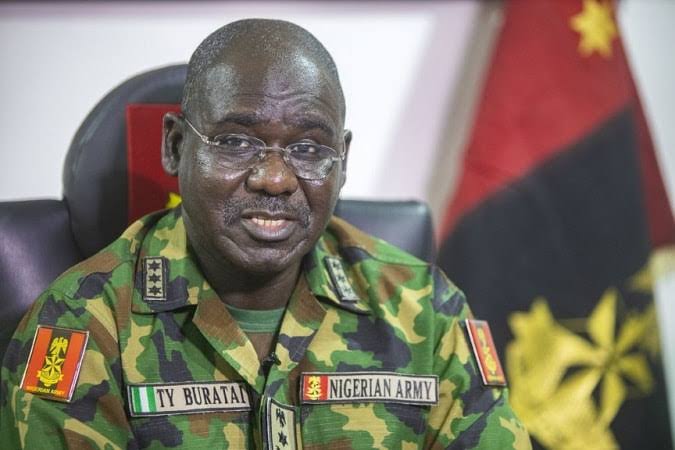
Former Chief of Army Staff, Lt. Gen. Tukur Buratai (retd.), has said that none of the $1bn approved for arms procurement during his tenure passed through his hands or the accounts of the Nigerian Army, Navy or Air Force. Speaking on Monday at the annual conference of the Defence Correspondents Association of Nigeria (DECAN) in Abuja, he said the money was released to the Ministry of Defence, which handled the entire procurement process. His remarks reopen one of the most persistent questions of the Buhari era: who spent the money, and what did Nigeria get for it?
“Not a single dollar of that fund passed through my hands or through the accounts of the Nigerian Army, Navy, or Air Force,” Buratai said. He described the allegations surrounding the fund as “political and malicious”, adding that the controversy had stuck to the service chiefs rather than the institution that managed the money. “Accountability must be properly located,” he said.
The fund has a long and contested history. On December 14, 2017, the National Economic Council, made up of state governors and chaired by then Vice President Yemi Osinbajo, approved the withdrawal of $1bn from the Excess Crude Account to fund the fight against Boko Haram. The account held about $2.3bn at the time, meaning the security fund took close to half of it. President Muhammadu Buhari formally approved the release in April 2018, drawing objections over whether the money could be spent without National Assembly appropriation.
Buratai said the allegations first surfaced during the 2019 election season, when the opposition claimed the funds had been diverted for electoral purposes. The record shows the political attacks began even earlier. In April 2018, the camp of then Ekiti State Governor Ayodele Fayose described the withdrawal as a pool of public funds for the President’s re-election bid, a claim the government rejected.
The controversy peaked in March 2021, weeks after Buratai and the other service chiefs were replaced. National Security Adviser Babagana Monguno was quoted in an interview with the BBC Hausa Service as saying that weapons bought with the money had not been seen. His office later said he never claimed money was missing, while presidential spokesman Garba Shehu insisted none of the $1bn was missing and that some procurements had simply not been fully delivered. Buratai, through his lawyer, also denied any wrongdoing and directed questions on procurement to the Ministry of Defence.
That position has not changed five years on. Buratai faulted the ministry for never publicly explaining how the funds were disbursed or how contracts were awarded. “When the media asks where the money went, the answer should come from the ministry that spent it, not from military officers who never touched it,” he said.
He proposed a Defence Procurement Transparency Portal that would publish broad categories of contracts awarded, the companies involved and delivery timelines, within national security limits. He also suggested quarterly bulletins summarising court martial outcomes on human rights violations and operational conduct. “The military is not above the law,” he said, adding that credible allegations against personnel should be investigated and, where substantiated, prosecuted.
The debate comes as defence spending reaches record levels in naira terms. The 2026 Appropriation Bill proposed ₦5.41tn for defence and security, the largest sectoral allocation in a ₦58.47tn budget, and roughly nine per cent of total spending. The Nigerian Army alone was allocated about ₦1.5tn in the proposal.
Former Senate President Ahmed Lawan, who chairs the Senate Committee on Defence, told the conference that the National Assembly had consistently backed the armed forces. “I have not seen any request sent by the executive for the armed forces and other security agencies that has not been approved,” he said, citing his 27 years in the legislature. He called for a dedicated percentage of national revenue to be set aside for the armed forces and other security agencies.
The Minister of Defence, Gen. Christopher Musa, represented by Air Commodore Steven Ogunmodede (retd.), said security threats had become more complex and interconnected. He said the country’s response must combine combat operations with intelligence, technology and cooperation among security institutions. “Technology is a force multiplier, it does not replace the human judgement,” the minister said.
Buratai’s call shifts the burden of explanation to the ministry, but the full trail of the $1bn remains undisclosed. No detailed public account of the contracts, suppliers or deliveries under the fund has been released since the 2018 approval.