
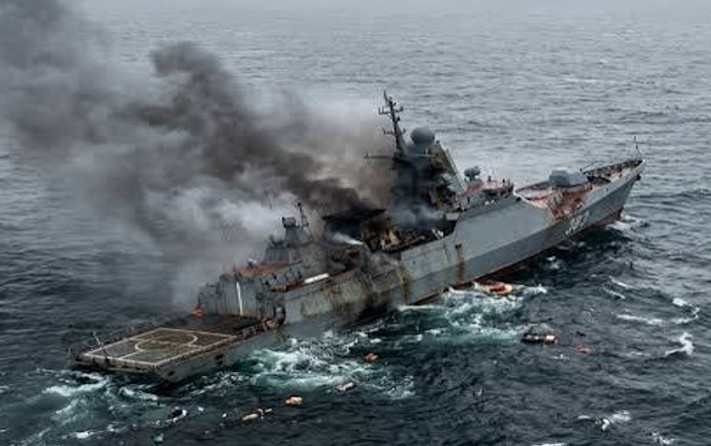
Seven unmanned sea craft sank the Russian corvette Merkury at Benghazi port, sparking sovereignty alarms across Libya and fresh questions over foreign military activity near African shipping lanes.
Fire rose over Benghazi harbour on Sunday as explosions struck a Russian naval vessel docked for fuel and supplies. More than two thousand kilometres from Moscow, the blast pulled North Africa deeper into the confrontation between Kyiv and the Kremlin.
Ukrainian President Volodymyr Zelensky stated on Monday that seven unmanned sea craft hit and sank the corvette Merkury. His account also noted the destruction of a Ka-27 helicopter aboard the vessel and an attack on a second ship, the container carrier MV Angara, linked to weapons transport.
Authorities in eastern Libya reported an explosion on the warship early Sunday while it was refuelling ahead of a return voyage to Russia. Health officials in the area also confirmed receiving injured personnel from a commercial ship hit off the coast, though records have not settled whether that vessel matches the ship named by Kyiv.
Satellite Proof and Naval Claims
Visual evidence quickly circulated online after the Sunday morning blast. Geolocated clips reviewed by BBC Verify showed flames and thick smoke over a vessel at the port, while Planet Labs PBC imagery recorded a burning craft at Benghazi harbour at 05:47 GMT.
Satellite pictures gathered by United States firm Vantor added further detail to the timeline. Images showed a Project 20380 Steregushchiy-class corvette identified as Merkury moored in Benghazi on Saturday, followed by Sunday images showing most of the hull capsized with only the forward bow remaining above water.
Zelensky called the strike an “exemplary Ukrainian operation in response to Russia’s war”. Moscow had not issued an official comment on the sinking in the initial reporting, leaving unanswered questions about losses and regional air or sea defences.
Rival Administrations and Sovereignty Alarms
Benghazi sits under the control of Libya’s eastern administration, the Government of National Stability, which did not name the ship in its initial statement. Officials there said the vessel was using the port under an existing maritime agreement and announced a joint inquiry with Russian counterparts to trace the source and perpetrators of the strike.
Eastern authorities condemned the attack inside a Libyan port as a breach of maritime safety and national sovereignty. Their statement stressed that Libya stands outside the war between Russia and Ukraine as well as conflicts beyond its borders.
Across the political divide in Tripoli, the internationally recognised Government of National Unity issued a separate warning carried by state media. It cautioned against hosting foreign forces or allowing ports and civilian sites to serve external conflicts, pointing to risks for citizens and national infrastructure.
Why North Africa Matters Now
Libya has remained divided since the 2011 uprising that ousted Muammar Gaddafi, producing competing power centres that foreign actors have long navigated. For ordinary citizens, turning local ports into staging points or strike zones brings physical danger and diplomatic strain without local upside.
Analyst Harchaoui noted that striking Russian vessels carries both financial pressure and political sting for Moscow. Disrupting oil and gas transport linked to Russia’s shadow fleet hits revenue, while losing a newer warship far from home embarrasses the Kremlin.
Harchaoui also observed that eastern military leader Khalifa Haftar, commander of the Libyan National Army, is likely to view the strike as a personal affront. Questions over who might have facilitated Ukrainian operations are expected to reverberate through Haftar’s circle.
Lessons for West Africa and Nigeria
Earlier tensions in the same waters surfaced in March, when Russia accused Ukraine of using unmanned sea drones launched from the Libyan coast to target the tanker Arctic Mtagaz between Libya and Malta. That episode showed how maritime routes linking Europe, North Africa, and wider shipping lanes can become contested corridors.
For Nigeria and neighbouring Gulf of Guinea states, the Benghazi strike offers a clear reminder on maritime security. Commerce along African coasts depends on safe ports, clear rules of navigation, and states refusing to let foreign wars play out in regional waters.
When proxy rivalries or external militaries use nearby hubs, freight costs, insurance premiums, and diplomatic friction can ripple far beyond the immediate blast site. Protecting sovereign ports and keeping African waters focused on trade rather than external battles remains a practical test for governments across the continent.