
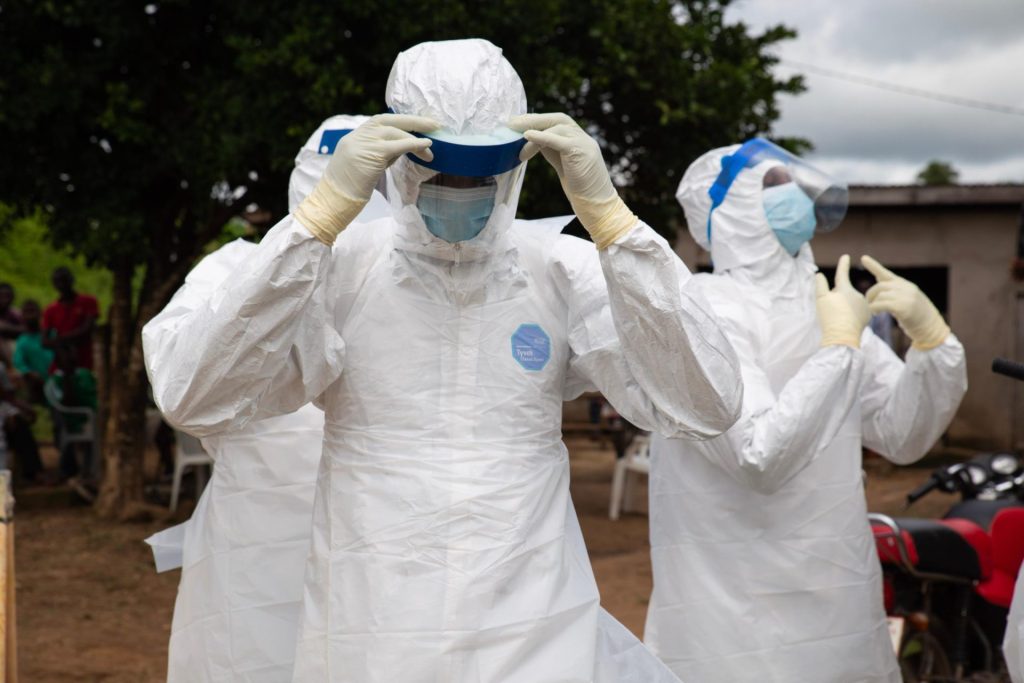
A senior official of the Democratic Republic of Congo’s ruling party has been beaten to death after appearing on a radio programme to raise awareness about the country’s worsening Ebola outbreak, according to a statement from the party.
Marie-Celestin Karondwa, acting president of the Union for Democracy and Social Progress (UDPS) federal executive committee in Butembo, was attacked on Sunday after taking part in a broadcast on Ebola prevention. The city, in North Kivu province, has become one of the newer hotspots of the epidemic.
According to the party’s federation in Butembo, the attackers beat Karondwa, stole his belongings and set his house on fire. He later died from his injuries. The UDPS said he was targeted after defending the party’s position on the existence of Ebola and the threat it poses. The identity and number of the attackers, and their motive, were not immediately established.
His killing is not an isolated act. It follows a string of attacks on health workers and treatment centres that specialists have linked to misinformation about the disease and deep distrust of the official response. The violence has included riots, damage to property and disruption of essential health services. Reuters reported that on Saturday, armed men attacked a hand-washing checkpoint in the nearby Beni territory, killing at least one person and injuring several others, citing a local civil society group.
The context helps explain why the outbreak has proved so hard to contain. The World Health Organisation’s regional emergency director for Africa, Dr Marie Roseline Belizaire, said last week that around one in three new infections are only identified after the person has already died in the community, outside any treatment centre. That points to people avoiding or resisting the health system, which allows the virus to keep spreading unseen.
The scale is stark. In its most recent situation report, dated 27 September and covering data up to 26 September, the DRC’s public health institute recorded 8,067 confirmed cases and 3,901 deaths, a figure the European Centre for Disease Prevention and Control also cited. That represents a case fatality ratio of about 48 per cent, meaning nearly half of confirmed patients have died. The institute reported 78 new confirmed cases and 49 new deaths in a single day.
The outbreak was officially declared on 15 May 2026, the 17th Ebola outbreak recorded in the DRC and, according to WHO data, one that began only about five months after the previous one ended. It is caused by the Bundibugyo virus, a species of Ebola for which there is no licensed vaccine or approved specific treatment, though the WHO notes that early supportive care saves lives.
By the numbers now confirmed, this is the deadliest Ebola outbreak in the country’s history. It has passed the death toll of the 2014 to 2016 outbreak in West Africa, which the WHO recorded at more than 11,000 deaths from over 28,600 cases. On confirmed cases, however, the West African outbreak remains larger, so the current epidemic has surpassed it in deaths rather than in total infections. The Africa Centres for Disease Control and Prevention has tracked the outbreak’s expansion across the region.
The geographic spread is a live concern. In its update dated 23 September, the WHO said the virus had reached 63 health zones across seven of the country’s 26 provinces, namely Bas-Uele, Haut-Uele, Ituri, North Kivu, South Kivu, Sud Ubangi and Tshopo. Ituri remains the epicentre, accounting for more than 6,000 confirmed cases, while North Kivu, where Butembo sits, is the second most affected. The recent extension into Sud Ubangi in the north-west and Dungu health zone near the South Sudan border, the WHO said, raises the risk of cross-border transmission.
There are, however, mixed signals in the trend. The WHO reported that over a recent 21-day window, cases fell by about 26 per cent in Ituri and 15 per cent in Haut-Uele, described by the organisation as the first encouraging signs of progress. Over the same period, North Kivu recorded a 73 per cent increase, which is part of why Butembo and its surroundings have drawn heightened attention.
Ebola was first identified in what is now the DRC in 1976. The disease affects humans and other primates and spreads through contact with infected bodily fluids or contaminated materials, which is why community cooperation with contact tracing and safe burials is central to bringing an outbreak under control.