
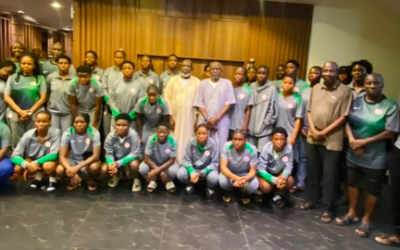

Falconets Target World Title Ahead Poland Departure

Nigeria’s under-20 women’s football team departed Abuja on Monday night for Poland ahead of the 2026 FIFA U20 Women’s World Cup finals. The Falconets wrapped up their intensive training camp in the federal capital after weeks of tactical drills and physical conditioning. They secured their ticket to the global tournament through a demanding qualifying run across the continent. The Nigerian girls swept past Rwanda with a five-goal aggregate rout before eliminating Senegal 3–1 over two legs. A narrow 3–2 aggregate victory over Malawi sealed their place among the world’s elite. Head coach Moses Aduku declared his squad ready to challenge for the ultimate prize in eastern Europe. The squad will open their Group F campaign against European heavyweights Spain on 7 September. Nigeria expects nothing less than a podium finish from its most consistent youth setup.
Coach Aduku built his tournament strategy around high-tempo pressing and rapid transitions from wide areas. He spent the final training block in Abuja sharpening set-piece execution and improving defensive cohesion under pressure. The technical crew worked hard to correct the defensive lapses that surfaced during the frantic qualifying scrap with Malawi. Team captain Joy Igbokwe assured supporters that the squad possesses the mental grit to overcome difficult moments abroad. She asked Nigerians to back the team with prayers as they embark on their quest for glory. The young midfielder knows that national expectation weighs heavily on age-grade teams. Talent alone rarely guarantees success in global tournaments without tactical discipline.
Historical precedent suggests that the Falconets will not fear any opponent they meet in Poland. Nigeria remains the only country to feature in every single edition of the tournament since its inception in 2002. The squad reached the final twice, picking up silver medals in Germany in 2010 and Canada in 2014. They also advanced to the semi-finals in Japan in 2012, proving their credentials on the global stage. Yet Nigerian teams often stumble at the final hurdle against tactically superior European and Asian outfits. The current generation must prove that they can turn promise into a gold medal. Consistent participation means little without a trophy to show for it.
The draw in Group F presents an immediate tactical test for Aduku and his coaching staff. Spain enter the tournament as reigning champions, boasting an immaculate youth development system rooted in positional dominance. The Spanish youth teams pass opponents into submission through quick one-touch combinations in central midfield. China bring technical precision and intense physical running that test defensive focus over ninety minutes. New Caledonia make their tournament debut, representing an unpredictable challenge in the final group fixture. The Falconets must secure maximum points from their first two games to avoid nervous arithmetic in the group finale. A single misstep in the opening clash could complicate their route to the knockout rounds.
The bulk of the current squad plies its trade in the domestic Nigeria Women Football League. Clubs like Nasarawa Amazons, Edo Queens, and Rivers Angels supplied the core talent for this international campaign. These domestic sides provide regular competitive football, yet their players often lack exposure to modern sports science and video analytics. European clubs routinely scout these youth tournaments to sign top African prospects for modest fees. A strong personal display in Poland can secure a lucrative professional contract in England, France, or the United States. Many of these young women carry the financial hopes of their extended families on their boots. Pressure builds quickly when life-changing professional contracts hang in the balance.
Administrative slip-ups often threaten to derail Nigerian teams before a ball is kicked at international competitions. Last-minute visa delays and late travel arrangements disrupted the squad’s travel itinerary over the weekend. The Nigeria Football Federation resolved the paperwork just in time to get the players on their flight to Warsaw. Nigerian football administrators have a bad habit of treating travel logistics as an afterthought. Players routinely spend valuable training hours waiting in embassy corridors instead of resting on the pitch. Such administrative chaos chips away at morale and drains physical energy before major matches. World champions need professional logistics, not eleventh-hour scrambles.
This youth tournament also serves as the main talent feeder for the senior national team. Most key players in the current Super Falcons squad earned their stripes through successful runs with the Falconets. Asisat Oshoala and Rasheedat Ajibade both used this youth platform to establish themselves as world-class forwards. Coach Randy Waldrum will watch the matches in Poland closely to identify fresh recruits for future senior assignments. Young defenders and central midfielders must show that they can cope with elite physical demands. The pipeline from youth football to senior stardom remains the bedrock of Nigerian women’s football. A successful campaign in Poland will secure the future of the national game for the next decade.