
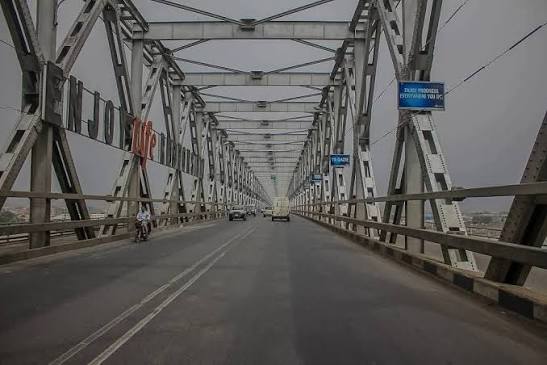
The Federal Government has ordered the full closure of the First Niger Bridge in Onitsha, Anambra State, for two weeks to allow emergency rehabilitation and maintenance works.
In a statement issued on Friday by the Acting Federal Controller of Works, Anambra State Field Headquarters, Timothy Emenike, the bridge will be closed to traffic from Monday, 7 September 2026, and is expected to reopen on Monday, 21 September 2026.
Motorists travelling between Anambra and Delta states, and other destinations beyond, have been advised to use the Second Niger Bridge route through Obosi towards Asaba throughout the period.
The decision follows a recent working visit to Anambra State by the Minister of Works, David Umahi, who expressed serious concern over the deteriorated condition of the bridge. The carriageway surface has worn significantly, while certain structural components have been damaged by vandalisation. These include portions of the expansion-joint steelwork and stanchion/steel truss nuts and bolts.
Messrs SKECC, the contractor handling the Km 0+000 to Km 20+000 section of the Onitsha-Enugu Dual Carriageway, has been directed to carry out the emergency works. The intervention will involve milling and removal of the existing deteriorated asphalt, laying of approximately 40mm of new asphalt wearing course, and associated maintenance and safety works. Solar-powered streetlights and closed-circuit television cameras will also be installed to improve surveillance and deter further vandalism.
Work will be undertaken day and night to minimise the duration of disruption. Traffic diversion arrangements, road signs, safety barriers and control personnel will be deployed to guide motorists.
The First Niger Bridge, completed in 1965, has long served as the primary road link across the River Niger between Onitsha in Anambra State and Asaba in Delta State. For decades it was the sole fixed crossing connecting the South-East with the rest of the country, carrying heavy volumes of passenger and commercial traffic. Congestion on the ageing structure became a persistent problem, prompting successive administrations to plan a second bridge.
The Second Niger Bridge, a 1.6-kilometre structure with approach roads, was commissioned in May 2023 after years of delays. It was built at a cost of approximately N336 billion under the Presidential Infrastructure Development Fund. Although ancillary access roads continue to be completed, the new bridge has provided an alternative route and reduced pressure on the original crossing.
Umahi’s inspection last week also highlighted the scale of vandalism on the older bridge, with scavengers removing bolts, nuts and steel components. The minister directed immediate remedial action and ordered the installation of lighting and CCTV to protect the structure.
The First Niger Bridge remains a critical national corridor for trade, travel and the movement of goods between the South-East, South-South and other parts of the country. The temporary closure is expected to cause inconvenience to road users, particularly commercial transporters and daily commuters. Authorities have urged motorists to plan journeys carefully, obey diversion instructions, reduce speed and allow extra travel time.
The Federal Ministry of Works said the intervention was necessary in the overriding public interest to restore the bridge to a safer and more efficient condition.