
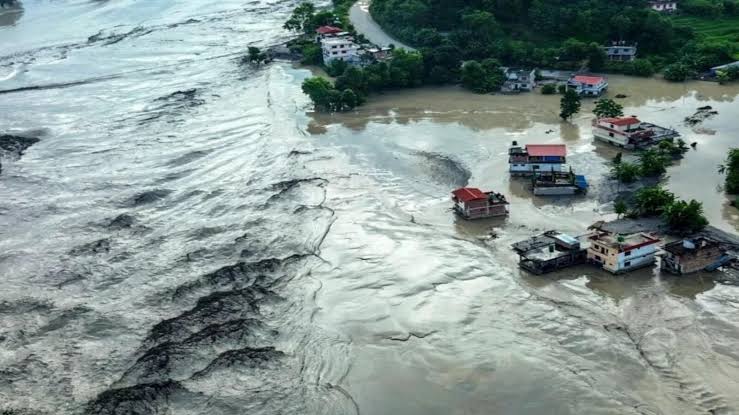
The death toll from devastating floods triggered by a glacial collapse on the China-Nepal border has risen to at least 1,287 in Nepal, the country’s disaster authority said on Friday, with 5,083 people still missing.
Chinese state media reported 21 deaths and 541 missing in Tibet, bringing the combined toll from the 26 August disaster to 1,308 dead and 5,624 missing.
More than 800 foreigners remain unaccounted for. They include trekkers in the Himalayas and pilgrims who had travelled to Mount Kailash in Tibet, a site sacred to both Hindus and Buddhists. At least 17 bodies have also been recovered from rivers in India. Officials presume these were carried downstream from Nepal and have not been included in the official tolls.
The catastrophe began high in the Himalayas when a large section of bedrock and ice collapsed from a glacier on the north face of Langtang Lirung, at an elevation of about 5,200 metres. Scientists analysing satellite imagery and seismic data said the failure generated a debris-laden surge that travelled at high speed into the Lhende River valley in Tibet. The material temporarily blocked the river before the natural dam burst, releasing a powerful wave of water, ice and rock downstream.
The flood struck Nepal’s Rasuwa and Nuwakot districts particularly hard, destroying roads, bridges, villages and hydropower facilities along the Trishuli River corridor. Entire settlements were buried under mud and debris. Rescue teams have focused on hydropower tunnels where hundreds of workers were feared trapped. Authorities have reported that more than 11,000 people have been rescued across the affected region, though identification of recovered bodies has been slow.
Foreign nationals from dozens of countries are among the missing. Early tallies listed hundreds of Indians, many of them pilgrims, as well as citizens of the United States, China, Malaysia, Ukraine, Britain, Australia and other nations. Consular teams from multiple countries have been assisting search efforts.
The disaster has caused extensive damage to infrastructure. Preliminary estimates in Nepal put reconstruction costs in the billions of dollars. Power and communication lines have been partially restored in some areas, but large sections of road remain impassable.
Experts have linked the event to the broader risks posed by a warming climate in the Himalayas, where glaciers are retreating and the potential for glacial lake outburst floods and ice-rock avalanches is rising. The United Nations has warned that millions of people across the region remain vulnerable to similar hazards in the years ahead.
Search and recovery operations continue on both sides of the border as authorities work to account for the missing and support affected communities.