
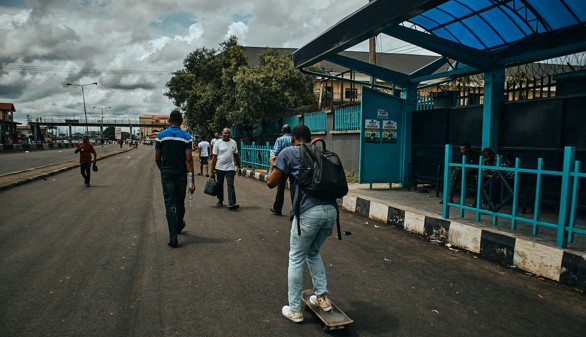
Once dismissed by elders and chased away by security, a determined group of Lagos street skaters turned late-night practice into a global movement, building a sanctuary for Nigeria’s youth.
Late into the night, in an apartment block in Lagos, a seventeen-year-old teenager crept outside into the dark. He carried a wooden board mounted on four small wheels – an object almost entirely unknown to his neighbours. As he set it on the ground and attempted his first rides, he moved with extreme care, desperate to prevent the sharp clatter of rolling wheels from echoing back into his family’s home and waking his father.
When asked years later who else was riding a skateboard in Nigeria during those early days, Samuel “Kaizer/Ziggy” Zakari simply laughed. “That’s a funny question because nobody even knew what a skateboard was,” he recalled.
It was 2010. Thousands of miles away in North America, global icons of the sport had already retired from competitive events, yet in Nigeria, the culture was practically non-existent. Driven purely by virtual gameplay on console video games, Zakari managed to procure his first board without ever seeing another human being ride one in real life.
“It was just me in the dark,” Zakari said. To a young man navigating the complex realities of West Africa’s largest metropolis, discovering this foreign pastime unlocked something profound. To him, “it was like a new reality opened up.”
Chasing Smooth Concrete in a City of Obstacles
Without mentors, instructional facilities, or designated public spaces, Zakari turned to online video platforms to teach himself basic manoeuvres. Finding suitable terrain in Lagos presented an immediate challenge. The city’s rugged roads and uneven pavements forced him to seek out flat, smooth surfaces, leading him to empty basketball courts during quiet hours. Passers-by and local elders rarely understood what he was attempting. As he rolled past, older residents would routinely shout, “Get a job!”
Eventually, Zakari began connecting with a loose network of like-minded urban pioneers – street dancers, independent musicians, and creative youths who shared his fascination with the wooden deck. They searched for usable concrete features tucked away in multi-storey parking garages or within the neglected grounds surrounding the National Stadium in Lagos. “We didn’t even really see it as a sport,” Zakari explained. “It was like therapy for us, but we didn’t know it at that time.”
The collective persisted without formal recognition or dedicated venues. Security guards frequently dispersed their gatherings, and local authorities occasionally seized their equipment. Yet the small movement kept attracting curious eyes.
Reclaiming Space: From Colonial Prison Grounds to Concrete Hub
As Zakari’s skills developed, he noticed younger children stopping to watch him practice. Recognising their curiosity and their need for direction- guidance he had lacked during his own teenage years – he began sharing his equipment, offering tips to youngsters waiting patiently for a chance to ride. “It was a part of me to do this, to empower these kids because when I started, nobody was there to inspire me,” Zakari told CNN. This grassroots mentorship eventually evolved into a formal structure. Today, at 31, Zakari heads Super Glider House, an agency dedicated to coaching and managing emerging talent. He conducts regular training clinics for young people at a landmark facility that marks a historic turning point for Nigerian subculture: WAF Park.
Constructed in 2024, WAF Park holds the distinction of being Nigeria’s premier public concrete skatepark. The facility was spearheaded by WAFFLESNCREAM—commonly known as WAF. – a pioneering Nigerian fashion and skate brand that has anchored the nation’s alternative street movement. To turn the concept into reality, WAF joined forces in 2023 with Wonders Around the World, an international volunteer organisation that constructs free public skate facilities across underserved areas in Africa, Asia, and Central America. Together, a team of local enthusiasts and overseas volunteers hand-built the park on a site rich with historical irony: the former grounds of a British colonial prison.
“We had a community before the WAF Park … the community was bubbling, gaining traction,” said Zakari. “The park helped solidify the community.”
Fahd Bello, a professional athlete and an early member of the waf. collective, echoed that sentiment. “This park is a go-to space for everybody here,” Bello observed. “A lot of people down here have had nothing, and skateboarding has created new pathways.”
From Barefoot Beginner to International Fashion Icon
The establishment of a permanent hub quickly birthed extraordinary personal transformations. Among those drawn to the construction site was Joseph Omojuwa, a 16-year-old local youth who watched the concrete bowl take shape without fully understanding its purpose. “I didn’t know what a skatepark was,” Omojuwa admitted.
When he first attempted to ride, Omojuwa had no footwear. “At that time, he had no shoes. He skated with his bare feet. I would give him my board,” Zakari recalled. Recognising the teenager’s raw talent, Zakari nicknamed him “Skywalker” and took him under his wing. He arranged for Omojuwa to receive his first complete setup – a board, wheels, and proper athletic shoes donated by international equipment manufacturers.
Equipped with proper gear, Omojuwa threw himself into daily practice. “From then I started skating every day,” Omojuwa said, “from around seven in the morning until 10 o’clock when they turn off the lights.” The rapid progress bore fruit on the competitive stage. Travel sponsored by the Roller Sports Federation of Nigeria (RSFN) enabled Omojuwa, accompanied by Zakari as his personal coach, to cross the border into neighbouring Benin Republic for the Francophone Youth Skate Championship, where the teenager secured the gold medal.
His rise culminated in a high-profile global fashion campaign. Sportswear giant Adidas partnered with WAF on a global release featuring footwear designed by creative directors in Lagos and inspired directly by the city’s street culture. Rather than hiring professional fashion models, the promotional campaign starred authentic local figures: Omojuwa took centre stage alongside Zakari, Bello, and WAF co-founder and creative director Jomi Marcus-Bello.
Administrative Hurdles and the Road to the World Stage
Despite these remarkable successes, the sport’s rapid growth has highlighted deep structural challenges within official administrative systems across Africa. Following Omojuwa’s gold medal victory in Benin, Team Nigeria Skateboarding, the officially recognised national squad established under the RSFN, believed the win had secured the young athlete an automatic qualification spot for the 2026 Youth Olympic Games in Dakar, Senegal. However, sports administrators soon discovered that the regional championship in Benin had not received formal accreditation as an Olympic qualifier from the Nigerian Olympic Committee or World Skate, the global governing authority recognised by the International Olympic Committee. By the time the bureaucratic oversight was uncovered, the deadline had passed, leaving Omojuwa without a spot on the official competitive roster.
“I believe when administrative systems fall short, community-led initiatives have to step up,” said Imoh Ekasi-Otu, a Nigerian-American skateboarder and the director of marketing and development for the RSFN.
Ekasi-Otu noted that talent across the continent faces persistent institutional barriers. “There are plenty of youth in Africa who could compete at that higher level,” Ekasi-Otu told CNN. But due to limited local facilities, stringent visa requirements, and the exorbitant cost of international travel to official qualifiers, “the path for African skaters is often defined by systemic hurdles.”
To bridge these gaps, Ekasi-Otu manages SHAPE (Skateboarding for Hope, Action, Progress, and Empowerment), a US-African non-profit organisation aligned with the RSFN. SHAPE is working to establish stronger institutional ties with the Nigerian Olympic Committee while developing modern training facilities across Nigeria. To ensure young talent is not entirely excluded from major events, SHAPE is raising funds through an art benefit event in Washington, DC, to sponsor approximately six young African skaters – including Omojuwa – to attend the 2026 Youth Olympics in Dakar. The initiative will let them experience the international competitive atmosphere, access direct mentorship, and ride the official Olympic venue facilities.
A Beacon for a New Generation
What began as a lonely, secretive midnight pursuit on the streets of Lagos has expanded into an accredited national sporting body, an international fashion movement, and a vital community sanctuary. For Zakari, seeing his young protege overcome obstacles offers proof that the landscape for Nigerian youth has fundamentally shifted. “When I started, nobody was there to inspire me,” Zakari reflected. “Now I feel like these kids have an opportunity to bloom faster … because they have an image to look at, and someone to show them.”
As institutions work to build the formal infrastructure for international competition, those on the ground maintain that the true power lies in its ability to offer young Nigerians purpose, belonging, and hope.
“Skateboarding is so much more than just a sport in Nigeria,” Ekasi-Otu emphasised. “It has become a vital outlet, a haven, and a form of creative self-expression for our youth.”