
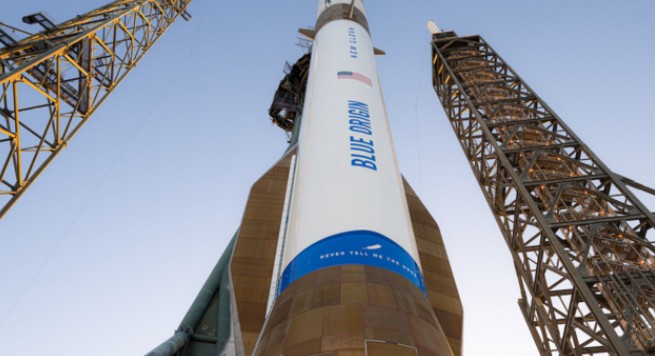
Jeff Bezos’s space venture, Blue Origin, suffered a catastrophic setback when its heavy-lift New Glenn rocket exploded during a routine engine test in Florida. The blast occurred during a scheduled hot-fire procedure at Cape Canaveral Space Force Station, lighting up the night sky and shaking nearby homes. While company officials confirmed that all ground personnel escaped injury, the vehicle was destroyed. The incident marks the second major technical failure for the aerospace firm in two months, threatening to disrupt both commercial operations and federal lunar schedules.
The immediate fallout centres on Launch Complex 36, the company’s sole operational pad for the New Glenn programme. Early estimates suggest the intense fireball caused severe structural damage that will require months of extensive engineering repairs. This specific booster was undergoing preparation for a June flight intended to deploy 48 internet satellites for Amazon’s Project Kuiper network. Those payloads were fortunately absent from the vehicle during the stationary firing sequence. Investigators have already commenced data reviews to determine the exact mechanical or software failure that triggered the ignition anomaly.
This failure severely complicates Blue Origin’s ambition to challenge Elon Musk’s SpaceX for commercial launch dominance. The New Glenn fleet had only recently returned to the pad following a temporary grounding by federal aviation regulators. That previous suspension followed an April mission failure where a booster fault delivered a customer satellite into an unusable orbit. This latest hardware destruction restarts the regulatory clock and will inevitably trigger another intense federal probe into the firm’s safety culture. Bezos expressed resolve online, promising to rebuild the facility and return to flight operations as soon as possible.
The engineering crisis ripples far beyond corporate rivalry, casting a shadow over America’s broader civilian space strategy. NASA has heavily leveraged the heavy-lift vehicle to support its multi-billion-dollar Artemis moon base initiatives. The space agency previously selected Blue Origin’s Blue Moon vehicle as one of two private human landing systems alongside SpaceX’s Starship. NASA administrators responded cautiously to the explosion, acknowledging the unforgiving nature of heavy-lift development while promising a thorough, joint investigation. Delays in pad reconstruction will almost certainly force federal managers to adjust upcoming uncrewed lunar flight timelines.
Local emergency services monitored the industrial site for several hours to contain secondary fires and assess hazardous chemical fumes. Cape Canaveral residents reported feeling distinct shockwaves, while social media networks quickly filled with footage of the massive orange fireball. The sheer scale of the visual flash underscores the volatile nature of the rocket’s cryogenic propellant mix. Aerospace analysts note that hot-fire tests are designed to expose precisely these structural vulnerabilities before actual flight operations. However, losing an entire flight-ready hull on the pad represents the worst possible outcome for an active test campaign.
The commercial satellite sector must now brace for prolonged launch bottlenecks as Blue Origin idles its primary vehicle line. Amazon’s Project Kuiper faces pressing regulatory deadlines to deploy its low-Earth-orbit constellation to preserve its global operating licences. Relying on competing firms like SpaceX or United Launch Alliance may become necessary if pad repairs drag into the autumn. For Blue Origin, the immediate task involves isolating the engine defect while maintaining investor confidence during an extended period of forced inactivity. The coming months will reveal whether the firm can swiftly fix its engineering processes or slide further behind its domestic rivals.