
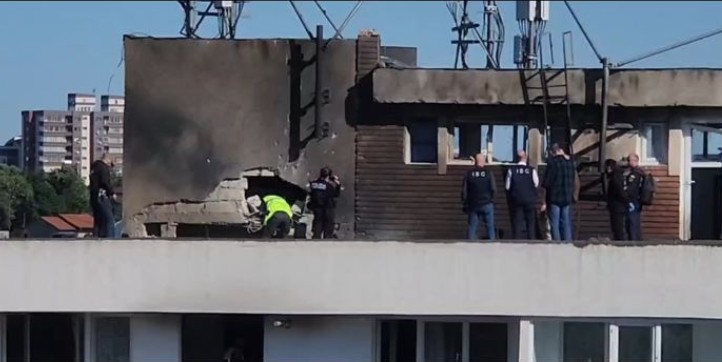
NATO has sharply condemned Moscow’s mounting geographic recklessness after a Russian drone crashed into a residential high-rise building in eastern Romania. The overnight strike occurred in the border city of Galați as the Kremlin launched fresh aerial bombardments against nearby Ukrainian infrastructure. Romanian defense officials confirmed that the drone’s full explosive payload detonated on the tenth floor, triggering a severe structural fire. Emergency rescue services treated two injured residents at the scene and successfully evacuated roughly seventy citizens from the smoking complex. While stray military hardware has previously breached the alliance’s frontier, this incident marks the first time NATO citizens have sustained direct casualties.
The immediate tactical fallout forced the Romanian Air Force to scramble two F-16 fighter jets to monitor the airspace. Radar operators tracked the unmanned vehicle over southern Galați before its sudden impact, highlighting the severe difficulties of intercepting low-altitude threats. The Romanian foreign ministry immediately labelled the cross-border detonation a serious and irresponsible escalation by the Russian Federation. Bucharest has briefed NATO Secretary-General Mark Rutte and requested an immediate acceleration of advanced allied anti-drone defense systems. Local municipal authorities spent the morning assessing the integrity of the damaged tower block while securing the perimeter from unexploded ordnance.
The diplomatic reaction from alliance headquarters in Brussels was swift but carefully calibrated to avoid a direct military confrontation. Alliance spokesperson Allison Hart denounced the blatant disregard for civilian safety but stopped short of invoking collective defense protocols. NATO has spent months reinforcing its eastern flank under dedicated air policing initiatives like Operation Eastern Sentry. However, the sheer density of Russian drone swarms targeting Ukrainian Danube ports makes absolute border containment nearly impossible. Western military planners acknowledge that these recurrent territorial penetrations continuously test the political threshold and response times of the Atlantic alliance.
The strike inside Romania coincides with an intense, nationwide Russian air campaign that has severely strained regional defensive networks. Ukrainian military commanders reported tracking over two hundred hostile drones and ballistic missiles launched across fourteen provinces during the same cycle. Kyiv has long warned that Western reluctance to intercept incoming threats near shared borders would eventually invite domestic disasters. Ukraine’s foreign ministry expressed immediate solidarity with Bucharest, reiterating that European security remains fundamentally indivisible from the war. Moscow has characteristically declined to comment on the Galați explosion, routinely dismissing previous airspace violations as fabricated Western propaganda.
Public anxiety is rising sharply across Romania’s border communities as the war directly encroaches on civilian spaces. Residents in Galati reported hearing the distinct hum of the drone’s engine minutes before the massive residential explosion shook the district. The country’s parliament recently adjusted its domestic legal framework to permit the pre-emptive downing of unauthorized military aircraft. Implementing these aggressive protocols remains highly controversial due to the risk of falling debris striking populated areas below. The incident places immense domestic pressure on the Romanian government to establish permanent, hard-kill air defense batteries directly along its northern rivers.
The coming weeks will test NATO’s collective resolve to enforce its sovereign borders without entering a wider European conflict. Allied defense ministers are scheduled to hold emergency consultations to review the rules of engagement for intercepting stray border threats. For now, the alliance will likely rely on increased electronic jamming and heavier deployment of fighter patrols to deter future incursions. The Galați strike removes any remaining ambiguity regarding the physical dangers that the conflict poses to neighboring states. Whether this civilian bloodshed triggers a more assertive Western defensive posture or simply yields further diplomatic condemnation remains to be seen.