
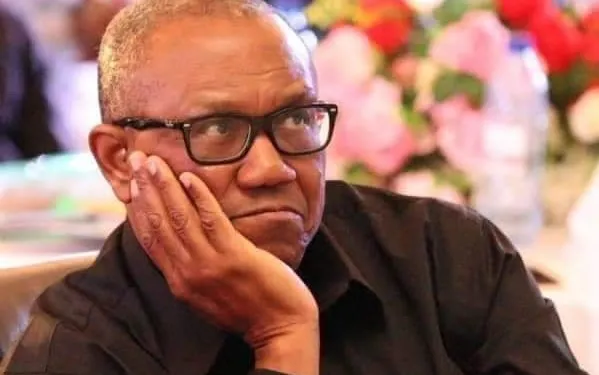
Armed street toughs blocked the motorcade of Peter Obi near the Nigerian Air Force Base in Makurdi on Tuesday, 8 September 2026, forcing the opposition leader to turn back. The former Anambra governor arrived in Benue State to deliver relief materials and console displaced families in rural communities. Instead, a crowd wielding wooden cudgels, iron rods, and stones barricaded the tarmac along Boko Road. His media team captured the ambush on mobile telephone video, showing young men pelting black sports utility vehicles with road gravel. The drivers wheeled round across the median to escape the falling debris. State police officers stood between the convoy and the mob but failed to disperse the gathering. The confrontation shows how quickly roadside muscle replaces civil politics in rural Nigeria. Broken asphalt makes a convenient political boundary.
The disruption aborted a planned humanitarian journey to Yelwata in Guma Local Government Area. Obi had intended to donate food trucks and medical supplies to victims of agrarian violence in the border district. Speaking beside his stalled vehicle, he described the blockade as naked rascality that shames the entire republic. He told reporters that his mission carried no partisan banners or campaign sound equipment. He wanted only to sit with families who buried their dead following communal clashes. Benue remains an open graveyard for subsistence farmers who face lethal attacks from armed herders. Turning relief vans away from starving camps turns human suffering into a cheap political bargaining chip. Pity is an early casualty of partisan ambition.
Party officials traded furious accusations within minutes of the retreat. Agile Bem Ordedoo, the state publicity secretary for Obi’s party, accused the ruling All Progressives Congress of hiring street gangs to stop the visit. He alleged that local party agents distributed cash to jobless youths to barricade the highway. In response, the state ruling party dismissed the claim as baseless theatre designed to manufacture sympathy ahead of the 2027 polls. State spokesman Benedict Yaweh insisted that the administration knew nothing about the incident on Boko Road. Both sides have played this game for decades. Politicians hire angry youths with loose cash, and then deny all knowledge when violence erupts. Denials ring hollow when the mob holds the tarmac.
The incident marks the second time in sixteen months that authorities have curtailed Obi’s movement through Benue State. In April 2025, the state government issued an administrative circular barring high-profile political visits without prior security clearance. That directive derailed a similar itinerary that included visits to nursing colleges and refugee settlements. State officials argued then that VIP convoys strain local police deployments and inflame communal tensions. Opposition figures counter that the government uses security decrees to enforce a domestic monopoly over the public square. Governor Hyacinth Alia, a Catholic priest on sabbatical, faces growing criticism over his administration’s intolerance of outside scrutiny. Priestly robes do not always soften the sharp edges of executive power. Autocratic instincts flourish behind pious public statements.
The failure of the police detachment to disperse the mob exposes the toothless nature of rural law enforcement. Video footage showed uniformed constables watching from the roadside as young men hurled debris at passing cars. Understaffed and under-equipped, provincial officers know better than to cross local political godfathers. They understand that arresting connected thugs often invites disciplinary transfers to remote bush outposts. The state command issued no immediate public statement to clarify why its men allowed the mob to breach their lines. Such administrative silence breeds deep cynicism among ordinary motorists. Citizens learn that uniforms offer little shelter against organised political intimidation. Uniformed officers cannot enforce laws that their paymasters quietly undermine.
The roadside ambush underlines the volatile climate building up ahead of the 2027 general elections. The Independent National Electoral Commission warned this week that thuggery and abusive rhetoric will attract heavy statutory fines and prison terms. Yet fine legal words in Abuja mean nothing to a young man holding a wooden club on a provincial trunk road. Party primaries are months away, yet contenders treat opposing travel itineraries as territorial invasions. The Middle Belt remains a crucial electoral battleground where agrarian grievances and communal fears run deep. Intimidating prominent opposition figures sends a chilling warning to lesser candidates who lack private security details. Electoral umpire warnings look absurd from the window of a battered car.
The political class continues to weaponise poverty to recruit cheap street foot soldiers. Benue State grapples with unpaid civil service pensions, closed factories, and collapsing farm yields. Hundreds of thousands of young men wander town squares without formal jobs or trade apprenticeships. Political fixers hire these idle hands for two thousand naira and a bag of dry grain. The youths gladly face police batons because hunger leaves them with few dignified choices. When politicians run out of ideas, they hire the very children their economic policies have abandoned. Hunger makes young men cheap to buy. A country that ignores its youth will eventually face them on the highway.
Federal security chiefs must investigate the Makurdi blockade if they wish to preserve basic freedom of movement. The constitution guarantees every Nigerian the right to travel unmolested through any state of the federation. Allowing partisan cartels to set up toll gates and checkpoints outside military bases makes a mockery of national sovereignty. The Inspector General of Police must sanction commanders who stood by while civilians threw rocks at a former governor. State governors must also stop treating their territories as personal kingdoms where visitors require internal visas. Nigeria cannot run a credible election if the open road belongs to whoever hires the largest mob. Highway checkpoints belong to the state, not to party thugs.