
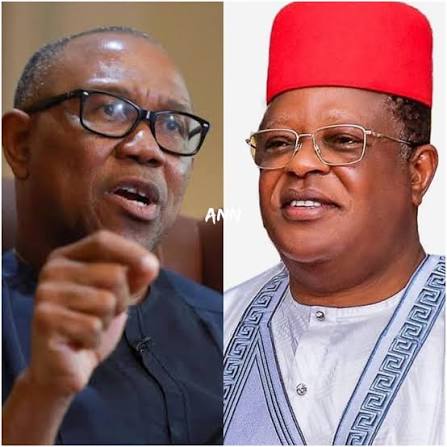
The Minister of Works, David Umahi, has waved off the notion that Peter Obi represents any real danger to President Bola Ahmed Tinubu’s re-election prospects, declaring on Tuesday that the former Anambra State governor “cannot even face” him, let alone the president, as the jostling for the 2027 presidency sharpens.
Speaking during an interview on Arise Television, Umahi described the aura around Obi as manufactured, reducing it to a phrase that quickly drew attention: “AI politics.” In his telling, the former governor’s political weight is a matter of noise rather than substance, and neither he, the president, nor the ruling All Progressives Congress has any cause for worry.
“Even I cannot be scared of Peter Obi, not to talk about President Bola Ahmed Tinubu or our party, the APC. What displays around Peter Obi is AI politics. It is putting something on nothing. Nobody is scared of Peter Obi. He is not a threat to our president because Peter Obi himself knows very well that he cannot even face me, let alone face the president,” the minister said.
The remarks land at a charged moment. Obi has grown into one of the administration’s sharpest critics, and only weeks ago he called on Tinubu to either resign or abandon his re-election bid over the country’s worsening insecurity, following a wave of abductions and killings that has kept the security question at the centre of national debate. Umahi seized on that call, turning it back on Obi’s own record in Awka.
“I read where it was said that Peter Obi said Tinubu should resign because of this, and I asked myself: How many times did Peter Obi resign as governor of Anambra State for failure to fix the roads, failure to establish industry, failure to empower people, failure to establish an airport, or failure to establish a seaport? Failure to pay contractors,” he said.
He went further, resurrecting an old line of attack over how Obi managed state finances, alleging that the former governor kept money in a bank while contractors went unpaid, and that his education record leaned heavily on a handful of special centres rather than broad investment. Obi has consistently defended his eight years in Anambra, pointing to savings he says he left behind and to his frugal style of governance, which became the emotional core of his 2023 campaign.
Umahi, himself a former two-term governor of Ebonyi State before crossing from the Peoples Democratic Party to the APC in 2020, also took aim at the movement that grew around Obi. He accused the Obidients of intolerance, saying dissent is often met with abuse, threats and litigation.
“Look at the pattern of politics around Peter Obi. You disagree with him, then he takes you to court. How many times have you been abusing President Bola Ahmed Tinubu? How many people has he taken to court? Look at the Obidient movement. You disagree, they insult people, they wish people dead, they issue threats and all kinds of things. Is that the kind of behaviour we want?” he asked.
In a challenge he has issued before, the minister invited any member of the movement to debate him on infrastructure and the administration’s reform record, insisting the government’s performance can survive scrutiny.
The exchange fits a familiar rhythm between the two camps. Umahi has repeatedly positioned himself as one of Tinubu’s most forceful defenders in the South East, arguing at various points that all five governors in the zone are aligned with the president and that federal road projects have shifted sentiment in the region. Obi, for his part, carried the zone comfortably in 2023 and continues to command a devoted online following, even as his critics question whether that energy translates into structured votes on the ground.
The political stakes behind Umahi’s comments are considerable. Obi emerged in late May as the presidential candidate of the Nigeria Democratic Congress, a relatively new party that registered earlier in the year and has become a magnet for opposition figures. His nomination sets up what many observers describe as a rematch of the 2023 three way contest, with Tinubu expected to fly the APC flag and former Vice President Atiku Abubakar now anchored in the African Democratic Congress after another round of opposition realignment.
That 2023 result still frames the current contest. Tinubu won with 8,794,726 votes, the lowest winning tally by any Nigerian president in the current democratic era, ahead of Atiku’s 6,984,520, while Obi finished third with roughly a quarter of the national vote on the strength of the Obidient surge. The splintering of the opposition then is widely credited with easing Tinubu’s path to Aso Rock, and analysts remain divided on whether a fragmented opposition in 2027 would again work in the incumbent’s favour or whether discontent over the economy could reshape the map.
That discontent is not abstract. Headline inflation stood at 15.93 per cent in May 2026, its third straight monthly rise, according to the National Bureau of Statistics, though it remains far below the 26.06 per cent recorded a year earlier as the naira reforms worked through the system. The cost of living, power supply and insecurity continue to dominate public conversation, and they form the terrain on which the opposition hopes to prosecute its case.
Umahi’s answer to that pressure was to plead for patience, arguing that the administration inherited problems built up over decades and cannot be expected to unwind them in a single term.
“The darkest part of the night is the dawn. There were so many practices by the previous administration that occasioned us into what President Bola Ahmed Tinubu inherited,” he said. “For those who are crying of hunger, put all the indices on the table. Is it road infrastructure? Is it education? Is it health? Which one has gone worse than how the president inherited it? When you are healing a wound, you don’t expect the wound to heal overnight. An economy doesn’t turn around instantly within three years.”
He closed with a firm endorsement of a second term, framing the reforms as beginning to bear fruit and insisting no rival can match the president’s output.
“Let people be fair, rather than just speaking because they want power. None of the political aspirants or candidates from other parties can do what President Bola Ahmed Tinubu is doing. There are a lot of successes and reforms that are beginning to yield a lot of dividends. None of them can do what this man is doing,” Umahi said.