
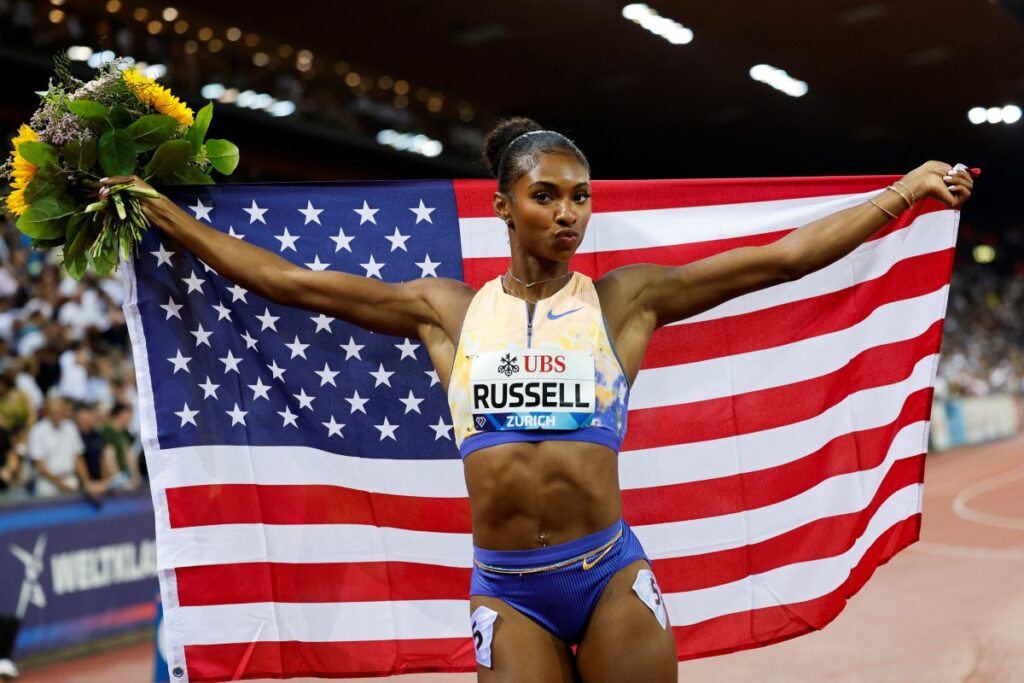
Masai Russell has ended Tobi Amusan’s four-year reign as the women’s 100m hurdles world record holder, but the Nigerian’s place in athletics history remains significant as the event enters a new era of extraordinary speed.
Russell clocked 12.09 seconds at the Zurich Diamond League on August 27, 2026, lowering Amusan’s 12.12 world record by 0.03 seconds. The performance came with no wind assistance, with World Athletics listing the race wind at 0.0m/s. The mark is currently listed as a world record pending formal ratification.
Amusan finished second in 12.23 seconds, her season’s best, while the Netherlands’ Nadine Visser was third in 12.34. The result was more than a change at the top of the record book. It completed a progression that had been visible throughout the 2026 season, with Russell repeatedly moving closer to the Nigerian’s mark.
Russell had already run 12.14 seconds in Xiamen, China, in May, only 0.02 seconds outside Amusan’s record. That performance had placed her second on the all-time list and showed that the 12.12 barrier was under serious threat.
The Zurich race finally settled the contest.
Amusan’s 12.12 seconds was not an ordinary world record.
On July 24, 2022, at the World Championships in Eugene, Oregon, she ran 12.12 seconds with a legal tailwind of 0.9m/s in the semi-finals. World Athletics subsequently ratified the performance as the world record, making Amusan the first Nigerian to hold the global record in the event.
The significance of the achievement was amplified by what happened less than two hours later.
Amusan won the final in 12.06 seconds, which was faster than her newly established world record. However, the wind reading was 2.5m/s, above the 2.0m/s limit for record purposes, so the performance could not be recognised as a legal world record. She nevertheless became world champion that night.
Her legal 12.12 therefore remained the benchmark for four years.
The record also represented a major improvement on the previous mark of 12.20 seconds set by American Kendra Harrison in London in 2016. Amusan lowered it by eight hundredths of a second, a substantial margin at elite sprint level.
Russell has now lowered Amusan’s record by another three hundredths.
The 26-year-old American did not arrive in Zurich as an unexpected record breaker.
Russell won Olympic gold in Paris in 2024, taking the 100m hurdles title in 12.33 seconds, one hundredth ahead of France’s Cyréna Samba-Mayela.
Her progression accelerated in 2025 and 2026. Before Zurich, her legal personal best was 12.14 seconds, recorded in Xiamen on May 23, 2026. World Athletics described that run as the second-fastest performance ever at the time.
That statistic is important because it shows that Russell’s world record was not an isolated performance. She had already established herself at the top of the event before breaking the record.
The Zurich performance now gives her the two fastest legal times in the history of the women’s 100m hurdles: 12.09 and 12.14.
Amusan remains firmly among the event’s elite. World Athletics currently lists her 12.12 as the former world record and her 12.23 Zurich performance as her 2026 season’s best.
For Nigeria, the loss of the world record does not erase Amusan’s wider achievements.
She remains a world champion, a three-time Diamond League Final winner and the first Nigerian athlete to set a world record in the women’s 100m hurdles. Her 2022 season also included the Commonwealth title, while her world championship victory established her as one of the country’s most successful track and field athletes.
More importantly, Amusan remains competitive against the athlete who now holds her record.
Her 12.23 in Zurich was her fastest performance of 2026 and placed her only 0.14 seconds behind Russell. The margin is significant in a race decided by hundredths, but the result also demonstrates that Amusan remains capable of competing at the highest level.
Their rivalry is not finished. The two are scheduled to meet again at the Diamond League Final in Brussels on September 4 and 5.
Zurich produced another important Nigerian result.
Ezekiel Nathaniel finished third in the men’s 400m hurdles in 47.50 seconds behind Brazil’s Alison dos Santos and Norway’s Karsten Warholm. Dos Santos set a new world record of 45.80 seconds, lowering Warholm’s 45.94 mark from the Tokyo Olympics in 2021.
Nathaniel’s performance was particularly notable because his personal best is 47.11 seconds, while his 2026 season best before Zurich was 47.37. His third-place finish placed another Nigerian athlete on a world-record night in Zurich.
The two Nigerian performances provide a broader picture of the country’s continuing presence in elite hurdles, even as one of its most recognisable records has changed hands.
The record books will now carry Russell’s name, subject to ratification. Amusan’s four-year reign is over, but the standard she established in Eugene has helped define a period in which the women’s 100m hurdles has become increasingly competitive.
For Nigerian athletics, the challenge is no longer simply preserving the old record. It is developing athletes capable of producing performances that can eventually challenge the new one.