
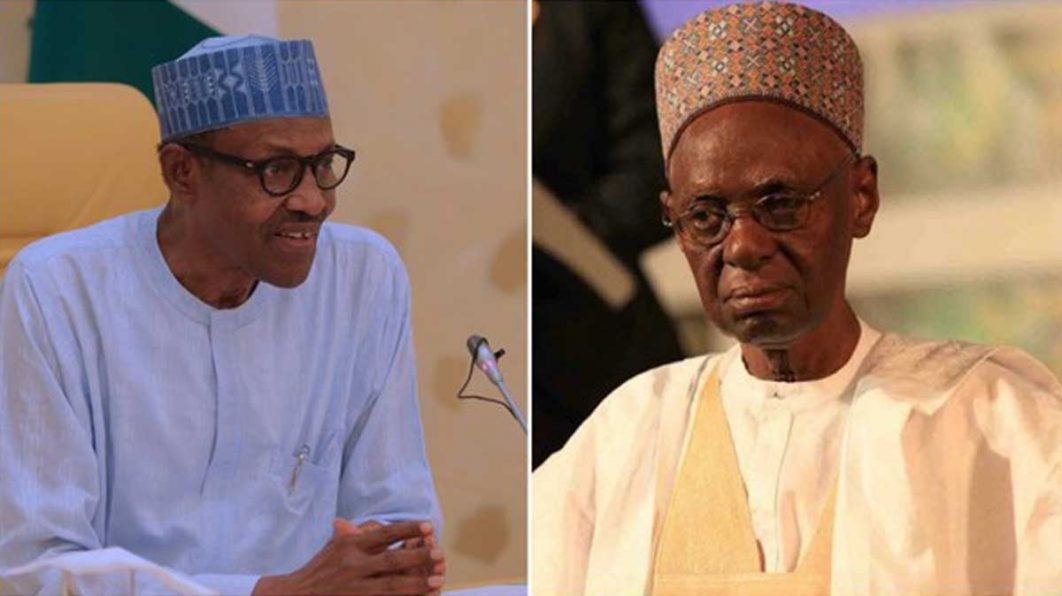
Decades before he became Nigeria’s elected president, Muhammadu Buhari came close to being forced out of the army by civilian politicians who feared he would one day seize power, according to a new authorised biography of the late leader.
The account, contained in *Muhammadu Buhari: The Authorised Biography* by Dr Udu Yakubu, states that shortly after Buhari returned from the War College in 1980 and took the salute as General Officer Commanding the 4th Infantry Division, a circle close to President Shehu Shagari moved against him. The Defence Minister, Professor Iya Abubakar, and the Transport Minister, Alhaji Umaru Dikko, questioned his temperament and urged the President to retire him, arguing that his continued presence in the army was a risk to the republic.
Buhari, then a brigadier, was soon ordered to a non-command posting in Lagos, a reassignment the biography describes as a calculated slight meant to embarrass him and push him out of service. Stung, he sought an audience with Shagari and said he would rather retire with dignity than be shuffled between posts. The President appeared taken aback and denied any knowledge of the decision. “I did not know who did this. I did not know what happened,” he is quoted as telling Buhari, before reversing the order and instructing him to resume his command.
The book traces the suspicion to Buhari’s record in the coups of 1966 and 1975, and to a rise that had made him unusually visible. Within roughly three years he commanded three of the army’s four divisions, a sweep that widened his following even as reports painted him as too firm, too disciplined and too independent. Singling him out was difficult, the biography notes, because many other serving officers had also played roles in past coups, and removing him alone risked unsettling the whole army.
Tension deepened in April 1983, when Chadian forces crossed into Nigeria and occupied nineteen islands around Lake Chad. Shagari ordered Buhari’s 3rd Armoured Division to repel them. Buhari cleared Nigerian territory and then pursued the attackers about fifty kilometres into Chad, defying a presidential instruction to withdraw. He told his superiors that his first loyalty was to his troops and that he would not fight to clear the enemy only to “feed the enemy and supply them with fuel for their tanks.” The three-day operation ended in a Nigerian victory but hardened doubts in Lagos about an officer willing to push military logic past political caution.
Those doubts proved well founded, if not in the way the ministers had imagined. On 31 December 1983, the military toppled Shagari’s government and Buhari, still commanding the 3rd Armoured Division, emerged as head of state, ending the Second Republic. He defended the takeover as necessary to remove a corrupt and failing administration. The men who had warned against him had watched their government fall to the very officer they tried to retire.
Buhari led a military government until August 1985, when Ibrahim Babangida removed him. He returned three decades later as a democratically elected president, serving from 2015 to 2023, and died in London in July 2025, aged 82. Dikko fled Nigeria after the coup and survived a notorious 1984 attempt by Nigerian agents to smuggle him home from London inside a crate; he died in 2014.
*Muhammadu Buhari: The Authorised Biography*, a three-volume work whose first instalment is subtitled *The Phenomenon*, was presented in Abuja on 19 November. Drawn from more than two years of research and interviews, it revisits the episodes that shaped Buhari long before the presidency, including how narrowly, by its own account, his military career once escaped a quiet end.