
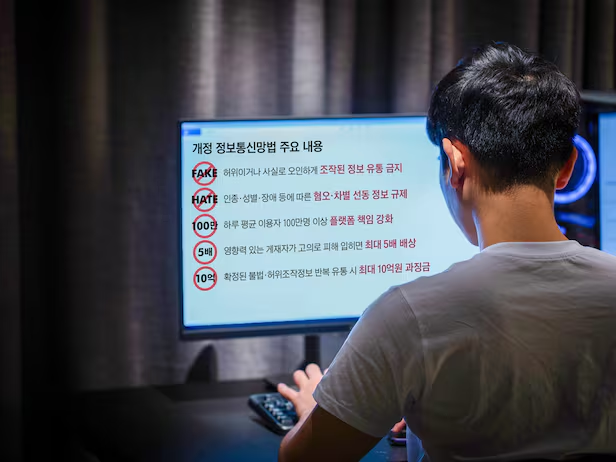
South Korea began enforcing a tougher law against false and manipulated information online on Tuesday, opening one of Asia’s most consequential experiments in policing digital falsehood, even as journalists, opposition politicians and civic groups warned that the same rules could be turned against legitimate speech.
The revised Information and Communications Network Act, widely referred to at home as the “fake news” law, moves the country away from the patchwork of general defamation statutes and civil damage claims it had long relied on to fight online lies. For years, South Korea had no clear legal framework aimed squarely at fabricated or doctored content. With this revision, it joins a growing list of governments across the world trying to get a grip on a flood of digital falsehoods that increasingly spill into real life with damaging effect.
The core of the new regime is financial pain. Under the law, anyone who intentionally spreads illegal, false or manipulated information can be ordered to pay up to five times the actual cost of the damage caused. Repeat offenders whose content has already been ruled illegal by the courts face administrative fines of as much as one billion won, roughly 655,000 dollars. The measure was promulgated after President Lee Jae-myung approved the legislation, which cleared the National Assembly in December 2025, with enforcement set to begin this July.
Crucially, the burden does not fall on individual users alone. Major platforms, including South Korea’s home-grown giants Naver and Kakao alongside the American companies Google and Meta, are now required to build systems that allow users to report content they believe to be false or manipulated. Those platforms must also publish transparency reports every six months, detailing the complaints they receive and the actions they take. The obligations, according to the enforcement decree, apply to large services averaging at least one million daily active users, while the stiffest personal penalties are reserved for high-reach accounts, such as YouTubers with large subscriber bases and busy social media pages that earn advertising or sponsorship revenue.
The timing is not accidental. South Korea saw a surge in online misinformation in the wake of the botched martial law attempt of December 2024, an episode that convulsed the country’s politics and included unsubstantiated claims of Chinese interference in the electoral system. That crisis has since run its full course through the courts. Former President Yoon Suk Yeol, who ordered troops to seal off the National Assembly, was jailed for life in February 2026 for masterminding what prosecutors described as an insurrection. The martial law saga left behind not only a bruised political order but also a public sphere awash in rumour, and it hardened the ruling Democratic Party of Korea’s argument that stronger tools were needed.
Entertainment scandals sharpened the case further. In a widely reported episode, a right-wing YouTuber was indicted for using AI-generated audio to falsely claim that the actor Kim Soo-hyun had dated a late actress while she was still a minor. The allegation snowballed into a major controversy, forcing Kim to suspend public appearances and pushing a major project into indefinite postponement. For supporters of the law, cases like that one, where synthetic media and profit-driven “cyber wreckers” collide with real reputations, are exactly the harm the new rules are meant to deter.
Opponents see a different danger. Their central objection is deceptively simple: who decides what is false? The main opposition People Power Party has repeatedly attacked the revision, arguing that platforms will scrub content pre-emptively to avoid clashing with the government, while ordinary users quietly censor themselves. “We will see a world where platform companies excessively remove information, investigative journalism is stifled, and citizens find it difficult to even speak their minds,” the party’s spokesperson, Cho Yong-sool, said in a statement.
Media bodies have echoed those fears. The Journalists Association of Korea has called for firm safeguards to ensure that public-interest reporting and routine news-gathering are not caught in the net. Critics also point to what they describe as the law’s soft underbelly, the absence of a precise legal definition of false or manipulated information, which they warn could invite broad and inconsistent enforcement in the early days, and hand outsized power to regulators and platforms rather than the courts.
The unease is not confined to South Korea. UNESCO cautioned in January 2026 that the law’s vague wording and wide enforcement powers could enable censorship and weaken public-interest journalism, while the International Press Institute condemned it as a threat to the media’s ability to hold power to account. Such reservations place Seoul within a familiar global tension, one that Nigeria and other democracies have grappled with in their own attempts to regulate online speech, where the line between curbing genuine harm and muzzling dissent is rarely as clear in practice as it appears on paper.
For now, the law is live, the penalties are real, and the definitions remain the battleground. How South Korean courts interpret “false and manipulated information” in the months ahead will determine whether the country has built a shield against digital deception or, as its critics fear, a blunt instrument that chills the very debate a democracy depends on.