
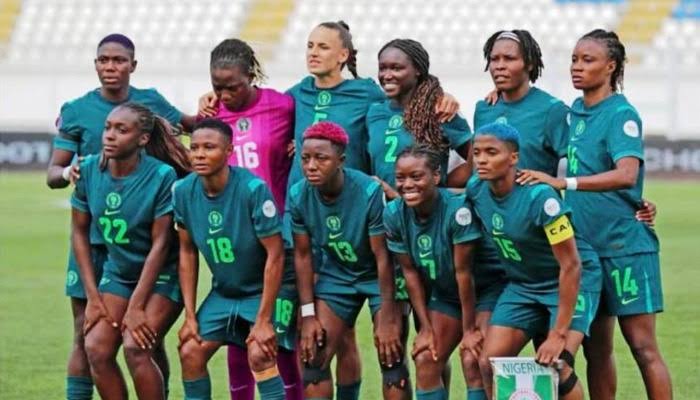
Nigeria’s Super Falcons will not be at the FIFA Women’s World Cup for the first time in the tournament’s history after suffering a 2-1 defeat to South Africa in Thursday night’s CAF play-off at the Moulay Rachid Stadium in Casablanca.
The defeat brings to an end a remarkable unbroken streak that stretched back to the inaugural tournament in China in 1991, when the Super Falcons became one of only seven countries worldwide to have featured in every single edition of the Women’s World Cup. Nigeria had appeared at all nine editions of the tournament since its inception.
The play-off represented Nigeria’s final route to the 2027 World Cup in Brazil after the team’s quarter-final exit from the Women’s Africa Cup of Nations, where they lost 1-0 to Cameroon. South Africa, who were also eliminated at the same stage after a 2-1 defeat to hosts Morocco, entered the decisive encounter knowing that only victory would keep their World Cup hopes alive.
After a goalless first half in which Nigeria created several early opportunities but failed to convert, South Africa struck against the run of play in the 56th minute. Star forward Thembi Kgatlana found the net following a counter-attack, with Hildah Magaia providing the cross from the left. Nigeria pushed forward in search of an equaliser, but South Africa extended their advantage in the 77th minute when captain Refiloe Jane reacted quickest to a rebound, with her effort taking a deflection off Nigeria substitute Christy Ucheibe before finding the net.
Nigeria’s hopes were revived in the 89th minute when a Video Assistant Referee review determined that Jane had handled a goal-bound header from Michelle Alozie inside the penalty area. The referee awarded Nigeria a penalty and showed Jane a second yellow card, reducing South Africa to 10 players. Ucheibe stepped up and converted the spot-kick in the 93rd minute to cut the deficit to 2-1.
With South Africa down to 10 women, Nigeria mounted intense pressure during six minutes of stoppage time. In the 97th minute, Alozie drilled the ball back across goal, only for South African goalkeeper Kaylin Swart to produce a brilliant save with her left boot to deny what would have been a dramatic equaliser. Banyana Banyana held on to secure a historic victory and advance to the six-team Inter-Confederation Playoff preliminary round, where they will compete for one of three available places at the 2027 Women’s World Cup.
Ghana also secured a place in the inter-confederation play-offs after coming from behind to beat Ivory Coast 2-1 earlier on Thursday.
For Nigeria, however, the defeat marks a historic low for a team that has won the WAFCON a record 10 times in 13 editions. The Super Falcons had opened their 2026 WAFCON campaign with a 3-2 defeat by tournament debutants Malawi before recovering with victories over Zambia and Egypt to reach the quarter-finals. Their quarter-final exit to Cameroon was the first time a Nigerian team had failed to reach the semi-finals in WAFCON history.
The team’s struggles in Morocco had already prompted the Nigeria Football Federation to issue a formal apology to President Bola Tinubu and Nigerians following the failure to secure direct qualification for the World Cup. NFF President Ibrahim Musa Gusau acknowledged the disappointment caused to millions of Nigerians who passionately supported the team throughout the tournament.
Former Super Falcons forward Francisca Ordega had earlier attributed Nigeria’s failure to secure automatic qualification to inadequate preparation for the tournament. “We failed to qualify because of poor preparation,” Ordega was quoted as saying, openly questioning the team’s preparations for the Women’s Africa Cup of Nations.
Coach Justin Madugu, who named a different lineup for a fifth straight game as he struggled to find his best eleven, has since apologised to Nigerians following the defeat, admitting that errors and poor finishing contributed to the loss. Madugu had previously warned that the Falcons have been left behind by teams investing more heavily in women’s football. Speaking before the match, he accepted responsibility for the team’s disappointing campaign and acknowledged the frustration felt by Nigerian supporters.
The defeat also means Nigeria’s women’s team joins the men’s Super Eagles in missing out on a World Cup, after the male team failed to advance out of the playoffs to compete in the 2026 World Cup that took place this summer.
Asisat Oshoala, the six-time African footballer of the year who was substituted soon after failing to convert a chance from inside the six-yard box in the second half, had called on Nigerians to rally behind the team ahead of the play-off. There will now be questions about whether the 31-year-old has appeared at her final WAFCON.
South Africa’s victory keeps their World Cup dream alive as they progress to the inter-confederation qualifiers, where they will be joined by Ghana. The top two teams from the preliminary round will advance alongside four teams that have received byes, with the winners of the three final-round ties qualifying for the World Cup in Brazil.
For the Super Falcons, the road to Brazil is closed. The team that has long set the standard for women’s football on the continent will now have to begin the difficult task of rebuilding and addressing the shortcomings exposed during a qualifying campaign that will be remembered as the one that ended a 35-year legacy.