
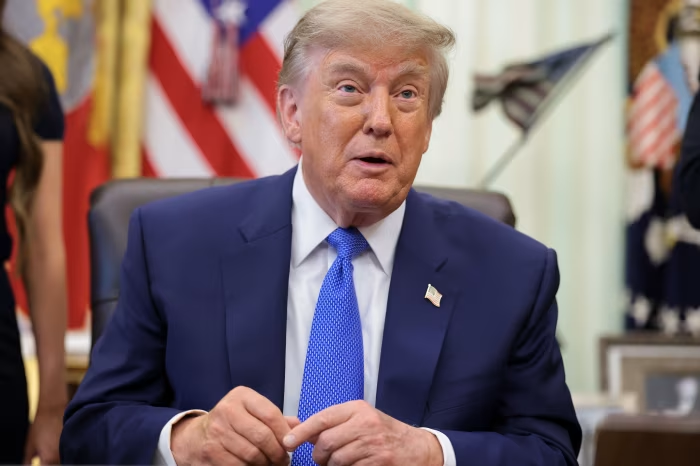
President Donald Trump has signed a proclamation imposing tariffs of up to 100 percent on imported unmanned drones and their components, a sweeping move aimed at reducing United States reliance on foreign supply chains in an industry overwhelmingly dominated by Chinese manufacturers.
The decision, announced on Thursday, imposes a 100 percent ad valorem duty on drones with a maximum take-off weight exceeding 25 kilogrammes, as well as those integrating thermal imagers, docking stations and other specified components deemed sensitive for national security. Smaller drones lacking such capabilities will face a 25 percent tariff, while imports from certain countries and regions, including Japan, South Korea, Taiwan and European Union member states, will attract duties capped at 15 percent. Products from Britain will face a maximum tariff of 10 percent.
The White House said the tariffs would “encourage increased domestic production” of drones and their components and reduce reliance on foreign supply chains. The proclamation, which Trump justified on national security grounds, also authorises Commerce Secretary Howard Lutnick to establish an onshoring programme for companies making new investments in drone manufacturing in the United States.
The tariffs will take effect 21 days after the proclamation was signed, while duties on less-sensitive drone components will take effect in 180 days. For products the Pentagon has approved for exemption from the Federal Communications Commission’s “Covered List” within 20 days of signing, the tariffs will also take effect 180 days after signing.
The move is the latest escalation in trade tensions between Washington and Beijing, coming just days after China announced restrictions on drone exports to the United States and blacklisted six American companies. On August 5, China’s Ministry of Commerce said it would tighten controls on the export of drone-related dual-use items to the United States, subjecting such exports to rigorous case-by-case review and excluding them from licence facilitation measures. Beijing justified the decision on national security grounds and its international non-proliferation obligations.
Those measures followed fresh US tariffs imposed on China and 59 other countries days earlier. The tit-for-tat restrictions have intensified pressure on global drone supply chains, which are heavily dependent on Chinese production. The Chinese company DJI, founded in 2006, has captured more than two-thirds of the global drone market in recent years, according to several studies. Industry estimates suggest DJI commands approximately 70 percent of the global drone market by units and holds an 80 percent share of the United States consumer drone market.
The tariffs represent the Trump administration’s most aggressive action yet to counter Chinese dominance in the unmanned aircraft systems sector. The United States has increasingly viewed drone technology as a strategic industry, with applications spanning military surveillance, commercial delivery, agriculture and emergency response. The administration’s decision to invoke national security grounds for the tariffs mirrors similar justifications used in previous trade actions against Chinese technology companies.
The timing of the proclamation is significant. It follows the FCC’s December 2025 ban on new foreign-made drone models, which had already reshaped the competitive landscape for next-generation systems. The new tariffs add another layer of protectionism, effectively raising the cost of imported Chinese drones to levels that could make domestic alternatives more competitive.
The proclamation exempts certain products from the highest tariff rates, including drones and components from Britain, which will face a maximum duty of 10 percent. Analysts have noted that the tiered tariff structure appears designed to penalise Chinese manufacturers most heavily while offering relief to allied nations. However, the complexity of global supply chains means that even drones assembled outside China often contain Chinese-made components, potentially subjecting them to the duties.
The United States drone market has grown rapidly in recent years, with commercial applications expanding across agriculture, construction, logistics and public safety. The new tariffs are expected to increase costs for American businesses and government agencies that rely on imported drones, particularly those from DJI. However, the administration has argued that the long-term benefits of building domestic manufacturing capacity outweigh the short-term costs.
The White House statement did not specify whether the tariffs would apply to drones already in transit or those ordered before the proclamation but delivered after the effective date. Industry observers have noted that the 21-day implementation window leaves limited time for importers to adjust their supply chains.
The broader context of US-China trade relations remains fraught. The two economies have been locked in a protracted trade war since Trump’s first term, with both sides imposing tariffs on hundreds of billions of dollars worth of goods. The drone tariffs represent an expansion of that conflict into a sector that has become increasingly critical to both economic and national security interests.
China’s response to the US tariffs has been swift. Beyond the export restrictions announced last week, Beijing has signalled its willingness to escalate further if Washington continues its protectionist measures. The Chinese Ministry of Commerce has described its export controls as necessary to safeguard national security and interests.
For Nigeria and other African nations, the escalating trade war between the world’s two largest economies carries potential implications. Drone technology has become increasingly important for agricultural monitoring, infrastructure inspection and security operations across the continent. Any disruption to global drone supply chains could affect availability and pricing for Nigerian buyers, though the immediate impact remains unclear.
The proclamation also raises questions about the future of international cooperation in drone regulation and standards. The United States has been a leading voice in shaping global norms for unmanned aircraft systems, and its decision to impose unilateral tariffs could complicate multilateral efforts to develop common frameworks for drone safety, security and trade.
As of Thursday, the White House had not provided further details on the onshoring programme authorised by the proclamation. Industry groups have called for clarity on the incentives available to companies investing in domestic drone manufacturing, arguing that tariffs alone are insufficient to rebuild a supply chain that has largely migrated to China over the past two decades.
The tariffs are set to take effect on September 3, giving importers and manufacturers a narrow window to prepare for the new duties. For the global drone industry, already navigating the aftermath of the FCC ban and China’s export restrictions, the latest US action adds another layer of uncertainty to an already volatile market.