
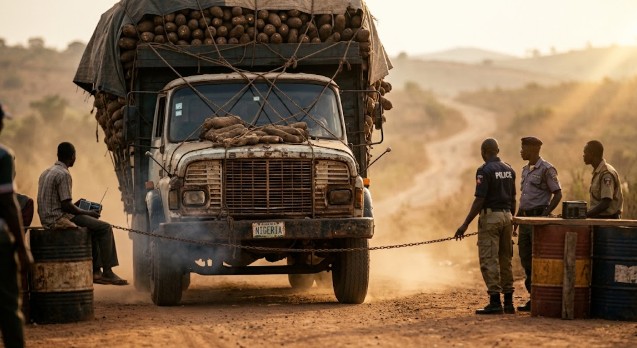
In the agrarian expanses of Benue, Niger, and the broader North Central belt, the harvest season no longer brings relief; it marks the arrival of tax collectors carrying automatic rifles. Across these food baskets, armed non-state actors have established a formalised extortion regime, demanding mandatory access fees, often starting at N500,000 per community or individual farm cluster, simply for the right to harvest planted crops.
While national security briefings remain focused on casualty figures and armed clashes, this shadow taxation system quietly rewrites the economics of Nigerian agriculture. The real crisis extending from the hinterlands into urban kitchens is not just lost output, but a pervasive agrarian rent that directly inflates food prices nationwide.
The Context & Policy Conflict
The prevailing narrative surrounding Nigeria’s food security crisis attributes rising prices primarily to foreign exchange volatility, transport fuel costs, and broad macroeconomic shocks. While these variables matter, they obscure the structural security tax embedded at the very origin of the supply chain.
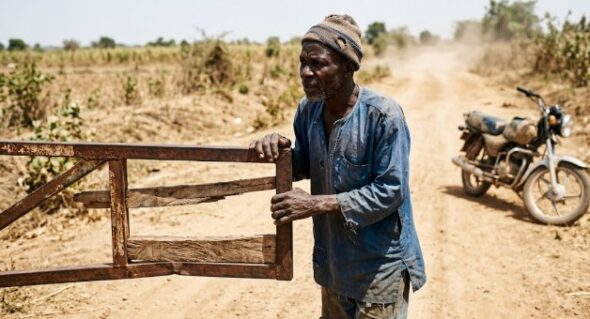
In rural farming communities, the state’s security presence is largely absent. Into this void step criminal syndicates that operate not merely as raiders, but as informal sovereign entities. They inspect fields, enforce payment deadlines, and physically block access to farmlands until local associations assemble the required levies.
This dynamic creates a clear policy conflict. Official agricultural interventions continue to focus on farm inputs, credit schemes, and fertiliser distribution. Yet, injecting capital into farming communities where armed groups extract the surplus value turns development aid into an indirect funding stream for criminal networks. The central government attempts to manage urban inflation through monetary tightening, while ignoring the physical extortion network that raises baseline costs at the farm gate.
Harvest Extortion as a Shadow Tax on Agrarian Chains
Harvest extortion operates with the systematic precision of an institutional tax authority. In many local government areas across Benue, Plateau, and Kaduna, bandit commanders issue formal demands to village heads before harvesting of yam, cassava, or maize begins. Failure to meet these demands results in the burning of crops, targeted abductions, or the destruction of villages.
To survive, farming collectives treat these protection payments as a standard operational cost. A farmer investing N300,000 in land preparation, seeds, and labour must now budget an additional N150,000 to N200,000 for the localised protection levy.
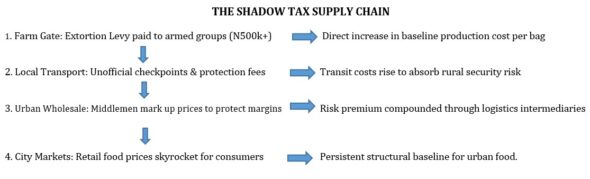
This extortion acts as an informal rent that artificially elevates the floor price of produce before it ever reaches a truck. Middlemen and produce traders who purchase at these inflated farm-gate prices subsequently apply their own risk margins to cover roadside transit, passing the compounded cost down the distribution chain to urban wholesale centres.
| Cost Component | Pre-Extortion Baseline | Current Extortion Environment |
|
Land & Input Cost Protection Levy Risk Margin Consumer Impact |
Standard Market Rate N0 Minimal Subject to Normal Seasonality |
Standard Market Rate N500,000+ per cluster/village High (Intermediary Markup) Permanent Structural Floor |
Grounded Security Interventions over Static Garrisoning
Conventional security responses rely on heavy military deployments stationed in urban centres or garrison towns. These forces occasionally execute sweeps along major highways, but rare patrols leave distant farm plots exposed to criminal cartels that monitor troop movements.
Protecting farm gates requires a fundamental shift in rural security strategy. Static garrisoning must give way to decentralised, community-anchored security models. Integrating vetted, locally recruited intelligence networks and agro-rangers into rural defence architecture offers a more responsive layer of protection.
To prevent civilian reprisals, these forces must be embedded directly within farming zones during peak cultivation and harvest periods, rather than relying on reactive mobile deployments after attacks occur. Securing the physical perimeter of agricultural zones neutralises the leverage criminal syndicates use to enforce their protection tariffs.
Cumulative Pressure on National Headline Food Inflation
The macro-level consequences of farm-gate extortion are visible in national food inflation metrics. Food inflation remains a primary driver of overall headline inflation, consistently outpacing non-food components and straining household budgets across major cities like Lagos, Kano, and Abuja. Standard economic models often explain these inflationary trends through currency movement or energy price shifts. However, structural supply contraction caused by farmland abandonment tells a more direct story.
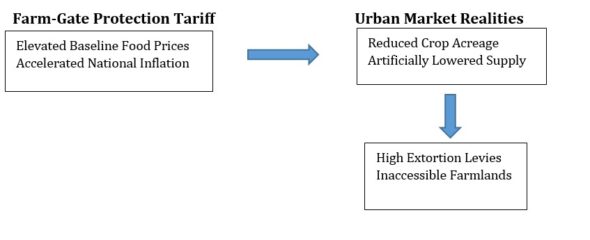
Faced with recurring extortion, many smallholder farmers reduce their cultivated acreage or abandon farming altogether. The resulting drop in domestic supply, combined with the embedded protection costs of the remaining harvest, creates a permanent high price floor for staple foods. Urban consumers ultimately bear the cost of this rural protection tax through persistent price hikes in local markets.
The Way Forward
Nigeria’s food crisis cannot be resolved through monetary policy adjustments or agricultural input subsidies alone. As long as criminal syndicates exercise territorial control over agrarian belts and extract protection tariffs from vulnerable communities, the cost of producing food will remain artificially high.
Addressing this structural crisis requires treating rural banditry not merely as a localised security issue, but a major macroeconomic threat. Federal and state authorities must prioritise the physical security of agricultural land with the same urgency applied to critical oil infrastructure in the Niger Delta.
Until state authority secures the farm gates and dismantles the rural extortion economy, the protection tax levied by bandits in the hinterlands will continue to drive up food prices in urban markets in the country. Food security begins with physical security at the point of production.