
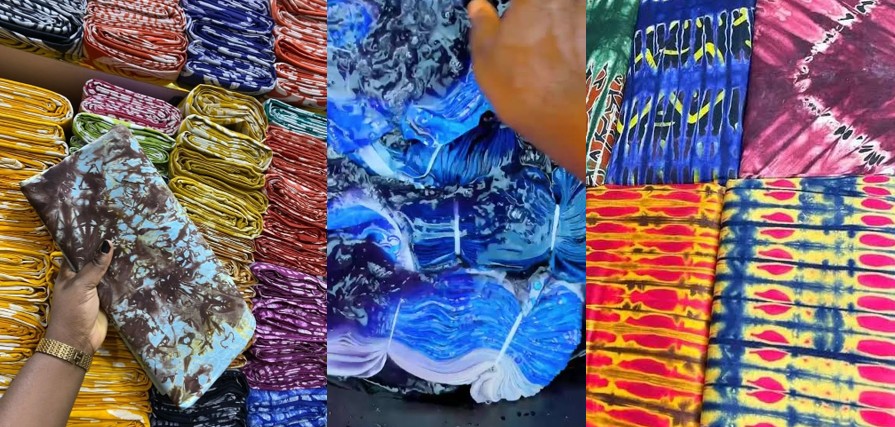
As cheap, foreign-manufactured synthetic prints flood local markets, the multi-generational, hand-dyed textile artisans of southwestern Nigeria face a grueling economic battle to keep their ancient visual language alive.
The transformation does not happen when the cotton is submerged; it happens when it breathes. In a cramped, open-air workshop off the labyrinthine alleys of Itoku Market, workers haul a bundle of tightly bound white brocade from a deep clay vat. When it first emerges, dripping and slick, the fabric is a strange, sickly shade of iridescent green. Within seconds of hitting the open Nigerian air, oxygen works its ancient chemistry. The green darkens, deepens, and locks into the resolute, midnight hue known across West Africa as authentic Adire.
Beside the vat, an elderly artisan watches the shift with eyes clouded by decades of woodsmoke and chemical vapour. Her forearms, stained a semi-permanent blue-black that reaches past her wrists, are a living testament to a family business passed down across generations. Yet the pride in this backyard workshop is increasingly mixed with a quiet, simmering anxiety.
While international luxury brands feature hand-dyed Nigerian motifs on Western catwalks, grassroots producers in the heart of Egbaland are facing a quiet economic asphyxiation. The threat isn’t from a lack of creativity, but from container ships arriving at the nation’s ports, carrying cheap, synthetic imitations that mimic the craft at a fraction of the cost.
The Geography of the Indigo Pit
To understand the crisis facing Nigeria’s local artisans, one must leave the glossy showrooms of Lagos fashion houses and sit on the low wooden benches of Abeokuta. This historic city, built around the protective shadows of Olumo Rock, has been the undisputed capital of the Adire industry since the nineteenth century. Pioneering Yoruba women first scaled up production here, utilising the wild indigo leaves (elu) harvested from the regional hinterlands.
The traditional workflow is an arduous, multi-stage marathon requiring physical precision. In the Adire Oniko method, sections of cloth are wrapped and tied so tightly with raffia twine that the dye cannot penetrate, creating crisp geometric patterns. The more intricate Adire Eleko relies on hand-painting elaborate symbols onto the textile using a paste of boiled cassava starch, applied with carved stencils or fine chicken feathers.
Each symbol functions as a word in a visual lexicon. A series of concentric circles might represent life’s cyclical nature, while jagged lines celebrate the historical resilience of neighbouring cities. These are not mere decorative prints; they are unwritten archives of history, philosophy, and identity stamped onto cotton.
The Shadow Market
The modern market square reveals a troubling economic divergence. A walk through Itoku stalls shows a space divided against itself. On one side are the authentic, hand-dyed cotton pieces, heavy to the touch and possessing a distinctive organic scent. On the other side are towering reams of polyester fabrics, glossy, lightweight, and perfectly uniform.
These factory-printed imitations, largely imported from overseas textile mills, have flooded domestic retail spaces. Because they are mass-produced on digital rollers, they can replicate traditional Yoruba motifs instantly, bypassing the days of manual labour required to make a single handmade piece.
“A genuine hand-dyed cloth can be worn for five or six years without losing its character,” notes one veteran market trader, gesturing toward her inventory. “The imported polyester costs less than half the price, but it suffocates the skin and fades after a few washes. Yet, when families are struggling to buy basic food items, price always beats authenticity at the counter.”
The financial implications for local workshops are stark. Market research shows that more than three-quarters of traditional Adire makers in Egbaland operate as small-scale entrepreneurs, starting their enterprises with less than ₦100,000 in personal or family capital. With slim profit margins, even a brief drop in weekly sales can force a workshop to empty its vats permanently.
A Crisis of Transmission
This economic strain has directly triggered a generational breakdown in how the craft is preserved. For centuries, the secrets of the dye formulation- the exact ratios of wood ash, caustic soda, and fermented indigo leaves – were closely guarded family secrets, passed down maternally from mothers to daughters or daughters-in-law.
Today, that chain of custody is breaking. Having witnessed the financial hardships and physical exhaustion their parents bore, many younger Nigerians are turning away from the dye pits. Instead, they are seeking livelihoods in technology, transport, or retail commerce.
The risk is not merely the loss of local employment; it is the complete erasure of a cultural vocabulary. When a senior artisan retires or passes away without an apprentice, centuries of unwritten formulas and the precise oral histories behind specific patterns are buried with them.
THE ECONOMIC GAP IN NIGERIAN TEXTILES
TRADITIONAL HANDMADE ADIRE │ IMPORTED SYNTHETIC PRINTS
- 3 to 5 days per piece • Thousands of yards/hour
- Natural cotton base • Synthetic polyester
- Higher local production • Low factory unit cost
- Generates community jobs • Wealth exported abroad
The Limits of Protection
In response to shifting markets, local trade associations and market leaders have repeatedly sought institutional intervention. Delegations of market women have marched to traditional palaces, appealing to royal authorities and state governments to curb the unchecked influx of counterfeit textiles.
Some regional governments have launched token initiatives to boost demand, such as mandating that civil servants and public school teachers wear indigenous fabrics on designated days of the week. E-commerce portals have been proposed to help local artisans bypass exploitative middlemen and sell directly to the Nigerian diaspora.
However, enforcement remains a complex regulatory challenge. Trade policy, border control, and import tariffs fall strictly under federal jurisdiction, leaving state governments largely powerless to implement outright bans on foreign textile products. As a result, counterfeit prints continue to clear customs smoothly, overshadowing regional markets and directly undercutting local production hubs.
The Soul of the Fabric
Despite the uneven playing field, the Abeokuta dyers refuse to abandon their vats. Their resilience is not rooted in romanticism, but in a profound, unyielding connection to their identity. For these communities, Adire is woven into the fabric of life; it is used to celebrate births, honour marriages, and shroud ancestors during burial rites.
As twilight falls over the Itoku industrial quarters, the rhythmic thumping of heavy wooden paddles echoes through the courtyards as artisans beat the dried fabrics to give them a distinct, glossy sheen. Air-drying lines stretch across rooftops, draped in deep blue tapestries that catch the fading evening light.
“The factories across the ocean can mimic our shapes on a screen,” says one local artisan, her dye-stained hands resting firmly on a fresh bolt of white cotton. “But they do not know the prayers we say when we mix the indigo. They cannot copy the spirit of the woman who sat over the pot for three days to make this cloth. That is why we are still here.”
Whether that spiritual dedication can withstand the brutal realities of modern global commerce remains an open question, unfolding day by day in the blue-stained courtyards of south-western Nigeria.