
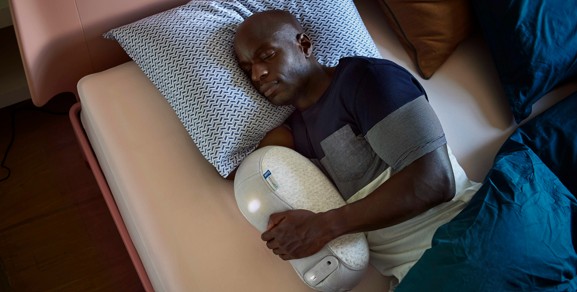
Obstructive sleep apnea starves the body of oxygen dozens of times a night. Discover the science of positional therapy and how head alignment keeps airways open without heavy machinery.
Every night across millions of households, a familiar scenario plays out behind closed doors. A spouse lies awake listening to their partner’s heavy, uneven breathing. The quiet of the night is shattered by a sudden, intense burst of snoring, followed immediately by an unsettling silence. For a few agonising seconds, breathing stops completely. Then comes a violent gasp for air, a sharp jerk of the body, and the pattern repeats.
By morning, the person who slept through these erratic interruptions wakes up feeling drained, heavy-headed, and irritable, convinced they had a rough night.
What many dismiss as mere loud snoring or routine fatigue is often something far more serious: obstructive sleep apnea. It is a physical condition in which the upper airway repeatedly closes off during sleep, starving the brain and body of vital oxygen dozens or even hundreds of times in a single night.
The Unseen Danger in the Dark
The true peril of sleep apnea lies in how quietly it erodes long-term health. Because the micro-awakenings that restart breathing last only a fraction of a second, most sufferers have no conscious memory of waking up. They move through their days believing that feeling chronically exhausted is just a normal part of ageing, hard work, or daily stress.
Underneath the surface, however, the human body is fighting a continuous nocturnal war.
Every time the throat muscles relax and the airway collapses, oxygen levels plunge. In response, the heart surges into overdrive, causing blood pressure to spike rapidly. Over months and years, this constant nightly strain takes a severe physical and mental toll:
- Cardiovascular Strain: Repeated blood pressure spikes force the heart to work under extreme pressure, increasing long-term cardiovascular risks.
- Metabolic Disturbance: Chronic sleep interruption disrupts essential hormones that regulate appetite, energy storage, and weight management.
- Cognitive and Emotional Fatigue: Persistent oxygen deprivation manifests as morning headaches, brain fog, mood swings, and heightened irritability.
- Strained Personal Relationships: Severe snoring frequently forces partners out of shared bedrooms into separate sleeping quarters, creating emotional distance.
The Search for Alternatives
For decades, standard medical treatment for sleep apnea has centred on continuous positive airway pressure (CPAP) devices—machines that use a motor to blow pressurised air through a facial mask worn throughout the night. While highly effective, many patients find the heavy masks, facial straps, and continuous mechanical noise intolerable.
Faced with the prospect of sleeping strapped to a machine every night, a significant number of diagnosed individuals abandon treatment entirely. They choose to endure the snoring and exhaustion rather than wear the apparatus.
This resistance has pushed clinical researchers to ask a fundamental question: Is there a non-invasive way to keep the airway open naturally before resorting to heavy equipment or surgical procedures?
The Hidden Science of Head Alignment
Clinical studies suggest the answer lies largely in physical positioning.
Research published in leading medical Journals, including the Journal of Clinical Sleep Medicine, shows that for a major portion of back and side sleepers, apnea events are strongly positional. When a person sleeps on a standard pillow, their head often tilts backwards or slumps too far forward.
A significant breakthrough came when researchers at the Zurich Sleep Laboratory conducted a detailed study on sleep posture. Their findings revealed a striking pattern: 89 per cent of observed sleep apnea episodes occurred when a patient’s head tilted backwards.
When the head falls back, gravity pulls the tongue and soft tissue in the throat directly backwards, causing the airway to collapse. Traditional household pillows frequently exacerbate this issue. Soft pillows allow the head to sink too far back, while overly thick or firm pillows force the chin down toward the chest, narrowing the breathing passage from the opposite direction.
Supporting the Airway Naturally
Medical insight shows that maintaining a precise, neutral neck alignment can help hold the airway open on its own during sleep. Keeping the neck supported in a natural curve – maintaining an optimal 15-degree extension – prevents the soft palate and tongue from sliding backwards.
This principle operates much like good posture in a chair. When the spine and neck are correctly aligned, airflow remains unobstructed.
While specialised ergonomic support is not a replacement for professional medical consultation, proper positional care provides a crucial, mask-free foundation. By supporting the natural neck contour whether lying on the back or rolling to the side, maintaining structural alignment gives the human body a fair, natural chance to breathe freely throughout the night.
What Lies Ahead for Sleep Health?
As public awareness around sleep disorders grows across developing health systems, the focus is shifting from reactive treatment to preventative structural care. Understanding that loud snoring and morning exhaustion are warning signs rather than minor inconveniences could save thousands from long-term cardiovascular damage.
The remaining question is how quickly everyday health awareness will adapt to these positional realities. Will more people recognise the warning signs in their own bedrooms before chronic health complications take hold?