
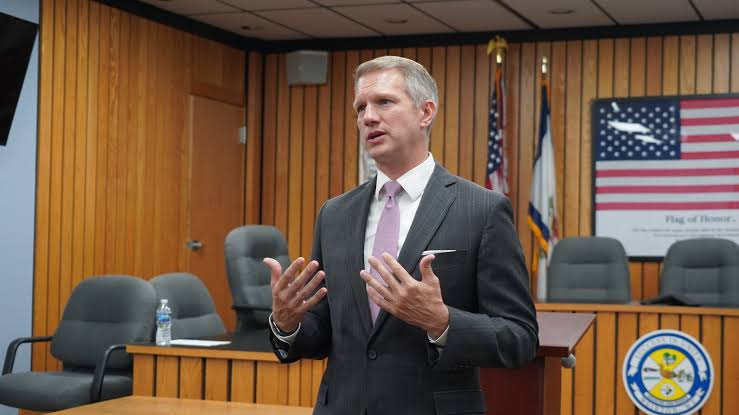
A member of the United States Congress, Riley Moore, has welcomed the Nigerian Senate’s passage of the constitutional amendment establishing state police, describing the reform as a tool that would help states protect citizens, particularly Christians he says face persecution.
Moore, who represents West Virginia’s 2nd Congressional District in the U.S. House of Representatives, made the remarks in a post on his X handle on Wednesday, following the Senate’s approval of the bill that seeks to decentralise policing by allowing states to establish their own police services alongside the Nigeria Police Force.
“I’m encouraged to see Nigeria’s Senate approve legislation to establish state-level police forces, a reform I’ve called for publicly and privately since I first started investigating the genocide against Christians in Nigeria,” Moore wrote. He added that the law empowering states to protect their own citizens and reduce dependence on Abuja was “critical” to defending persecuted Christians and addressing insecurity.
Moore also credited President Bola Tinubu for backing the proposal, while noting that the amendment must still secure approval from at least two-thirds of the state Houses of Assembly before it can take effect. “President Tinubu deserves credit for pushing it forward, but now we need 2/3rds of the states to ratify before it will take effect,” he said.
The Senate passed the bill on Wednesday, June 24, after more than two-thirds of senators voted in support during a manual voting process. Titled the Constitution of the Federal Republic of Nigeria (Alteration) (State Police and Related Matters) (Sixth Alteration) Bill, 2026, the legislation replaces the existing Nigeria Police Force framework with a dual structure comprising a Federal Police Service and State Police Services. Tinubu transmitted the executive bill to the Senate on Tuesday, June 23, urging expedited consideration.
Under Clause 17 of the amendment, each State Police Service is to be headed by a Commissioner of Police appointed by the governor and confirmed by the state legislature, while the Federal Police Service remains under the Inspector-General of Police. The bill bars state police from being deployed against individuals or groups merely for criticising a state government, except in accordance with the law.
Moore’s intervention fits a wider pattern of US pressure on Abuja over religious violence. In November 2025, he introduced a House resolution condemning the persecution of Christians in Nigeria, citing claims by advocacy groups that more than 7,000 Christians had been killed that year. That figure remains contested. Nigeria’s President Tinubu has objected to the US characterisation, stating it did not reflect the country’s reality, and noting that successive governments had worked to maintain peaceful coexistence among faith communities. Independent analysts who reviewed Armed Conflict Location and Event Data have argued that armed groups, criminal gangs and jihadists target victims across both faiths.
The reform follows years of debate. The House of Representatives earlier passed its own version of the state police bill, with 289 lawmakers voting in favour. If endorsed by at least 24 state assemblies, the measure will create, for the first time, a constitutional framework for state policing since the return to democratic rule in 1999. The Senate also raised the Nigeria Police Trust Fund allocation from the Consolidated Revenue Fund from 0.5 per cent to one per cent.
The next test lies with the state Houses of Assembly, whose ratification will determine whether the decades-old proposal finally enters the Constitution.