
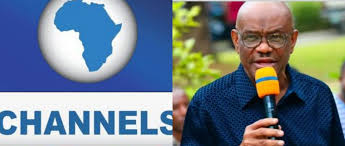
Tensions between Nigeria’s Federal Capital Territory Minister Nyesom Wike and Channels Television have escalated sharply following the minister’s public questioning of how the media organisation acquired its Abuja headquarters, reigniting debate about government allocations, media independence, and the relationship between political power and press institutions.
The dispute erupted during a televised media interaction in Abuja, where Wike questioned the circumstances surrounding the broadcaster’s occupation of prime real estate in the Guzape district. The minister contended that the land was originally allocated by the Federal Capital Territory Administration and suggested that many organisations benefit from government privileges while maintaining a facade of complete independence.
Wike, the former Rivers State governor, further argued that television stations receive financial compensation for broadcasting official government events and public engagements. He maintained that live transmission of government programmes requires significant logistical investment and cannot reasonably be treated as a free public service to the state.
His remarks, particularly those contained in video clips that subsequently circulated online, prompted swift and forceful pushback from the broadcaster’s management. Channels Television issued a detailed statement clarifying that its Abuja property was lawfully acquired through established procedures recognised by the FCT administration. The organisation disclosed that the land allocation was officially granted for commercial purposes on March 6, 2007, and that all associated legal and statutory obligations have been fully discharged.
The broadcaster rejected any suggestion of impropriety, emphasising that obtaining land allocation from government authorities represents standard business practice across Nigeria’s capital and does not constitute illegality. Channels Television further defended the professional fees it receives for covering government events, explaining that such payments are necessary to cover technical production costs, outside broadcast operations, engineering support, transmission infrastructure, and associated logistics required for real time broadcasting.
In a pointed response to questions about editorial independence, Channels Television reaffirmed its commitment to objective reporting and uncompromised journalism, denying that financial transactions for broadcast services in any way compromise its news judgement or coverage decisions.
Media analysts describe the confrontation as emblematic of deepening friction between government officials and major news organisations in Nigeria’s political landscape. Several observers note that the dispute raises substantive questions about government transparency, the constitutional role of the press, and the appropriate boundaries between political authority and media institutions in a democracy.
Public reactions have divided sharply along predictable lines. Supporters of Wike praised his willingness to engage questions about land administration and public spending within the Federal Capital Territory. Critics, however, accused the minister of unnecessarily targeting a prominent broadcaster known for critical political coverage, suggesting the dispute reflects broader frustration with media scrutiny.
Press freedom advocates have expressed concern about what they characterise as escalating hostility toward journalists and media organisations nationwide. Civil society groups warned that public attacks on media institutions risk undermining public confidence in democratic accountability mechanisms and free expression protections.
This is not Wike’s first public disagreement involving media professionals. Earlier remarks directed at veteran broadcaster Seun Okinbaloye generated substantial backlash from media stakeholders and advocacy organisations who interpreted the comments as aggressive toward journalists exercising their constitutional responsibilities.
Political commentators note that the controversy emerges during a period of intensified scrutiny of Abuja land allocations, following ongoing reforms introduced by the current FCT administration. Many observers view Wike’s confrontational governance style as a consistent feature of his tenure, attracting both praise and criticism across different sectors.
Despite the escalating public dispute, Channels Television has declared its intention to continue prioritising factual reporting, public accountability, and balanced national coverage without intimidation or external pressure.
Media scholars and democracy advocates suggest the latest disagreement may deepen ongoing conversations about press freedom protection, journalistic ethics, and the media’s role in holding political leaders accountable within Nigeria’s democratic system. As both parties maintain their positions, many Nigerians anticipate further developments in what has become a significant test of media institutional resilience against political pressure.